Vera has five sticks of distinct lengths l1, l2, l3, l4, l5. Vera may choose any three of the five sticks to form the sides of a triangle. How many different triangles can Vera make? Each triangle must have positive area and sticks cannot be bent or cut.
Line 1 contains integers l1, l2, l3, l4, l5 (1 ≤ li ≤ 1000).
Print one line with one integer, the number of ways to form a triangle.
1 2 3 4 5
3
1 2 4 8 16
0
For the first example, the 3 ways to form a triangle are choosing sticks 2, 3, 4 or 2, 4, 5 or 3, 4, 5.
Vera has A × B cards. Each card has a rank, an integer between 0 and A - 1, and a suit, an integer between 0 and B - 1. All cards are distinct. A set of five different cards is known as a hand. Each hand is in exactly one of nine categories numbered from 1 to 9. If a hand satisfies the conditions for membership in multiple categories, it is considered to be in the lowest-numbered such category. The rules for each category are:
Currently, Vera has two cards with ranks a1, a2 and suits b1, b2. Of the remaining cards, Vera will choose three more cards and form a hand with her two current cards. Compute the number of different hands formed in this way that belong in each category.
Line 1 contains integers A and B (5 ≤ A ≤ 25, 1 ≤ B ≤ 4).
Line 2 contains integers a1, b1, a2, b2 (0 ≤ a1, a2 ≤ A - 1, 0 ≤ b1, b2 ≤ B - 1, (a1, b1) ≠ (a2, b2)).
Print one line with nine integers, the number of different of hands that belong in each category in increasing order of categories (from Straight flush to High card).
5 2
1 0 3 1
0 0 0 0 8 0 12 36 0
13 4
0 0 1 0
1 2 18 164 63 308 792 7920 10332
Let (a, b) denote a card with rank a and suit b.
For the first example, Vera currently has cards (1, 0) and (3, 1). If she chooses additional cards (3, 0), (4, 0), (4, 1), her hand will be a Two pair as there are two cards with rank 3 and two other cards with rank 4. Note that this hand also satisfies being a One pair, but Two pair is the lower-numbered category.
Vera has N integers a1, ..., aN. A margin is a non-negative integer L such that it is possible to choose N integers x1, ..., xN such that for all i, 1 ≤ i ≤ N, the interval [xi, xi + L] contains at least K of Vera's integers and also contains ai.
Compute the minimum possible margin.
Line 1 contains integers N and K (1 ≤ K ≤ N ≤ 2 × 10⁵).
Line 2 contains N integers, a1, ..., aN ( - 109 ≤ ai ≤ 109).
Print one line with one integer, the minimum possible margin.
5 3
1 -2 10 5 4
6
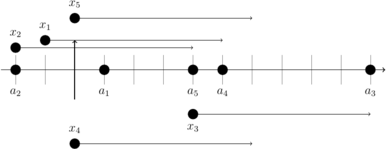
For the first example, one possible solution is to choose x1 = - 1, x2 = - 2, x3 = 4, x4 = 0, x5 = 0, which is illustrated below.
Vera has a grid with H rows and N columns. Rows are numbered 1 to H and columns are numbered 1 to N. Let the cell in the r-th row and c-th column be (r, c). Cells are coloured white or black. A colouring is a pyramid if:
Two pyramids are different if there is a cell that is white in one pyramid and black in the other. Compute the number of different pyramids modulo 109 + 7.
Line 1 contains integers H and N (1 ≤ H, N ≤ 105).
Print one line with one integer, the number of different pyramids modulo 109 + 7.
2 6
7
3 20
487
For the first example, the seven pyramids are:
###### ####.. ####.. #####. #####. #####. #####.
...... .##... ..##.. .#.... ..#... ...#.. ....#.
Vera has N rectangles. The i-th rectangle has corners (ai, bi) and (ci, di). Let U be the union of the N rectangles. The intersection of U and the line y = s - x is composed of disjoint line segments (maybe degenerate ones). Let f(s) be the sum of the lengths of these line segments or be zero if the intersection is empty.
Given integers L and R, let  . It can be seen that
  for some integer V. Compute the value of V.
Line 1 contains integers N, L, R (1 ≤ N ≤ 103, - 2 × 10⁸ ≤ L < R ≤ 2 × 10⁸).
N lines follow. The i-th line contains integers ai, bi, ci, di ( - 108 ≤ ai < ci ≤ 108, - 108 ≤ bi < di ≤ 108).
Print one line with one integer, the value of V.
3 -1 3
-2 -1 0 2
-1 0 1 1
1 -2 2 -1
7
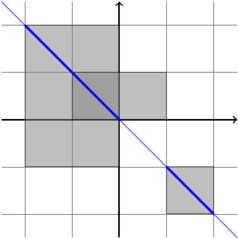
The below figure illustrates the first example when s = 0. f(0) is the sum of the lengths of the two thick blue line segments. Note that  .
.