


You are given a string $$$S$$$ of length $$$2n$$$, consisting of the characters A, B and C. Determine if $$$S$$$ can be split into $$$n$$$ non-intersecting subsequences, each of which forms one of the strings "AB", "AC", "BC". If it is possible, find such a splitting.
The first line of input contains one integer $$$n$$$ ($$$1 \le n \le 10^5$$$).
The second line of input contains a string $$$S$$$ of length $$$2n$$$, consisting of the characters A, B and C.
If the splitting is not possible, print "NO" (without quotes).
If the splitting is possible, print "YES" (without quotes), followed by $$$n$$$ lines, each describing two indices for the $$$i$$$-th subsequence ($$$1 \le l_i \lt r_i \le 2n$$$).
3
BABBCC
YES
3 5
1 6
2 4
2
CBAC
NO
1
AA
NO
3
ABCACB
YES
2 3
4 6
1 5
Let's call an array $$$[a_1, a_2, \ldots, a_k]$$$ of positive integers phenomenal, if the product of its elements is equal to the sum of its elements (i.e. if $$$a_1 a_2 \ldots a_k = a_1 + a_2 + \ldots + a_k$$$) .
For example, the array $$$[2, 2]$$$ is phenomenal, because $$$2\cdot 2 = 2+2 = 4$$$, and $$$[3, 1, 2]$$$ is phenomenal, because $$$3\cdot 1 \cdot 2 = 3 + 1 + 2 = 6$$$, but the array $$$[2, 3]$$$ is not phenomenal, as $$$2\cdot 3 \neq 2+3$$$.
Let $$$f(i)$$$ denote the number of phenomenal arrays of size $$$i$$$. It can be shown that for any fixed $$$i \ge 2$$$ there is only a finite number of phenomenal arrays of size $$$i$$$.
You are given an integer $$$n$$$. Find $$$f(2), f(3), \ldots, f(n)$$$. As these numbers can be very big, output them modulo $$$P$$$, where $$$P$$$ is a given prime number.
The only line of the input contains two integers $$$n, P$$$ ($$$2 \le n \le 2\cdot 10^5$$$, $$$10^8 \le P \le 10^9$$$, $$$P$$$ is prime).
Output $$$n-1$$$ integers — the values $$$f(2), f(3), \ldots, f(n)$$$ modulo $$$P$$$.
7 804437957
1 6 12 40 30 84
You are given integers $$$N, M$$$ with and a prime modulo $$$P$$$.
Consider all permutations of length $$$N \cdot M$$$ such that the length of their longest increasing subsequence equals $$$N$$$ and the length of their longest decreasing subsequence equals $$$M$$$.
Define $$$f(pos, val)$$$ for each $$$1 \le pos, val \le N \cdot M$$$ as the number of such permutations in which the $$$pos$$$-th element of the permutation equals to $$$val$$$.
Find $$$f(pos, val)$$$ for all $$$1 \le pos, val \le NM$$$, modulo $$$P$$$.
The only line of input contains three integers $$$N$$$ $$$M$$$ $$$P$$$ ($$$1 \le N \cdot M \le 100$$$, $$$10^8 \le P \le 10^9$$$, $$$P$$$ is prime).
Print a table of size $$$NM \times NM$$$, the $$$val$$$-th value in $$$pos$$$-th line should be equal to $$$f(pos, val) \bmod P$$$.
3 2 998244353
0 10 10 5 0 0
10 0 0 6 9 0
10 0 0 4 6 5
5 6 4 0 0 10
0 9 6 0 0 10
0 0 5 10 10 0
1 7 100000007
0 0 0 0 0 0 1
0 0 0 0 0 1 0
0 0 0 0 1 0 0
0 0 0 1 0 0 0
0 0 1 0 0 0 0
0 1 0 0 0 0 0
1 0 0 0 0 0 0
Given are two black and white $$$N \times M$$$ images $$$A$$$ and $$$B$$$.
The "flood fill" tool works as follows: you choose any cell $$$(x, y)$$$, locate its connected component and flip the colors of all the cells in the component (if the cell was black, it becomes white, and if it was white, it becomes black). The connected component of the cell is the set of cells you can reach by going up/down/left/right without changing color.
You can apply the "flood fill" tool to image $$$A$$$ any number of times. What is the minimum number of cells in which $$$A$$$ can be different from $$$B$$$ after some sequence of operations?
The first line of input contains two integers $$$N$$$ and $$$M$$$ ($$$1 \le N, M \le 100$$$) — the dimensions of the images.
Each of the next $$$N$$$ lines contains a binary string of length $$$M$$$, describing the corresponding row of the image $$$A$$$.
Each of the next $$$N$$$ lines contains a binary string of length $$$M$$$, describing the corresponding row of the image $$$B$$$.
Here 0 corresponds to the cell colored white, 1 corresponds to the cell colored black.
Output a single integer — the minimum possible number of cells in which $$$A$$$ can be different from $$$B$$$ after some sequence of operations.
1 3
101
010
1
4 4
0001
0101
0101
0111
0000
1110
1110
1110
7
In the first example, you can apply the tool to the middle cell twice. This way, two images will differ only in $$$1$$$ cell.
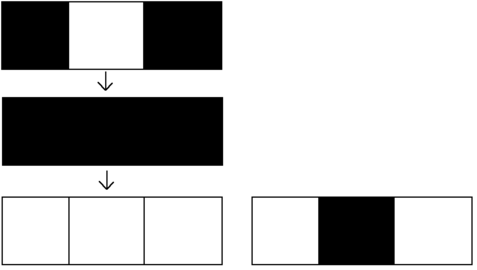
In the second example, you can just make the entire image black. This way, two images will differ in $$$7$$$ cells.

You are playing a game, and you are going to fight the secret boss. In this game, the boss doesn't attack you, but they can cast regeneration spells.
The fight consists of exactly $$$N$$$ rounds, in each round the following actions can happen, in this order:
- The boss can choose to cast the "Regeneration" spell.
- You can choose to cast the "Poison" spell if you have any mana left.
- You attack with a sword, dealing $$$X$$$ damage.
- All the passive effects are applied.
There are two types of passive effects: regeneration and poison. The effects stack, which means that the current state of the boss can be described with three integers: current health points ($$$hp$$$), current poison stacks ($$$p$$$) and current regeneration stacks ($$$r$$$). At the beginning of the fight, there are no poison stacks and no regeneration stacks ($$$p=r=0$$$). Each poison stack deals $$$P$$$ damage, each regeneration stack heals $$$R$$$ health points.
Spells have the following effects:
"Regeneration": increase the number of regenerations stacks $$$r$$$ by $$$1$$$.
"Poison": increase the number of poison stacks $$$p$$$ by $$$1$$$. If the number of regeneration stacks is strictly positive ($$$r \gt 0$$$), then decrease it by $$$1$$$.
After the round the $$$hp$$$ will decrease by $$$X + P \cdot p - R \cdot r$$$ (this value can be negative if the boss heals faster than you deal damage).
For each round you know if the boss will cast "Regeneration". You have enough mana to cast "Poison" $$$K$$$ times (you don't have to use all of your mana). What's the largest total damage you can deal to the boss, in other words, what is the maximum value of $$$hp_{start} - hp_{end}$$$? Assume that $$$hp_{start} = 10^{1000}$$$, so you can't actually kill the boss in $$$N$$$ rounds. Boss $$$hp$$$ can go higher than the initial value (see the third sample case).
The first line of the input contains $$$5$$$ integers $$$N$$$, $$$X$$$, $$$R$$$, $$$P$$$, $$$K$$$ ($$$1 \le N, X, R, P \le 10^6$$$, $$$0 \le K \le N$$$).
The second line of the input contains a binary string of length $$$N$$$. The $$$i$$$-th character of this string is 1, if the boss casts "Regeneration" at the beginning of the $$$i$$$-th round, and 0 otherwise.
Output a single integer — the largest total damage you can deal during the fight.
2 1010 1 1 1
01
2021
3 2 1 1 1
001
8
10 1 10 40 1
1111111111
-40
Let's look at the first sample. We can cast the "Poison" spell at most once. Let's look at what will happen if we cast this spell during the first round.
- During the first round, we apply a "Poison" spell, so at the end of this round there will be $$$0$$$ regeneration stacks, and $$$1$$$ poison stack. Therefore, the $$$hp$$$ will decrease by $$$X + P\cdot 1 - R\cdot 0 = 1011$$$ this round.
- At the beginning of the second round, the boss will cast the "Regeneration" spell, so there will be $$$1$$$ regeneration stack and $$$1$$$ poison stack at the end of the second round. So, the $$$hp$$$ will decrease by $$$X + P\cdot 1 - R\cdot 1 = 1010$$$ this round. Overall, the health of the boss decreased by $$$1011 + 1010 = 2021$$$.
Now let's look at what will happen if we cast this spell during the second round.
- During the first round, no spells are applied, so at the end of this round there will be $$$0$$$ regeneration stacks, and $$$0$$$ poison stacks. Therefore, the $$$hp$$$ will decrease by $$$X + P\cdot 0 - R\cdot 0 = 1010$$$ this round.
At the beginning of the second round, the boss will cast the "Regeneration" spell, so that there will be one regeneration stack after that. Then, we will we apply a "Poison" spell, decreasing the number of regeneration stacks by one. So, there will be $$$0$$$ regeneration stacks and $$$1$$$ poison stack at the end of the second round. Therefore, the $$$hp$$$ will decrease by $$$X + P\cdot 1 - R\cdot 0 = 1011$$$ this round. Overall, the health of the boss decreased by $$$1010 + 1011 = 2021$$$ again.
So, no matter when we cast the "Poison" spell in this sample, we will still decrease the $$$hp$$$ by $$$2021$$$.
Consider an array $$$A$$$ and a set $$$B$$$ of integers such that all numbers in $$$A$$$ and $$$B$$$ are distinct. Your task is to turn $$$A$$$ into a sorted array. To do this you can take any number from $$$B$$$ and replace any element of $$$A$$$ with it. You can perform this operation any number of times, but each element of $$$B$$$ can be used at most once.
Determine the minimum number of operations needed to turn $$$A$$$ into a sorted array, or determine that it is impossible.
The first line of input contains two integers $$$N$$$ and $$$M$$$ ($$$1 \le N, M \le 5 \cdot 10^5$$$) — the sizes of $$$A$$$ and $$$B$$$ respectively.
The second line contains $$$N$$$ integers $$$A_1, A_2, \ldots, A_N$$$.
The third line contains $$$M$$$ integers $$$B_1, B_2, \ldots, B_M$$$.
All the $$$(N + M)$$$ elements are distinct, positive and do not exceed $$$10^9$$$.
If it is impossible to turn $$$A$$$ into a sorted array, print $$$-1$$$. Otherwise, print the minimum number of operations needed.
4 1
2 6 13 10
5
-1
4 2
2 6 13 10
5 4
2
4 3
2 6 13 10
5 4 19
1
In all three examples, the issue is that $$$13 \gt 10$$$, so we have to change at least one of them.
In the first one, we can decrease $$$13$$$ by replacing it with $$$5$$$, but it breaks the other side, so there is no solution.
In the second one, we also have $$$4$$$, which we can use to fix the broken side. It is impossible to do with less than $$$2$$$ operations.
In the third example we can finally increase the last element, thus fixing $$$A$$$ in 1 operation.
You are given a colored tree on $$$n$$$ nodes, node $$$i$$$ has color $$$c_i$$$. As a reminder, a tree on $$$n$$$ nodes is a connected graph with $$$n-1$$$ edges.
Compute the number of connected subgraphs of this tree, for which there exists some color (majority color), such that strictly more than half of the nodes of this subgraph have this color.
Since the answer can be quite large, compute it modulo $$$998\,244\,353$$$.
The first line of input contains one integer $$$n$$$ ($$$1 \le n \le 3000$$$) — the number of nodes in the tree.
The second line contains $$$n$$$ integers $$$c_1\ c_2\ \ldots\ c_n$$$ ($$$1 \le c_i \le n$$$) — the colors of the nodes.
The $$$i$$$-th of next $$$n-1$$$ lines contains $$$2$$$ integers $$$u_i, v_i$$$ ($$$1 \le u_i, v_i \le n$$$, $$$u_i \neq v_i$$$), representing the edge $$$(u_i, v_i)$$$ of the tree. It is guaranteed that the given graph is a tree.
Print a single integer — answer to the problem modulo $$$998\,244\,353$$$.
3
2 3 3
1 2
2 3
5
4
1 1 3 3
1 2
1 3
1 4
8
In the following pictures, we use blue for color $$$1$$$, red for color $$$2$$$, and yellow for color $$$3$$$. The first example looks as follows:
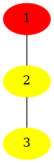
The tree has a total of $$$6$$$ non-empty connected subgraphs: $$$3$$$ of size $$$1$$$, $$$2$$$ of size $$$2$$$ and $$$1$$$ of size $$$3$$$, the latter in fact being the whole tree. All such subgraphs of sizes $$$1$$$ and $$$3$$$ have a majority color. For those of size $$$2$$$ only the subgraph induced by vertices $$$1$$$ and $$$2$$$ does not have a majority color (red and yellow both appear equally often in it). Therefore, there are $$$6 - 1 = 5$$$ connected subgraphs with a majority color.
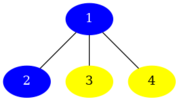
The second example looks as follows, and it has $$$8$$$ connected subgraphs with a majority color:
You are given a permutation $$$p_1, p_2, \ldots, p_n$$$ of integers from $$$1$$$ to $$$n$$$. Each position from $$$1$$$ to $$$n$$$ is colored in one of $$$k$$$ colors. We want to sort the permutation, and for that, we can apply any number of operations of the following types:
- Swap any two elements. This operation costs $$$S$$$ coins;
- Choose any color $$$i$$$, and permute the elements on positions of color $$$i$$$ as you wish. This operation costs $$$C_i$$$ coins.
Note that the positions are colored, not the elements, so when you swap two elements, the positions won't change their colors.
Find the minimum number of coins you need to spend to sort the permutation.
The first line of the input contains a single integer $$$T$$$ ($$$1 \le T \le 10^{3}$$$) — the number of independent test cases you need to process. The description of the test cases follows.
The first line of each test case contains two integers $$$n$$$ and $$$k$$$ ($$$1 \le n \le 10^{5}$$$, $$$1 \le k \le 5$$$) — the size of the permutation and the number of colors.
The second line of each test case contains $$$(k+1)$$$ integers $$$S, C_1, C_2, \ldots, C_k$$$ ($$$0 \le S, C_i \le 10^9$$$) — the costs of the operations.
The third line of each test case contains $$$n$$$ integers $$$p_1, p_2, \ldots, p_n$$$ ($$$1 \le p_i \le n$$$, all $$$p_i$$$ are distinct) — the permutation.
The fourth line of each test case contains $$$n$$$ integers $$$col_i$$$ ($$$1 \le col_i \le k$$$) — the colors of the positions.
The sum of $$$n$$$ over all test cases in one file does not exceed $$$10^{5}$$$.
For each test case print a single integer — the minimum number of coins you need to spend to sort the permutation.
4
4 1
1 10
2 3 4 1
1 1 1 1
4 1
10 1
2 3 4 1
1 1 1 1
6 2
10 1 1
5 2 4 6 1 3
1 2 1 2 1 2
4 3
6 7 8 9
1 2 3 4
2 2 3 2
3
1
12
0
In the first test case, we can sort the permutation by applying the "Swap" operation $$$3$$$ times: $$$(2, 3, 4, 1) \to (4, 3, 2, 1) \to (4, 2, 3, 1) \to (1, 2, 3, 4)$$$. This way you will spend $$$3$$$ coins.
Another way to sort it would be to permute all elements on positions of color $$$1$$$, but this would cost $$$10$$$ coins, and we can do cheaper.
In the second test case (which differs from the first one only in the costs of operations), however, it's cheaper to just permute all elements on positions of color $$$1$$$, spending $$$1$$$ coin on this.
In the third test case, one of the optimal sequences of operations would be the following:
Permute the elements on positions of color $$$2$$$ to obtain the permutation $$$(5, 2, 4, 3, 1, 6)$$$. This operation costs $$$1$$$ coin.
Swap elements $$$p_3, p_4$$$. The permutation is now $$$(5, 2, 3, 4, 1, 6)$$$. This operation costs $$$10$$$ coins.
Permute the elements on positions of color $$$1$$$ to obtain the permutation $$$(1, 2, 3, 4, 5, 6)$$$. This operation costs $$$1$$$ coin.
In total, we spent $$$12$$$ coins.
In the fourth test case, the permutation is already sorted, so we don't have to spend anything.
You are given a string $$$S$$$ of length $$$3n$$$, consisting of the characters A, B and C. You are allowed to perform the following operation:
- Select some subsegment of this string and a character $$$c$$$ (one of A, B and C). Then, replace all the characters on the subsegment with $$$c$$$.
Find the smallest number of times that you would have to apply the operation above to get a string which contains each of characters A, B and C exactly $$$n$$$ times. It can be shown that it is always possible to get such a string.
In addition, find a sequence of operations of the smallest possible length. If there are many such sequences, you can output any of them.
The first line of input contains a single integer $$$n$$$ ($$$1 \le n \le 3 \cdot 10^5$$$).
The second line of the input contains a string $$$S$$$ of length $$$3n$$$, consisting of the characters A, B and C.
In the first line print the minimum number of operations $$$k$$$.
In the $$$i$$$-th of the next $$$k$$$ lines print $$$2$$$ integers $$$l_i, r_i$$$ and a character $$$c_i$$$ ($$$1 \le l_i \le r_i \le 3n$$$, $$$c_i \in \{\texttt{A}, \texttt{B}, \texttt{C}\}$$$), denoting that in the $$$i$$$-th operation you will replace each of the characters $$$S_{l_i}, S_{l_i+1}, \ldots, S_{r_i}$$$ with $$$c_i$$$.
If there is more than one solution with a minimum number of operations, you can print any one of them.
1
AAA
2
2 3 B
3 3 C
1
CAB
0
3
ABABCABAB
1
1 2 C
In the first sample, the string will undergo the following transformations:
AAA $$$\to$$$ ABB $$$\to$$$ ABC.
In the second sample, the string already contains exactly one A, one B and one C.
In the third sample, the string will undergo the following transformation:
ABABCABAB $$$\to$$$ CCABCABAB. Now, it contains each letter $$$3$$$ times.
Consider an undirected tree. The following algorithm constructs a post-order traversal of the tree:
fun dfs(v):
    mark v as used
    for u in neighbours(v):
        if u is not used:
            dfs(u)
    append v to order
The post-order traversal will be in the list order.
You are allowed to choose the order of neighbors for each vertex as well as the starting vertex. What is the lexicographically minimal order you can get?
The first line of input contains one integer $$$T$$$ ($$$1 \le T \le 10^{5}$$$) — the number of test cases you need to process. Description of the test cases follows.
The first line of each test case contains a single integer $$$n$$$ ($$$2 \le n \le 2 \cdot 10^{5}$$$) — the number of vertices in the tree.
The $$$i$$$-th of the next $$$n-1$$$ lines contains two integers $$$u_i, v_i$$$ ($$$1 \le u_i, v_i \le n$$$, $$$u_i \ne v_i$$$), meaning that there is an undirected edge $$$(u_i, v_i)$$$ in the tree. It is guaranteed that the given graph is a tree.
The sum of $$$n$$$ over all test cases in one test file does not exceed $$$2 \cdot 10^{5}$$$.
For each test case print the lexicographically minimal order on a separate line.
3
3
1 3
3 2
3
2 1
1 3
7
1 2
1 3
2 4
2 5
3 6
3 7
1 2 3
2 1 3
4 5 2 1 6 3 7
The first test looks as follows:
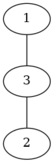
By starting in vertex $$$1$$$ we can only get order $$$2\ 3\ 1$$$. By starting in vertex $$$2$$$ we can only get order $$$1\ 3\ 2$$$. By starting in vertex $$$3$$$ we can get two orders: $$$1\ 2\ 3$$$ and $$$2\ 1\ 3$$$. The lexicographically minimal of the four orders is $$$1\ 2\ 3$$$.
The second test looks as follows:
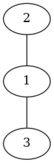
By starting in vertex $$$1$$$ we can get two orders: $$$2\ 3\ 1$$$ and $$$3\ 2\ 1$$$. By starting in vertex $$$2$$$ we can only get order $$$3\ 1\ 2$$$. By starting in vertex $$$3$$$ we can only get order $$$2\ 1\ 3$$$. The lexicographically minimal of the four orders is $$$2\ 1\ 3$$$.
The third test looks as follows:
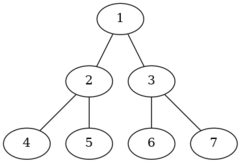
The lexicographically minimal order is $$$4\ 5\ 2\ 1\ 6\ 3\ 7$$$ it can be obtained by starting in node $$$7$$$.
Define $$$\mathbb{P}_{LR} = \mathbb{P} \cap [L;R]$$$, where $$$\mathbb{P}$$$ is the set of prime numbers. In other words, $$$\mathbb{P}_{LR}$$$ is the set of all primes between $$$L$$$ and $$$R$$$ inclusive.
Given $$$L$$$ and $$$R$$$, find the number of integers that can be represented as XOR of some (possibly empty) subset of $$$\mathbb{P}_{LR}$$$.
The first line of input contains one integer $$$T$$$ ($$$1 \le T \le 100$$$) — the number of independent test cases you need to process. Descriptions of $$$T$$$ test cases follow.
The description of one test case consists of two integers $$$L$$$ and $$$R$$$ ($$$2 \le L \le R \le 10^{12}$$$).
For each test case print the answer on a separate line.
3
2 10
999999940 1000000000
2 1000000000000
8
1
1099511627776
In the first example, $$$\mathbb{P}_{LR} = \{ 2, 3, 5, 7 \}$$$.
- $$$0 = 2 \oplus 5 \oplus 7$$$
- $$$1 = 2 \oplus 3$$$
- $$$2 = 2$$$
- $$$3 = 3$$$
- $$$4 = 3 \oplus 7$$$
- $$$5 = 2 \oplus 7$$$
- $$$6 = 3 \oplus 5$$$
- $$$7 = 7$$$
In the second example, $$$\mathbb{P}_{LR} = \varnothing$$$, so only $$$0$$$ can be represented as XOR of some subset.
Given $$$K$$$, construct two non-empty binary strings $$$S$$$ and $$$T$$$ of length at most 8848 such that they have exactly $$$K$$$ different longest common subsequences. More formally, if $$$L$$$ is the length of the longest common subsequence of $$$S$$$ and $$$T$$$, there should exist exactly $$$K$$$ distinct binary strings of length $$$L$$$ which are subsequences of both $$$S$$$ and $$$T$$$.
It is guaranteed that under the constraints of this problem such strings always exist.
The only line of input contains a single integer $$$K$$$ ($$$1 \le K \le 10^9$$$).
Print non-empty binary strings $$$S$$$ and $$$T$$$ on separate lines. The length of each of them should not exceed $$$8848$$$. They can have different lengths.
If there is more than one solution, you can print any one of them.
1
1111
00
2
10
01
3
010
1001
100
10001000001011100001010100011
11000010001010101001010011100
In the first example, the longest common subsequence of 1111 and 00 has length $$$0$$$, and there exists only one string of length $$$0$$$ which is a subsequence of both of them — the empty string.
In the second example, the length of the longest common subsequence of strings 10 and 01 is $$$1$$$, and there are $$$2$$$ strings of length $$$1$$$ which are subsequences of both $$$S$$$ and $$$T$$$: 0 and 1.
In the second example, the length of the longest common subsequence of strings 010 and 1001 is $$$2$$$, and there are $$$3$$$ strings of length $$$2$$$ which are subsequences of both $$$S$$$ and $$$T$$$: 00, 01, and 10.
It would be disrespectful to make strings longer than Everest...
You are given $$$2n$$$ pairs $$$(a_i, b_i)$$$ of integers. Consider a complete graph on $$$2n$$$ vertices and define the weight of the edge $$$(ij)$$$ to be $$$w_{ij} = max(|a_i-a_j|, |a_i-b_j|, |b_i-a_j|, |b_i-b_j|)$$$.
Determine the maximum weight of the matching in this graph.
In other words, consider all ways to select $$$n$$$ edges of this graph such that no two chosen edges have a common endpoint. What is the maximum possible total weight of these edges?
The first line of the input contains a single integer $$$n$$$ ($$$1 \le n \le 10^5$$$).
The $$$i$$$-th of the next $$$2n$$$ lines contain two integers $$$a_i$$$ and $$$b_i$$$ ($$$0 \le a_i, b_i \le 10^9$$$).
Print a single integer — the maximum weight of the matching in this graph.
2
0 10
7 7
9 4
2 15
18
Adjacency matrix:
| 0 | 7 | 9 | 15 |
| 7 | 0 | 3 | 8 |
| 9 | 3 | 0 | 11 |
| 15 | 8 | 11 | 0 |