


Today, we are happy to invite so many good friends. IHI has just written a long string to celebrate this great party. How many occurrences of "hznu" as a continuous substring are there in the long string? Please write a program to count the number.
The only line contains a non-empty string, consisting of no more than $$$100\,000$$$ lowercase Latin letters, 'a' to 'z'.
Output a line containing a single integer, indicating the number of occurrences of "hznu" in the given string.
hznu
1
hhzznnuu
0
You are given $$$n$$$ strings and a new rule of overload the less-than sign, please print the $$$K$$$-th lexicographically smallest string.
Every string contains only lowercase letters.
A string $$$a$$$ is lexicographically smaller than a string $$$b$$$ if and only if one of the following holds:
- there exists a position $$$i$$$, $$$a_i \lt b_i$$$ and for all $$$j \lt i$$$, $$$a_j=b_j$$$,
- for every $$$i$$$, $$$a_i=b_i$$$ and the length of $$$a$$$ is less than the length of $$$b$$$.
The first line gives $$$26$$$ characters from $$$a$$$ to $$$z$$$, each character will appear only once. The earlier a letter appears, the smaller it is. For example, $$$acb \cdots xyz$$$ in the first line means that character '$$$c$$$' is less than character '$$$b$$$' and character '$$$c$$$' is greater than character '$$$a$$$'.
The second line contains an integer $$$n$$$ $$$(1 \lt n \lt 10^3)$$$, indicating the number of strings.
Next $$$n$$$ lines, each line contains a string, whose length of the string is less than $$$10^3$$$.
The next line contains an integer $$$K$$$ $$$(1 \leq K \leq n)$$$, indicating the $$$K$$$-th smallest string you need to find.
The $$$K$$$-th lexicographically smallest string.
acbdefghijklmnopqrstuvwxyz
2
abc
acb
1
acb
zabcdefghijklmnopqrstuvwxy
2
a
b
1
a
Now, $$$n$$$ people are checking the problems. There are $$$10^{10^{10}}$$$ problems in total and numbered from $$$1$$$ to $$$10^{10^{10}}$$$. The $$$i$$$-th person starts the check from the $$$a_i$$$ problem. It takes one minute to check a problem. More formally, the problem with the number $$$a_i+j-1$$$ will be checked by the $$$i$$$-th person at the $$$j$$$-th minute.
Now, your task is to answer $$$q$$$ queries. Each query will give you an integer $$$t$$$, please calculate the number of problems that have been tested at least once after $$$t$$$ minutes.
The first line contains a single integer $$$n (1 \leq n \leq 5 \cdot 10^5)$$$ indicating the number of people.
The second line contains $$$n$$$ integers $$$a_1, a_2, \cdots,a_n$$$ $$$(1 \leq a_1 \leq a_2 \leq \cdots \leq a_n \leq 10^{18})$$$ indicating the problem number of the first check for the $$$i$$$-th person.
The next line contains a single integer $$$q$$$ $$$(1 \leq q \leq 5 \cdot 10^5)$$$ indicating the number of queries.
Each of the next $$$q$$$ lines contains an integer $$$t$$$ $$$(0 \leq t \leq 10^{18})$$$.
it is guaranteed that $$$a_{i+1}-a_i \leq a_{i+2}-a_{i+1}$$$ for every $$$1 \leq i \leq n - 2$$$.
For each query, output the total number of problems that have been tested at least once after $$$t$$$ minutes in one line.
3
1 3 8
3
2
4
10
6
10
17
After two minutes, the first person checked $$$[1,2]$$$ problems, the second person checked $$$[3,4]$$$ problems and the third person checked $$$[8,9]$$$ problems, the answer is $$$6$$$.
After four minutes, the first person checked $$$[1,2,3,4]$$$, the second person checked $$$[3,4,5,6]$$$, and the third person checked $$$[8,9,10,11]$$$, the answer is $$$10$$$.
You are given a tree consisting of $$$n$$$ vertices. Recall that a tree is a connected graph consisting of $$$n$$$ vertices and $$$(n-1)$$$ undirected edges.
Now, your task is to answer $$$q$$$ queries. Each query will give you a vertex $$$x$$$, please calculate the number of simple paths of length at least one through the vertex $$$x$$$. Note that paths that differ only by their direction are considered the same (i. e. you have to calculate the number of undirected paths). For example, paths $$$[1,2,3]$$$ and $$$[3,2,1]$$$ are considered the same.
Recall that a simple path is a path that visits each vertex at most once.
The first line contains an integer $$$n$$$ $$$(2 \leq n \leq 10^5)$$$ indicating the number of vertices.
For the next $$$(n-1)$$$ lines, the $$$i$$$-th line contains two integers $$$u_i$$$ and $$$v_i$$$ $$$(1 \leq u_i, v_i \leq n)$$$ indicating an edge connecting vertices $$$u_i$$$ and $$$v_i$$$ in the tree.
The first line contains an integer $$$q$$$ $$$(1 \leq q \leq 10^5)$$$ indicating the number of queries.
For the next $$$q$$$ lines, the $$$i$$$-th line contains an integer $$$x_i$$$ $$$(1 \leq x_i \leq n)$$$ indicating the vertex as described above.
For each query output one line containing one integer indicating the answer.
5
1 2
1 3
3 4
3 5
5
1
2
3
4
5
7
4
9
4
4
The example looks like that:

There are $$$7$$$ different simple paths through vertex $$$1$$$:
- $$$[1, 2]$$$;
- $$$[1, 3]$$$;
- $$$[2, 1, 3]$$$;
- $$$[1, 3, 4]$$$;
- $$$[1, 3, 5]$$$;
- $$$[2, 1, 3, 4]$$$;
- $$$[2, 1, 3, 5]$$$.
Now you have an $$$n \times n$$$ map. It contains obstacles '$$$*$$$', space '$$$.$$$', playerA '$$$a$$$', playerB '$$$b$$$'.
You can control two players to move up, down, left or right at the same time. For example, now $$$A$$$ and $$$B$$$ are in $$$(x_a,y_a)$$$ and $$$(x_b, y_b)$$$, next time the two players can go to:
- $$$(x_a, y_a+1)$$$ and $$$(x_b, y_b+1)$$$
- $$$(x_a, y_a-1)$$$ and $$$(x_b, y_b-1)$$$
- $$$(x_a+1, y_a)$$$ and $$$(x_b+1, y_b)$$$
- $$$(x_a-1, y_a)$$$ and $$$(x_b-1, y_b)$$$
Note that if the next location is a boundary or obstacle the player will not move.
You need to find the minimum number of steps when two players can meet.
The first line contains one integer $$$n$$$ $$$(2\leq n \leq 50)$$$.
For the next $$$n$$$ lines, each line contains a string of length $$$n$$$.
If in any case, the two players do not meet, print "no solution" in one line.
Otherwise, output the minimum number of steps.
6
.a....
*.....
......
..b*..
..**..
......
4
4
a*..
*...
....
...b
no solution
4
.ab.
....
....
....
2
7
..a.b..
.......
.......
.......
.......
.......
.......
4
Give you an array of $$$n$$$ positive integers, your task is to count the number of subarrays whose sum is a multiple of $$$k$$$.
A subarray of array is a sequence $$$a_{l},a_{l+1},...,a_{r}$$$ for some integers $$$(l,r)$$$ such that $$$1\leq l \leq r \leq n$$$.
The first line contains two positive integers $$$n$$$ $$$(1\leq n \leq 10^{5})$$$, $$$k$$$ $$$(1\leq k \leq 10^{9})$$$.
The second line contains $$$n$$$ positive integers $$$a_1, a_2, \cdots, a_n$$$ $$$(0\leq a_i \leq 10^{9})$$$.
Output one line containing one integer indicating the number of subarrays.
6 3
0 1 2 4 7 7
7
For the test
$$$sum[1,1] = 0 $$$ , $$$0$$$ is a multiple of $$$3$$$
$$$sum[1,3] = 0 + 1 + 2 = 3$$$ , $$$3$$$ is a multiple of $$$3$$$
$$$sum[1,6] = 0 + 1 + 2 + 4 + 7 + 7= 21$$$ , $$$21$$$ is a multiple of $$$3$$$
$$$sum[2,3] = 1 + 2 = 3$$$ , $$$3$$$ is a multiple of $$$3$$$
$$$sum[2,6] = 1 + 2 + 4 + 7 + 7= 21$$$ , $$$21$$$ is a multiple of $$$3$$$
$$$sum[3,4] = 2 + 4 = 6$$$ , $$$6$$$ is a multiple of $$$3$$$
$$$sum[4,6] = 4 + 7 + 7 = 18$$$ , $$$18$$$ is a multiple of $$$3$$$
So the ans is $$$7$$$.
Ganyu just learns the persistent segment tree and decides to practice immediately. Since Paimon has become a master of the persistent segment tree, Ganyu asks her for help. Therefore Paimon gives her an easy problem to start:
The elements in the sequence have two states - locked and unlocked. If one element $$$a_i$$$ is locked, it cannot be modified, but the unlocked state has no effect. More formally, you can only modify elements that are in the unlocked state.
Given a sequence $$$a_1, a_2, \cdots, a_n$$$ of length $$$n$$$ with initial values of $$$1$$$ and states are unlocked.
Paimon will apply $$$m$$$ modifications to the sequence. There are $$$3$$$ types of modifications:
- flip $$$p$$$: change the state of the element $$$a_p$$$.
- mul $$$l$$$ $$$r$$$ $$$x$$$: for every element $$$a_i$$$ in the subarray $$$(a_l,a_{l+1}, \cdots,a_r)$$$, replace unlocked $$$a_i$$$ with $$$a_i \times x$$$.
- div $$$l$$$ $$$r$$$ $$$x$$$: for every element $$$a_i$$$ in the subarray $$$(a_l,a_{l+1}, \cdots,a_r)$$$, you should check if all of them(including elements in unlocked and locked states) are divisible by $$$x$$$. If it holds, replace unlocked $$$a_i$$$ with $$$a_i \div x$$$, otherwise do not perform the operation.
Please help Ganyu to check whether each div modification can be performed.
There is only one test case in each test file.
The first line of the input contains two integers $$$n$$$ and $$$m$$$ $$$(1 \leq n, m \leq 10^5)$$$ indicating the length of the sequence, and the number of modifications.
Then the following $$$m$$$ lines indicate modifications. Each of them must be in one of the following forms.
- flip $$$p$$$
- mul $$$l$$$ $$$r$$$ $$$x$$$
- div $$$l$$$ $$$r$$$ $$$x$$$
All $$$p, l, r$$$ and $$$x$$$ mentioned in these $$$m$$$ lines satisfy $$$1\leq p \leq n$$$, $$$1 \leq l \leq r \leq n$$$ and $$$1 \leq x \leq 30$$$.
For each div modifications, print "YES" on the single line if all the elements in the subarray are divisible by $$$x$$$. Otherwise, print "NO".
You can print each letter in any case (upper or lower).
5 11
mul 1 5 18
div 2 3 6
div 1 2 9
flip 2
div 1 2 9
mul 2 2 3
div 1 2 9
div 2 3 3
flip 2
mul 2 2 3
div 1 2 9
YES
NO
NO
NO
YES
YES
Here is the explanation for the example:
- $$$[18, 18, 18, 18, 18]$$$
- $$$[18, 3, 3, 18, 18]$$$
- $$$[18, 3, 3, 18, 18]$$$, $$$a_2$$$ and $$$a_3$$$ are not divsiable by $$$9$$$
- $$$[18,$$$ 3$$$, 3, 18, 18]$$$, $$$a_2$$$ is locked
- $$$[18,$$$ 3$$$, 3, 18, 18]$$$, $$$a_2$$$ is not divsiable by $$$9$$$
- $$$[18,$$$ 3$$$, 3, 18, 18]$$$, $$$a_2$$$ is locked so you can't change its value
- $$$[18,$$$ 3$$$, 3, 18, 18]$$$, $$$a_2$$$ is not divsiable by $$$9$$$
- $$$[18,$$$ 3$$$, 1, 18, 18]$$$, $$$a_2$$$ and $$$a_3$$$ are divsiable by $$$3$$$ but $$$a_2$$$ is locked, so you only change $$$a_3$$$
- $$$[18, 3, 1, 18, 18]$$$, $$$a_2$$$ is unlocked
- $$$[18, 9, 1, 18, 18]$$$
- $$$[2, 1, 1, 18, 18]$$$
Alice is going to go to the supermarket, which is $$$p$$$ meters away from her. She can walk or ride a bike. There are $$$n$$$ bike stops on the road, and she can only get on and off at these stops if she rides a bike.
She needs to pay to ride a bike. One yuan allows riding at most $$$s$$$ meters(less than $$$s$$$ meters costs one yuan, too). Formally, if two stops are $$$x$$$ meters away from each other and Alice chooses to bike, it costs her $$$\lceil\frac{x}{s}\rceil$$$ yuan.
Now, she has $$$k$$$ yuan, and she wants to know, what is the minimum number of meters to walk.
The first line contains three integers $$$n, p, s$$$ $$$(1 \le n \le 10^6, 1 \le p \le 10^9,1\le s \le 10^9)$$$ indicating the number of the bike shops, the location of the store, and maximum meters that one yuan allows to ride.
The second line contains $$$n$$$ integers, $$$a_1, a_2, \cdots, a_n$$$ $$$(0 \le a_i \le p)$$$ indicating the position of the $$$i$$$-th stop ($$$\forall i \lt j, a_i \lt a_j$$$).
The third line contains an integer $$$k(1\le k \le 5)$$$, indicating Alice has $$$k$$$ yuan.
Output one line containing one integer indicating the minimum number of meters that Alice needs to walk.
1 10 10
2
5
10
3 100 10
80 99 100
2
80
4 10 3
1 2 6 7
1
9
In the first test case, Alice cannot find any other bike stops to get off, so she has to walk $$$10$$$ meters.
In the second test case:
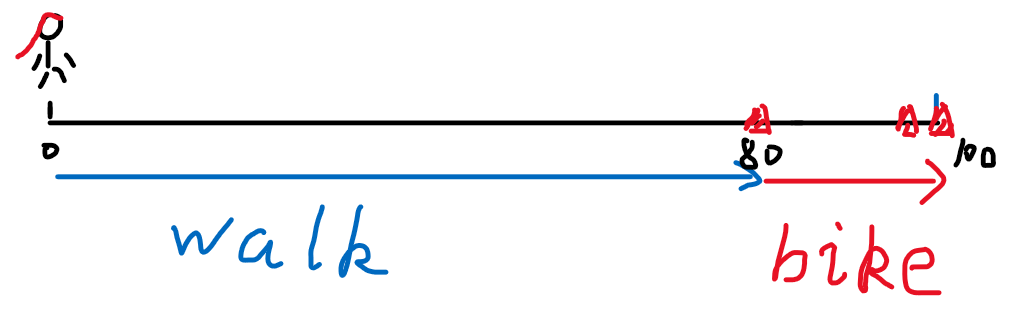
Alice can walk $$$80$$$ meters and then pay two yuan to ride $$$20$$$ meters.
In the third test case, Alice can only ride from $$$1$$$ to $$$2$$$ or $$$6$$$ to $$$7$$$, so she has to walk the remaining $$$9$$$ meters.
IHI's assignment today is to solve inequality. His task is to calculate the number of solutions of the inequality $$$x_1+x_2+...+x_n\le s$$$.
To exercise IHI's ability to draw inferences from one another, the teacher gave each $$$x_i$$$ a limit. Each $$$x_i$$$ should be greater than or equal to $$$a_i$$$. In other words, $$$\forall x_i \ge a_i(1\le i \le n)$$$.
The teacher assigned a total of $$$q$$$ problems. For each of them, you are given two integers $$$x$$$ and $$$val$$$. You need to change the value of $$$a_x$$$ to $$$val$$$. In other words, each times, $$$a_x = val$$$. Then calculate the answer. Since this number may be very large, the teacher asks IHI to find the number modulo $$$(10^9 + 7)$$$.
Can you help IHI?
The first line of input contains three space-separated integers $$$n$$$, $$$s$$$ and $$$q$$$ $$$(1\le n \le 2\times{10}^{5}$$$, $$$0\le s \le2\times{10}^{5}$$$, $$$1\le q\le2\times10^{5})$$$ —— the length of the array $$$a$$$, the right value of the inequality, and the number of operations.
The second line contains $$$n$$$ space-separated integers $$$a_1,a_2,\cdots,a_n$$$ $$$(0\le a_i\le 2\times10^{5})$$$
The next $$$q$$$ lines contains two integers $$$x$$$ and $$$val (1\le x \le n$$$, $$$0\le val\le 2\times10^{5})$$$ —— You need to change $$$a_x$$$ to $$$val$$$.
Note that each operation permanently changes array $$$a$$$. In other words, $$$a_x$$$ will be forever changed.
Print $$$q$$$ integers. The $$$i$$$-th line is the answer to this problem after the $$$i$$$-th operation.
3 5 4
1 1 1
1 1
1 2
2 2
3 2
10
4
1
0
After the first operation ,$$$a$$$=$$$[1,1,1]$$$.The value of $$$ \{ x_1 , x_2 , x_3 \}$$$ can be $$$\{ 1,1,1\}$$$, $$$\{ 1,1,2\}$$$, $$$\{ 1,2,1\}$$$, $$$\{ 2,1,1\}$$$, $$$\{ 2,2,1\}$$$, $$$\{ 2,1,2\}$$$, $$$\{ 1,2,2\}$$$, $$$\{ 3,1,1\}$$$, $$$\{ 1,3,1\}$$$, $$$\{ 1,1,3\}$$$.So there are $$$10$$$ solutions, output $$$10$$$.
After the third operation,$$$a=[2,2,1]$$$.There's only one set of solution satisfies the inequality.——The value of$$$\{x_1,x_2,x_3\}=\{2,2,1\}.$$$
After the fourth operation,$$$a=[2,2,2]$$$,No set of solutions satisfies the inequality, so the output is $$$0$$$.
IHI has recently acquired a magic power that can perform the following operations on strings:
- puts a character at the end of a string.
- deletes a character at the end of a string (does not operate if the string is empty).
- replaces all current character $$$x$$$ in the string to characters $$$y$$$.
All characters are lowercase.
Now IHI has a string that starts empty, he wants to know what the final string is after $$$q$$$ operations.
The first line contains a number $$$q$$$ $$$(1 \leq q \leq 10^5)$$$ indicating the number of operations.
The next $$$q$$$ lines represent $$$q$$$ operations.
There are three types of operations:
- $$$1$$$ $$$x$$$: In the first operation, you should put character $$$x$$$ at the end of the string.
- $$$2$$$: In the second operation, you should delete a character at the end of the string if and only if this string is not empty.
- $$$3$$$ $$$x$$$ $$$y$$$: In the third operation, replace $$$x$$$ in the string with $$$y$$$.
If the final string is empty, you should output "The final string is empty".
Otherwise, output the final string in one line.
5
1 a
1 b
1 c
3 a c
1 b
cbcb
6
1 a
1 b
1 c
1 c
3 a c
3 c a
abaa
5
1 a
1 c
3 a c
2
2
The final string is empty
Today little Klee wanted to go on an adventure outside. Klee wanted to go to so many places to play, but finally, she could only go to one place to play and she can pass away any number of times in other places.
First of all, let's consider the plane where Klee is located as a two-dimensional plane, which is divided into four quadrants, and there are $$$n$$$ points in the whole plane. Klee can only move directly from one point to another for each movement.
Since each quadrant represents a different country, the maximum speed that can be achieved differs for each quadrant. The ranges and maximum speeds of these four quadrants are defined as follows:
| quadrant | x | y | maximum speed |
| $$$1$$$ | $$$x \geq 1$$$ | $$$y \geq 1$$$ | $$$v_1$$$ |
| $$$2$$$ | $$$x \leq -1$$$ | $$$y \geq 1$$$ | $$$v_2$$$ |
| $$$3$$$ | $$$x \leq -1$$$ | $$$y \leq -1$$$ | $$$v_3$$$ |
| $$$4$$$ | $$$x \geq 1$$$ | $$$y \leq -1$$$ | $$$v_4$$$ |
If two points are in the same quadrant, Klee can reach the maximum speed given in that quadrant. For example, in one movement, if Klee's start point and Klee's endpoint are both located in the first quadrant, the maximum speed is $$$v_1$$$.
If the two points are not in the same quadrant, then Klee's speed must not be greater than $$$v_0$$$ to transfer directly in both quadrants. For example, in one movement, if Klee's start point is located in the first quadrant and Klee's endpoint is located in the second quadrant, the maximum speed is $$$v_0$$$ in this movement.
Now, given the initial index of the point that Klee is in and the final index of the point that Klee finally wants to play, please find the minimum time needed for Klee to get from the initial point to the final point.
The First line is an integer $$$n$$$ $$$(1 \leq n \leq 3 \cdot 10^3)$$$ indicating the number of points.
The second line contains $$$5$$$ integers $$$v_1, v_2, v_3, v_4, v_0$$$ $$$(1 \leq v_1, v_2, v_3, v_4, v_0 \leq 10^5)$$$ as described above.
The third line contains two integers $$$s, t$$$ $$$(1 \leq s, t \leq n)$$$, indicating the initial index of the point and the final index of the point.
For the following $$$n$$$ lines, the $$$i$$$-th line contains two integers $$$x_i, y_i$$$ $$$(-10^5 \leq x_i, y_i \leq 10^5, x_i \neq 0, y_i \neq 0)$$$, indicating the coordinate of the $$$i$$$-th point.
We ensure that there is no overlap between the two points(which means for any point $$$i$$$ and $$$j$$$, we can ensure that $$$x_i = x_j$$$ and $$$y_i = y_j$$$ do not occur simultaneously).
Output one line containing one integer indicating the minimum time needed for Klee to get from the initial point to the final point.
Your answer will be accepted if the absolute or relative error does not exceed $$$10^{-6}$$$. Formally, let your answer be a, and the jury's answer is b. Your answer is considered correct if $$$\frac{|a-b|}{max(1,|b|)}\leq 10^{-6}$$$.
3
1 2 3 4 5
1 3
1 -5
1 -1
1 1
1.2000000000
4
5 1 1 10 1
1 4
1 1
2 1
2 -1
1 -2
2.3414213562
3
1 1 1 1 100
1 3
1 1
2 -1
1 -100
1.0100000000
In the second test case:
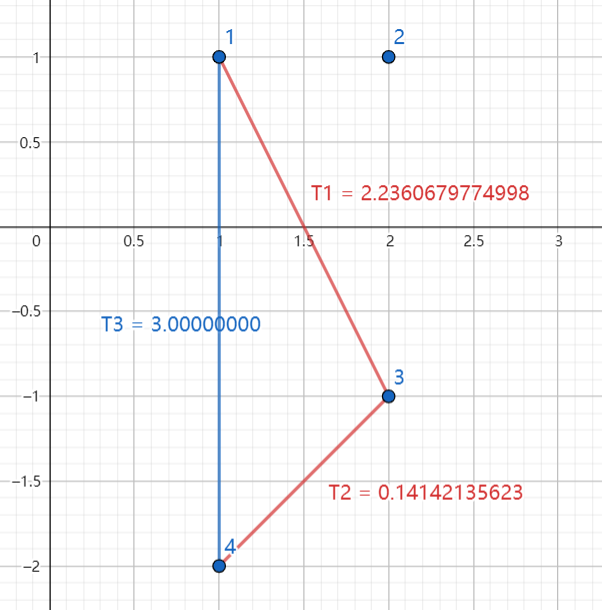
Klee needs to move from point $$$1$$$ to point $$$4$$$.
She will first move from point $$$1$$$ to point $$$3$$$ with a speed of $$$v_0$$$, and then from point $$$3$$$ to point $$$4$$$ at a speed of $$$v_4$$$.