


Just before the 2022 Shanghai Collegiate Programming Contest, you decide to play some games to chill out. Today, your friend Tommy introduces a game called Nerdle to you. This game is about to guess some equations.
 A game in Nerdle.
 You can present an equation to the jury each time. The jury will send back results by the colors:
After playing for a while, you found that you spent a lot of time just trying to make the left-hand side equal to the right-hand side. As a strong competitive programmer, it's so much a waste of time for you. You decide to use your computer to analyze the result of one equation so that the remaining possible equation can be obtained. The equation and answer have the following restrictions:
Write a program to find out all possible remaining equations by a given result.
The input contains two strings $$$E, C$$$ of length $$$8$$$ in two lines, denoting the equation asked and the color returned by the jury, respectively. $$$C$$$ consists of 'GPB', denoting green, purple, and black of the corresponding spot.
It's guaranteed that:
Print an integer $$$R$$$ in the first line, denoting the number of different remaining possible equations. Two equations are considered different if they are different on at least one character.
For the next $$$R$$$ lines, print a string in each line denoting a valid equation corresponding to the input.
You can print your solution in any order. It's guaranteed that at least one valid equation exists.
40+11=51
PBGPPGGB
7
11+42=53
11+43=54
11+44=55
11+45=56
11+46=57
11+47=58
11+48=59
12+46=58
GBGGPGGB
6
11+45=56
13+43=56
15+41=56
16+40=56
16+41=57
16+43=59
11+22=33
PBGPPGGP
1
22+13=35
11+22=33
BPGPPGGP
1
22+13=35
01+02=03
PPGPPGPP
2
10+20=30
20+10=30
From the first and the second example, one can conclude that the only solution for the game in the figure is 11+45=56.
The third and the fourth sample are the same, yet the black and purple tiles are chosen differently.
Bracket sequences are perfect examples of graceful balancing. Here we talk about bracket sequence consisting of '(' and ')'. For example, "(())", "()(())" are valid balanced bracket sequence.
More formally, a bracket sequence is valid if and only if it can be constructed by the following rules:
Today Sayu is playing a game with you. She has a valid bracket sequence $$$S$$$ with length $$$n$$$, and you can ask her questions in the form "What is the difference between the numbers of left and right brackets in the substring of $$$S$$$ from the $$$l$$$-th character to the $$$r$$$-th character?", and then Sayu will tell you the answer.
You want to determine the bracket sequence using the above method. After playing for a while, however, Sayu escaped and went to grab some sleep. "Mission accomplished! Can I go back and sleep now?"
You want to retrieve a possible valid bracket sequence from already known queries. You may also find contradictions in the queries since Sayu was sleepy, in which case you should report no solution.
The first line contains two integers $$$n, q\,\left(2 \leq n \leq 3000, 0 \leq q \leq \min ({n + 1\choose 2}, 5\times 10^5)\right)$$$, denoting the length of the bracket sequence and the number of known queries.
In the following $$$q$$$ lines, the $$$i$$$-th line contains three integers $$$l_i, r_i, c_i\, (1 \leq l_i \leq r_i \leq n,\, -n \leq c_i \leq n)$$$, denoting the $$$i$$$-th query ranges $$$q_i=[l_i, r_i]$$$, and the answer to the query is $$$c_i$$$, which is the number of the left brackets subtracts the number of right brackets in the interval.
It's guaranteed that $$$n$$$ is even, and the queried intervals are pairwise different.
If there's no valid solution, print "?".
Otherwise, print "! $$$S$$$" in a single line where $$$S$$$ is a valid bracket sequence consistent with input.
4 1
1 2 0
! ()()
4 1
1 2 2
! (())
2 2
1 1 1
2 2 -1
! ()
2 1
1 1 2
?
4 0
! (())
For the first and the second test case, the only possible valid bracket sequences with length $$$4$$$ are "(())" and "()()". By asking the substring containing the first two characters, one can distinguish two different substrings since the answer will be $$$2$$$ and $$$0$$$, respectively.
You're doing your giant project, which will due by the day after tomorrow. You still have some time, yet your body and mind are falling asleep and keeping your head knocking on the desktop.
Don't worry! You have a sufficient supply of coffee – everybody knows that coffee contains caffeine, and caffeine will keep you awake. One issue you might notice is that coffee will keep you awake for a period, but after that, you will be more exhausted. To be more productive, you must use your fatigue weapon wisely.
We use the stamina $$$S$$$ to evaluate how energetic you are. At each second, you contribute $$$S$$$ points of completeness to your project, and your stamina will decrease by $$$1$$$ after that. When your stamina decreases to $$$0$$$ or less, you will lose control and fall into dreamland.
You can drink a shot of coffee at the beginning of each second, and the effect will last for $$$C$$$ seconds. During the effect of the coffee, you can not drink another shot and your stamina will be fixed at the beginning. After that, your stamina will reduce $$$C + 1$$$, i.e., $$$1$$$ extra cost caused by coffee.
Your goal is to maximize the productivity before you are too sleepy. Given $$$S$$$ and $$$C$$$, find the optimal schedule to maximize the total points of completeness.
The first line contains one integer $$$T (1 \leq T \leq 10^5)$$$, the number of test cases.
For each case, there is only one line containing two integers, $$$S, C ~(1 \leq S, C \leq 172\,800 = 2\times 24 \times 60 \times 60)$$$, denoting your initial stamina and the coffee period length.
For each test case, output a single integer in a separate line denoting the maximum possible total points of completeness.
41 22 110 4172800 172800
2
3
63
29859840000
For the first sample case, you may drink the coffee at the very beginning, and the stamina sequence will be $$$1, 1, -2$$$.
For the second sample case, since the coffee is literally not working for you, you should stop overdosing and keep a healthier life.
For the third sample case, one optimal schedule is to drink a shot at the beginning of $$$3$$$-rd and $$$7$$$-th second respectively, and the stamina sequence will be $$$10, 9, 8, 8, 8, 8, 3, 3, 3, 3, -2$$$.
Little Desprado2 doesn't think it is interesting enough since everybody knows it. Now, he wants demonstrate some properties of the GCD by generating some infinite sequences. He has two positive integers $$$P$$$ and $$$Q$$$, and $$$Q|P$$$ is satisfied. Here $$$a|b$$$ means that $$$a$$$ is a factor of $$$b$$$, that is, $$$b \bmod a = 0$$$. And he has $$$k$$$ candidate pairs of positive numbers $$$\{(a_1,b_1),(a_2,b_2),...,(a_k,b_k)\}$$$ to generate $$$k$$$ infinite sequence, where the $$$i$$$-th sequence $$$\{x_{i,0},\ x_{i,1},\ x_{i,2},\ ...\}$$$ is generated by the following rules:
He thinks that an infinite sequence $$$\{x_0,\ x_1,\ x_2,\ ...\}$$$ is demonstrational, if and only if there exists two integers $$$u$$$ and $$$v$$$ ($$$0\le v \lt u$$$) such that $$$\gcd(x_u-x_v, P) = Q$$$. Here $$$\gcd(a,b)$$$ denotes the greatest common divisor of $$$a$$$ and $$$b$$$.
For each infinite sequences, Little Desprado2 wants you to tell him whether it is demonstrational.
The first line contains three integers $$$P, Q, k$$$ ($$$1\le P\le 2^{32}-1$$$, $$$1\le Q\le 2^{20}$$$, $$$1\le k\le 200$$$). It's guaranteed that $$$Q|P$$$ is satisfied.
Then follows $$$k$$$ lines. The $$$i$$$-th line contains two integers $$$a_i$$$ and $$$b_i$$$ ($$$1\le a_i,\ b_i\le 2^{64}-1$$$), denoting the $$$i$$$-th pair of numbers.
Print a $$$0/1$$$ string of length $$$k$$$. The $$$i$$$-th character is $$$1$$$ if the $$$i$$$-th infinite sequence is demonstrational, $$$0$$$ otherwise.
15 5 5
1 1
1 2
2 4
4 8
8 16
11010
998244352 1048576 3
2022 924
12345678 1234567
23333333 6666666
001
In the first example,
In order to make your money more abundant, rather than earning more it's much easier to reduce your expenditure.
Junpei is the manager of a membership restaurant. Due to the influences of the pandemic, the restaurant can not afford the excessively large menu of tasty dishes. It's then a problem to consider how to diminish the menu while keeping the specialties.
The menu can be viewed as a string $$$S$$$ containing only lowercase English letters and digits, and Junpei believes that the core feature of the restaurant is a string $$$F$$$ that is currently a subsequence of $$$S$$$. To reduce the menu, you can reduce $$$S$$$ to one of its substring $$$S'$$$, while keeping $$$F$$$ be the subsequence of $$$S'$$$. Junpei asks you to find the shortest substring $$$S'$$$ from $$$S$$$ that satisfies the requirement.
To those who may be curious about the definition of subsequence and substring, consider two non-empty strings $$$A, B$$$:
The first line contains a single integer $$$T ~ (1 \leq T \leq 10^4)$$$, denoting the number of test cases.
For each test case, there's a single line containing two string $$$S, F ~ (1 \leq |S| \leq 10 ^ 5, 1 \leq |F| \leq 100)$$$ separated by a single space. It's guaranteed that $$$F$$$ is a subsequence of $$$S$$$, and both strings containing only lowercase English letters ('a' to 'z') and digits ('0' to '9').
It's guaranteed that the $$$\sum |S|$$$ of $$$T$$$ cases doesn't exceed $$$5 \times 10 ^ 5$$$.
For each test case, print one string in a single line denoting the shortest substring of $$$S$$$ containing $$$F$$$.
If there are multiple answers, print any of them.
4114514 15shanghaicpc acaaabbbaaabbbccc abchowdeliciousandfreshitis oishii
145
aic
abbbc
owdeliciousandfreshiti
Forest of Magic, as its name suggests, is a forest full of magic. In the Forest lives Kirisame Marisa, who is a young but skilled magician.
There are many places in the Forest, and they are connected with bidirectional roads, in such way that each pair of places are connected directly or indirectly by the roads, and there is only one simple path from a place to the other one. In other words, the places and the roads in the Forest forms a tree.
Initially, there are $$$n$$$ places in the Forest, numbered from $$$1$$$ to $$$n$$$. Marisa's house is in $$$1$$$, so the Forest can be regarded as a tree rooted on $$$1$$$ from Marisa's point of view.
As all lost things will go into Gensokyo, there will be new places now and then, and the new places will also have exactly one bidirectional road connecting with an existing place, so that the Forest is still a tree after the new place appears.
There are many naughty fairies in the Forest too. Sometimes a fairy will go from a specific place to another place, and since fairies are nature incarnate, on each place passed by the fairy, $$$k$$$ flowers with a specific color will grow out. The colors can be denoted as numbers from $$$1$$$ to $$$10^9$$$.
Marisa likes flowers, and sometimes she wants to invite her friends to watch the flowers together. Before that, she will count the total number of the flowers with color number no greater than $$$c$$$, in the subtree of a specific place. We say a place $$$v$$$ is in the subtree of $$$u$$$ if $$$u$$$ lies on the simple path between $$$v$$$ and $$$1$$$. Note that Marisa will not pick the flowers, so the counting will not change anything.
However, the Forest is too big, so she asks you to count the flowers each time instead. Also, you must answer her immediately each time she makes a query.
The first line of input contains two integers $$$n$$$ and $$$q$$$ ($$$1 \le n \le 3 \times 10^4$$$, $$$0 \le q \le 10^5$$$), indicating there are $$$n$$$ places in the Forest initially, and Marisa will give you $$$q$$$ operations.
In each of the following $$$n-1$$$ lines, there are two positive integers $$$u_i$$$ and $$$v_i$$$ ($$$1 \le u_i, v_i \le n$$$, $$$u_i \ne v_i$$$) separated by a single space, indicating that there is a bidirectional road connecting the $$$u_i$$$-th and the $$$v_i$$$-th place directly.
Each of the following $$$q$$$ lines represents an operation by order, which has one of the three formats below:
In addition, to make sure that you answers Marisa immediately each time, you need to keep a variable $$$\mathrm{last}$$$, which equals to the value of the last answer modulo $$$2^{31}$$$ (or $$$0$$$ initially). Each time you read a line of operation, all numbers except the first one should bitwise XOR to $$$\mathrm{last}$$$, and the result is the actual value of that number.
The bitwise XOR of non-negative integers $$$A$$$ and $$$B$$$, $$$A \oplus B$$$, is defined as follows:
For each operation of the third type, print a non-negative integer in a single line, denoting the count of flowers in the subtree of the $$$u_i$$$, which color is no greater than $$$c_i$$$.
3 5
1 2
1 3
2 2 3 1 4
3 1 1
1 13
2 13 8 14 13
3 13 14
12
14
The actural value of the numbers in the input should be:
3 5
1 2
1 3
2 2 3 1 4
3 1 1
1 1
2 1 4 2 1
3 1 2
You are playing the game Apex Legends, which is a Battle Royale game famous for, uh, a large number of cheaters, a.k.a. Mr. Gua. ('Gua' means cheating in Chinese)
One type of cheating is changing the parameters of guns. For example, someone can even hold two guns parallelly like the following screenshot, which makes you wonder if she were the Lucian in the game League of Legends.
 Bilibili Video: BV1V3411j7QW
 After losing a huge amount of rating points in the ranking games, you are angry because of the arrogance of Mr. Gua and the ignorance of the game development company, Respawn. You decide to write a complaint letter to teach Respawn detecting cheaters.
Someone killed you with a gun that each bullet will deal at maximum $$$B$$$ damages. This gun can shoot $$$R$$$ Rounds Per Minute (RPM), meaning that after shooting a bullet the gun must rest for at least $$$1/R$$$ minute. There is a special case $$$R=0$$$, which means that the player is without weapon or out of ammo, so no damage can be dealt.
In the replay, the player dealt $$$D$$$ damages in $$$S$$$ seconds, counting from the first bullet to the last bullet. If we say that this guy must be cheating by changing the parameters of guns, it means that he/she dealt more damage than he/she could. Here, we consider the maximum possible damage by only $$$B, R, S$$$, ignoring the other aspects in the games like magazine size, reload time and bugs.
We take the gun Wingman used in the above screenshot as an example. This gun can deal $$$38$$$ damage when hit Fortified legends on the body, and the cheater dealt $$$152 = 38 \times 4$$$ damages to the enemy in just $$$1$$$ second. Since the gun's rate of fire is only $$$156$$$ RPM, it's only possible to wait $$$156/60=2.6$$$ cool-downs in a second, which means shoot $$$3$$$ bullets at maximum. Because $$$4 \gt 3$$$, we can ensure that this guy is really cheating.
Write a demo program to determine whether a player must be cheating by $$$B, R, D, S$$$.
The first line contains a single integer $$$T (1 \leq T \leq 10 ^ 3)$$$, denoting the number of test cases.
For each test case, there are four integers $$$B, R, D, S (0 \leq B, R, D, S \leq 2000)$$$ in a single line, denoting maximum single bullet damage, rate of fire in RPM, damage dealt by the player, the time window from the first bullet to the last bullet in seconds.
For each test print a single line,
738 156 152 1280 25 280 099 51 9 100 0 1 199 0 1 111 1080 209 111 1080 210 1
gua!
ok
ok
gua!
gua!
ok
gua!
The first sample case is explained above.
For the second sample case, it's possible to use Kraber to do a head shot, in which we count the time window as $$$0$$$. We are not sure whether it is really cheating, although it's possible that the player use some aiming aid cheating.
The real Bronze player plays normally in the third case, and it's a reminder that the player can deal 'partial' damage using shotgun like Peacekeeper. As long as the total amount of damage does not exceed the maximum possible damage, we can't determine whether it is really cheating or not.
The fourth and fifth are the cases when one player has no weapon or has out of ammo. Therefore, no damage can be dealt without help of the 'high technique'.
Today, he draws a ring divided by $$$n$$$ grids, and there are $$$m$$$ kinds of colors. He wants to paint the ring as he wants. However, because of some technical issues – using a heirloom printer nozzle to save cost, for example – the robot will paint exactly $$$k$$$ continuous grids with the same color each time. In addition, the strong organic pigment can overlay the previous paintings, which means that the color applied later will replace the previous color.
Little Desprado2 wants to know the minimum number of times that his robot should paint from the empty grids to a given pattern, or it's impossible to do so.
The first line contains one integer $$$T$$$ ($$$1\le T\le 10^5$$$), denoting the number of test cases.
For each test case, the first line contains three integers $$$n$$$, $$$m$$$ and $$$k$$$ ($$$1\le n, m\le 10^6, 1\le k\le n$$$), denoting the number of grids, colors and grids the robot will paint each time, respectively. The second line contains $$$n$$$ numbers $$$c_1,\ c_2,\ ...,\ c_n$$$ ($$$1\le c_i\le m$$$), $$$c_i$$$ denotes the color of the $$$i$$$-th grid that little Desprado2 wants.
There are no color at the beginning, and you can consider the uncolored grids with color $$$-1$$$ for simplicity.
It is guaranteed that sum of $$$n$$$ over all test cases won't exceed $$$10^6$$$.
For each test case, print a single integer in a separated line - the minimal times the robot should paint. If the mission is impossible, print $$$-1$$$.
311 4 21 1 1 2 2 3 3 3 4 4 15 2 11 2 1 2 16 2 21 2 1 2 1 2
6
5
-1
For the first example, one optimal strategy is:
Nice cooperation helps. Bad cooperation sucks.
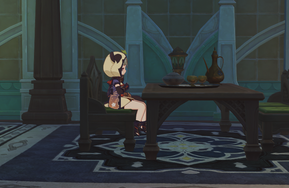 A sittable chair and a sleepy Sayu.
 As the leader of Mihomo, a company producing sittable chairs, Koji is encouraging cooperation to enlarge the scale of production pipeline. In order to guarantee the quality of cooperation, here are three requirements that the cooperation relations must satisfy:
There are $$$n$$$ employees in the company, including Koji himself. Koji considered it very important to make fair cooperation. The dice never lie, so he decided to roll some dice to decide the fair division. The procedure of the dice rolling is as follows:
Koji wrote a program of the above procedure in just $$$114$$$ seconds, but he finds that it had taken $$$514$$$ seconds until the program finished its execution. Since Koji is not good at counting numbers above nine, he wants you to help him calculate the expected number of iterations of the above procedure in order to decide if there is a potential bug in the program.
Input contains a single integer $$$n (1 \leq n \leq 200)$$$, the number of employees in Mihomo.
Print a single real number in decimal, denoting your answer.
Your answer will be considered correct, if the absolute error or relative error to the reference answer is less than $$$10^{-6}$$$.
To print a fixed decimal number for some digits after the decimal point, say, $$$9$$$ digits, you can use
1
0.000000000
2
2.000000000
3
8.250000000
For the first sample case, Koji can cooperate with nobody, so the program terminates immediately.
For the second sample case, either $$$\{(1, 2)\}$$$ or $$$\{(2, 1)\}$$$ will be the final $$$R$$$, and with probability $$$1/2$$$ invalid cooperation relations $$$(1, 1), (2, 2)$$$ can be obtained. Therefore, the expected number of iterations is $$$$$$1 \times (1/2) + 2 \times (1/4) + 3 \times (1/8) + \cdots = 2.$$$$$$
Relax. Let me tell you in the fastest pace what you need to do.
Give you a simple graph $$$G = (V, E)$$$ consisting of undirected edges. You need to tell me, what is the minimum number of edges should you add to the graph, resulting a simple graph containing at least one odd cycle and at least one even cycle.
A simple graph is a graph without multiple edges and self-loops, which means that each edge connects two different vertices and no two edges connect the same pair of vertices.
A cycle is a sequence of distinct vertices $$$\{v_1, v_2, \dots, v_k\}$$$, such that $$$(v_{i}, v_{i \bmod k + 1}) \in E$$$. The odd or even describes the parity of $$$k$$$. A smallest odd cycle is of length $$$3$$$, and a smallest even cycle is of length $$$4$$$.
The first line contains two integers $$$n, m ~ (1 \leq n \leq 10 ^ 5, 0 \leq m \leq \min \left\{2 \times 10 ^ 5, {n \choose 2}\right\})$$$, denoting the number of vertices ($$$|V|$$$) and the number of edges ($$$|E|$$$).
In the next $$$m$$$ lines, each line contains two integers $$$u, v ~ (1 \leq u, v \leq n, u \neq v)$$$, denoting that there are edges connecting vertices $$$u$$$ and $$$v$$$.
It's guaranteed that the input graph is a simple graph.
Print one integer in a single line, denoting your answer. If the mission is impossible, print '-1' instead.
3 3
1 2
2 3
1 3
-1
4 0
5
5 4
1 2
2 3
3 4
4 5
2
4 6
1 2
1 3
1 4
2 3
2 4
3 4
0
4 4
1 2
2 3
3 4
4 1
1
7 7
1 2
2 3
3 4
4 1
5 6
6 7
7 5
0
Here is one possible solution of sample 2. The contained odd cycles are $$$\{1, 2, 3\}$$$ and $$$\{1, 3, 4\}$$$, and the only even cycle is $$$\{1, 2, 3, 4\}$$$.

In League of Legends, Blast Cone is a type of plant with explosive fruit. Their explosive properties are powerful enough to fling a humanoid several meters away.
 Cryin used Blast Cone to speed up the movement of him and his teammates.
 Suppose your character is in the Summoner's Rift now. For simplicity,
There are $$$n$$$ rectangle barriers and $$$m$$$ Blast Cones. Now you start from the starting point $$$(x_s,\ y_s)$$$ and you want to reach the end point $$$(x_t,\ y_t)$$$. Your moving speed is $$$1$$$ unit length per second. Can you calculate the minimum time cost from starting point to end point?
The first line contains three integers $$$n, m, R~(0\le n,\ m\le 40,\ 1\le R\le 10^6)$$$, denoting the number of rectangle barriers, the number of Blast Cones and the jump radius, respectively.
In the following $$$n$$$ lines, the $$$i$$$-th line contains four integers $$$x^b_{i,1},\ y^b_{i,1},\ x^b_{i,2},\ y^b_{i,2}$$$ ($$$-10^6\le x^b_{i,1},\ y^b_{i,1},\ x^b_{i,2},\ y^b_{i,2}\le 10^6,\ \ x^b_{i,1} \lt x^b_{i,2},\ \ y^b_{i,1} \lt y^b_{i,2}$$$), which denotes the $$$i$$$-th barrier's bottom left corner is $$$(x^b_{i,1},\ y^b_{i,1})$$$ and its upper right corner is $$$(x^b_{i,2},\ y^b_{i,2})$$$.
In the following $$$m$$$ lines, the $$$i$$$-th line contains two integers $$$x^c_{i},\ y^c_{i}$$$ ($$$-10^6 \le x^c_i,\ y^c_i\le 10^6$$$), which denotes the $$$i$$$-th Blast Cone is at $$$(x^c_i,\ y^c_i)$$$.
The last line contains four integers $$$x_s,\ y_s,\ x_t,\ y_t$$$ ($$$-10^6 \le x_s,\ y_s,\ x_t,\ y_t\le 10^6$$$), denoting the starting point $$$s$$$ and the end point $$$t$$$.
It is guaranteed that:
Output a decimal real number in a single line, denoting the minimum time cost from starting point to end point. Your answer will be judged as correct, if the relative or absolute error between your answer and jury's answer is less than or equal to $$$10^{-6}$$$.
It's guaranteed that there are valid solutions by the given condition.
To print a fixed decimal number for some digits after the decimal point, say, $$$9$$$ digits, you can use
1 2 2
0 2 7 4
-3 3
8 2
1 1 6 6
9.543203767
The figure of the sample input is as follows:
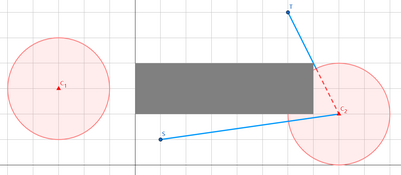
The answer is $$$\sqrt{7^2+1^2} + \sqrt{2^2+4^2} - 2 \approx 9.543203767$$$.
As you might know, people from the ancient always stick to the old form, like the famous Kong Yiji. The Competition Finance Officer from the great Qin dynasty – who chose the Hot Spring Hotel without cell phone signal and clean tap water for Easter Chicken Finals – always speaks in an odd manner. For example, whenever you present some facts to him that he is unwilling to see, he would shout out 'QFMYQ!!!!!! QFMYQ!!!!!! QFMYQ!!!!!!' (QFMYQ means violation of the right of reputation, and its Chinese pronunciation is 'qin fan ming yu quan').
The competition participants, known as Easter Chicken predators, understand statistics and probabilities well and use them as weapons. As other predators are practicing how to use randomness and constructions to kill the intermediate boss Hash, AntiLeaf, the No. 1 seed, is already planning to kill the final boss Easter Chicken. To do so, he wants to analyze the frequency of words spoken by the Finance Officer in order to imitate him by some machine learning tricks – something not ancient at all. After that, AntiLeaf can easily sneak into the arena without triggering warnings by imitating the Finance Officer, who considers the Easter Chicken his own property and wants to make money from it.
A sample sentence said by the Finance Officer can be represented by a string $$$s$$$ containing lowercase English letters. AntiLeaf has already selected $$$n$$$ lowercase English words $$$\{t_i\}$$$ as the dictionary of Finance Officer's classic quotes. For $$$t_i$$$, it has a corresponding value $$$v_i$$$, denoting how classic it is.
To predict the Finance Officer's behavior, AntiLeaf want to calculate the score of each prefix of $$$s$$$, which is defined as follows:
Since the answers may be very huge, you just need to output the answers modulo $$$998\,244\,353$$$.
The first line of input contains a string $$$s$$$ ($$$1\le |s| \le 2 \times 10^5$$$), which contains only lowercase English letters.
The second line contains a positive integer $$$n$$$, denoting the number of classical quotes.
In the following $$$n$$$ lines, the $$$i$$$-th line contains a lowercase English string $$$t_i$$$ ($$$1 \le |t_i| \le 2 \times 10^5$$$) and a positive integer $$$v_i$$$ ($$$0 \lt v_i \lt 998\,244\,353$$$), denoting the $$$i$$$-th classical word and the value of it.
It is guaranteed that all of $$$t_i$$$ are pairwise distinct, and the sum of their lengths does not exceed $$$2 \times 10^5$$$, and
Output $$$|s|$$$ numbers separated with spaces in a single line, the $$$i$$$-th of which represents the answer of the prefix of $$$s$$$ with length $$$i$$$, modulo $$$998\,244\,353$$$.
ababa
2
aba 2
ba 3
1 1 6 6 26
qfmyqqfmyqqfmyq
2
qfmyq 111111
myqq 404968002
1 1 1 1 111112 405079114 405079114
405079114 405079114 771912310
239058268 239058268 239058268
239058268 31169271
wwwsoupunetcom
2
money 999999
soup 998244352
1 1 1 1 1 1 0 0 0 0 0 0 0 0
Here is the explanation of the last answer of the first example. Let us denote the unused letters with dots, and different substrings are denoted by underlines and overlines.
The answer is $$$$$$(6 + 2 + 2 + 3 + 3 + 9 + 1) \bmod 998\,244\,353 = 26.$$$$$$
The second sample's output is wrapped for the convenience of printing, in real test data it contains no extra line breaks.
People rank for things. Yes, ranking is nothing for most of the time, except when you are doing year-end report to your boss.
Under the promotion of the construction of world-class universities, a lot of universities are struggling to improve ranking in every way. Publishing papers, applying for funds, improving diversity... They are too hard and your result may not be fairly judged by institutions like US News and Times! However, some universities are more clever – they publish their own rankings, which makes the ranking indirectly better. For example, using Shanghai Ranking's Academic Ranking of World Universities (ARWU) produced by Shanghai Jiao Tong University, Desprado2 can prove that his school is better than MIT.
 https://www.zizhengfang.com/applets/transitivity
 Anyway, that is a joke unless you are finding jobs and need to brag about your school. But at the same time, Desprado2 comes out a problem: assume there are $$$n$$$ universities in total, and he has collected $$$m$$$ university rankings. For simplicity, all the universities are denoted by a number from $$$1$$$ to $$$n$$$. Here, Desprado2 defines that university $$$x$$$ is directly better than university $$$y$$$, if and only if there exists a university ranking such that university $$$x$$$ ranks higher than university $$$y$$$. Furthermore, Desprado2 defines that university $$$x$$$ is better than university $$$y$$$, if and only if there exists a sequence $$$\{s_1,\ s_2,\ ...,\ s_k\}$$$ ($$$k\ge 2$$$), such that:
For each university, Desprado2 want you to tell him it is better than how many of other universities.
The first line contains two integers $$$n$$$ and $$$m$$$ ($$$1\le n\le 5\times 10^5$$$, $$$1\le m\le 5\times 10^5$$$, $$$1\le n\times m\le 10^6$$$), denoting the number of universities considered, and the number of university rankings.
Then follows $$$m$$$ lines. The $$$i$$$-th line contains $$$n$$$ distinct integers $$$s_{i,1},\ s_{i,2},\ ...,\ s_{i,n}$$$ ($$$1\le s_{i,j}\le n$$$), denoting the order of the $$$i$$$-th university ranking (from high to low).
Output one line with $$$n$$$ integers $$$a_1,a_2,\dots,a_n$$$, separated by spaces. The $$$i$$$-th number $$$a_i$$$ denotes the number of universities that university $$$i$$$ is better than.
4 2
1 2 3 4
1 3 2 4
3 2 2 0
4 2
1 2 3 4
4 3 2 1
3 3 3 3
5 2
5 4 3 2 1
5 4 3 2 1
0 1 2 3 4
Koji, the mathematician and philosopher, is hereby proving the statement that $$$$$$\Huge\text{9 \gt 10}$$$$$$ by the following solid proof.
Proof. We write down two numbers in decimal representation. $$$$$$\Large \underline{\texttt{9}}\texttt{.}$$$$$$ $$$$$$\Large \underline{\texttt{1}}\texttt{0}$$$$$$
Look at the first digit that they are different at! Since $$$9 \gt 1$$$, we proved that $$$9 \gt 10$$$. $$$Q.E.D.$$$
Again, you can easily use the same argument to prove $$$114\,514 \lt 1919$$$: $$$$$$\Large \texttt{1}\underline{\texttt{1}}\texttt{4514}$$$$$$ $$$$$$\Large \texttt{1}\underline{\texttt{9}}\texttt{19..}$$$$$$ and $$$9 \lt 999$$$: $$$$$$\Large \texttt{9}\underline{\texttt{.}}\texttt{.}$$$$$$ $$$$$$\Large \texttt{9}\underline{\texttt{9}}\texttt{9}$$$$$$
Wow, that is math! How logical it is! Now you have fully understood how the Koji compares two numbers. Write a program to compare two input numbers!
A single input line consists of two positive integers $$$a, b~(1 \leq a, b \leq 20\,220\,924)$$$ seperated by a single space, both are guaranteed without leading zeros.
Print a single line by the method of Koji Comparison,
9 10
9>10
114514 1919
114514<1919
9 999
9<999
99 99
99=99
2022 924
2022<924