


Lana and Alan are twins, and they study in the same school. One day, they were given homework in which they had to make up a word using given letters. As they didn't want to be considered cheaters, they wanted to make up words that differ at every position.
Given a string of lowercase English letters $$$A$$$, find two words $$$B$$$ and $$$C$$$ that use all these letters (in other words, they both must be an anagram of $$$A$$$), such that $$$B$$$ and $$$C$$$ contain different letters in each place. These words don't have to be actual words of any real-world language.
The input contains a string $$$A$$$, consisting of lowercase English letters. The length of $$$A$$$ is between $$$1$$$ and $$$1000$$$.
If an answer exists, print two lines containing words $$$B$$$ and $$$C$$$. Each word must be an anagram of $$$A$$$ (containing the same letters as $$$A$$$, possibly, in a different order). For each $$$i$$$ from $$$1$$$ to the length of $$$A$$$, $$$B_i$$$ must be different from $$$C_i$$$.
If it's impossible to make up such $$$B$$$ and $$$C$$$, print "IMPOSSIBLE". If there is more than one correct answer, you can print any of them.
| Subtask | Points | Constraints |
| 1 | 30 | All letters in $$$A$$$ are distinct |
| 2 | 30 | The length of $$$A$$$ does not exceed $$$10$$$ |
| 3 | 40 | No additional constraints |
nala
alan
lana
abacaba
IMPOSSIBLE
innopolisopen
noepsilonnopi
opinionnpoles
A prominent toy company Matryoshka Inc is going to launch a marketing campaign. They will invite participants to solve the following problem: there are $$$n$$$ matryoshkas in a row, numbered from $$$1$$$ to $$$n$$$, the $$$i$$$-th matryoshka's size is $$$s_i$$$. The participant's goal is to assemble a stack of matryoshkas using as many matryoshkas as possible. But, there is a restriction: they must create the stack using matryoshkas in order from left to right, from the smallest to largest (possibly, skipping some of them).
To begin, you can choose the first matryoshka, then select some other matryoshka with a larger index and strictly larger size, and then put the first matryoshka inside the second one. After this, you can select another matryoshka whose size and index are strictly larger than the size and index of previously selected matryoshkas, put the first two matryoshkas inside the third one, and so on. When you are done, your score is the number of matryoshkas used. In the case when you cannot put a matryoshka inside another one with a larger index, or if there is just one matryoshka, the score is considered to be equal to one.
Now the CEO of Matryoshka Inc is interested in the maximum score a participant can achieve. They sent you a message with $$$n$$$ numbers $$$s_1, \ldots, s_n$$$, but there were some connection issues. Instead of $$$n$$$ numbers $$$s_1, \ldots, s_n$$$, you received $$$n$$$ numbers $$$a_1, \ldots, a_n$$$, where $$$a_i$$$ is equal to $$$s_i$$$, but the digits were shuffled, possibly with leading zeroes.
There is very little time, so the CEO asks you to determine the maximum score a participant can achieve based only on $$$a_1, \ldots, a_n$$$. Recall that $$$a_i$$$ is a digit permutation of $$$s_i$$$, possibly with leading zeroes.
The first line contains the single integer $$$n$$$ ($$$1 \leq n \leq 1000$$$) — the number of matryoshkas.
The second line contains $$$n$$$ integers $$$a_1, \ldots, a_n$$$ ($$$0 \leq a_i \lt 10^{18}$$$). Each integer $$$a_i$$$ has at most $$$18$$$ digits, possibly, with leading zeroes.
Output a single integer — the maximum possible score that a participant can theoretically achieve.
Let's define $$$L$$$ as the maximum length of an input number $$$a_i$$$.
| Subtask | Points | Constraints |
| 1 | 12 | $$$n \le 3$$$ |
| 2 | 8 | $$$n \le 18$$$ |
| 3 | 9 | $$$L = 1$$$ |
| 4 | 17 | $$$L \le 3$$$ |
| 5 | 26 | $$$n \le 200, 1 \le L \le 8$$$ |
| 6 | 28 | No additional constraints |
2
1 1
1
5
10 2 30 4 50
5
6
77 88 91 22 33 44
4
3
390100 200200 012
3
Let's consider the first example. In that case, you have only two matryoshkas of equal sizes. It means that you can not put any matryoshka inside the other one. So, the answer for the first example is $$$1$$$.
Lets's consider the second example. Theoretically, the sequence of the matryoshka's sizes could be $$$01$$$, $$$2$$$, $$$03$$$, $$$4$$$, $$$05$$$. In that case, a participant could achieve a score equal to $$$5$$$. So, the answer for the second example is $$$5$$$.
Let's consider the third example. There are only two ways the real sequence of matryoshka's sizes could look like. The first one is $$$77$$$, $$$88$$$, $$$91$$$, $$$22$$$, $$$33$$$. And the second one is $$$77$$$, $$$88$$$, $$$19$$$, $$$22$$$, $$$33$$$. It's easy to see that in the first case, the maximum score that the participant can achieve equals $$$3$$$, but in the second case, the maximum score that the participant can achieve equals $$$4$$$. So, the answer for the third example is $$$4$$$.
Let's consider the fourth example. There is a scenario where the sequence of the matryoshka's sizes is $$$000139$$$, $$$000202$$$, $$$210$$$. So, participant could assemble a stack of three matryoshkas. So, the answer for the forth example is $$$3$$$.
Andrey got a cool new lock for his birthday. You can set several passwords on it at the same time; when you enter any of them, the lock opens.
The lock consists of a sequence of cells, each has an integer written on it. You can swap places of any two cells any number of times; when they are arranged in any correct order, the lock opens. The order is considered correct when the sum of two integers on any pair of adjacent cells is not divisible by $$$k$$$.
You found out about the structure of this lock and, of course, decided to try to open it. Given the numbers on the cells and the value of $$$k$$$, find the permutation of cells that opens the lock.
The first line of the input contains two integers $$$n$$$ and $$$k$$$ ($$$1 \le n \le 10^5$$$, $$$1 \le k \le 10^9$$$) — the number of cells on the lock and the number $$$k$$$.
The second line of the input contains $$$n$$$ integers $$$a_i$$$ ($$$1 \le a_i \le 10^9$$$) — the initial configuration of cells on the lock.
If there is no suitable permutation of cells, print "NO" (without quotes, case insensitive) on the first line.
If a suitable permutation of cells exists, print "YES" (no quotes, case insensitive) on the first line. In the second line, print $$$n$$$ integers — the permutation itself.
| Subtask | Points | Constraints |
| $$$1$$$ | $$$8$$$ | $$$n \le 8$$$ |
| $$$2$$$ | $$$8$$$ | $$$k = 2$$$ |
| $$$3$$$ | $$$8$$$ | $$$k = 3$$$ |
| $$$4$$$ | $$$8$$$ | $$$n = k$$$; numbers $$$a_i$$$ are distinct and are between $$$1$$$ and $$$n$$$ |
| $$$5$$$ | $$$25$$$ | $$$k$$$ is odd |
| $$$6$$$ | $$$43$$$ | No additional restrictions |
3 4
1 3 2
YES
1 2 3
5 4
1 2 2 2 4
YES
2 4 2 1 2
Consider an infinite sequence of integers $$$a_1, a_2, a_3, \ldots$$$. The sequence is called a self-describing if $$$a_i$$$ is equal to the number of occurrences of $$$i$$$ in this sequence.
If we restrict this sequence to satisfy $$$a_1 = 1$$$ and the numbers a non-decreasing (that is, $$$a_i \le a_{i+1}$$$ for all $$$i$$$), then the self-describing sequence is unique. The first thirty elements are as follows:
$$$$$$ 1, 2, 2, 3, 3, 4, 4, 4, 5, 5, 5, 6, 6, 6, 6, 7, 7, 7, 7, 8, 8, 8, 8, 9, 9, 9, 9, 9, 10, 10, \ldots $$$$$$
Your task is to calculate the range sum queries for this sequence efficiently. Let's go!
The first line contains an integer $$$t$$$ ($$$1 \le t \le 10^4$$$) — the number of range sum queries. The following $$$t$$$ lines contains two integers $$$l_i$$$ and $$$r_i$$$ ($$$1 \le l_i \le r_i \le 10^{15}$$$) each. The $$$i$$$-th query requires you to calculate $$$\sum_{k=l_i}^{r_i} a_k$$$.
Print $$$t$$$ lines, each one with a single integer — the answer to the range sum query. Because the sum can be large, print it modulo $$$1\,000\,000\,007$$$.
| Subtask | Points | Constraints |
| 1 | 12 | $$$l_i = r_i$$$; $$$r_i \le 1000$$$ |
| 2 | 7 | $$$l_i = r_i$$$; $$$r_i \le 10^6$$$ |
| 3 | 8 | $$$r_i \le 10^6$$$ |
| 4 | 30 | $$$r_i \le 10^{10}$$$ |
| 5 | 43 | No additional constraints |
5
1 1
2 2
3 4
56 56
5 13
1
2
5
14
42
Testing hypotheses and theories is an integral part of the scientific process. One of the most essential questions in evolutionary biology is studying the history of how the species developed; when and how the species evolution diverged into new species. In this problem, you will evaluate the difference between two evolutionary hypotheses, represented as trees.
The evolutionary history of $$$n$$$ modern species can be represented as a binary tree with $$$n$$$ leaves corresponding to those $$$n$$$ species. Each internal vertex corresponds to an extinct species that, at some point in time, had diverged into two other species. The root of this tree is a hypothetical "primordial" species, a predecessor to all modern species. The leaves are numbered from $$$1$$$ to $$$n$$$; the other vertices have numbers from $$$n + 1$$$ to $$$2n - 1$$$. The vertex $$$2n - 1$$$ is the root of the tree.
To compare two evolutionary theories, scientists use different metrics, one of them is called "triplet distance". Consider three different modern species (leaves in the tree). Go up the evolutionary tree from those species and find two species where these three modern species diverged. For three modern species $$$A$$$, $$$B$$$, and $$$C$$$, there are, essentially, three different evolutionary structures (shown in the picture below): the common ancestor split into one species that then evolved into $$$A$$$ and $$$B$$$, and another one, that eventually evolved into $$$C$$$. Similarly, there are two more structures with different partitions. We'll say that, for a given triple $$$(A, B, C)$$$, its history is different in two theories if these basic structures differ. Shown below are the three different historic structures for the three modern species. Every edge in the picture might be a chain of multiple intermediate species.
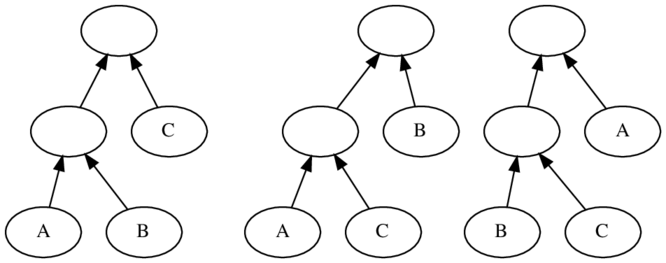
Find the number of triples of modern species with different historic structures in the two given evolutionary trees.
The first line contains one integer $$$n$$$ ($$$3 \le n \le 50\,000$$$) — the number of modern species (also the number of leaves in the tree). Then, two lines describing the trees follow.
Each tree is represented as an array of parents of length $$$2n - 2$$$: for every vertex $$$i$$$ from $$$1$$$ to $$$2n - 2$$$, you are given the number of its parent in the tree $$$\t{parent[}i\t{]} \gt i$$$. Vertex number $$$2n - 1$$$ is the root of the tree. It's guaranteed that the vertices $$$1$$$ to $$$n$$$ are leaves, and they don't appear as values in the parent array. It is also guaranteed that the tree is a binary tree: each internal vertex has a number from $$$n + 1$$$ to $$$2n - 1$$$ and has exactly two children (that is, all these values appear exactly twice in the parent array).
Print a single integer — the number of triples of species with different evolutionary histories.
| Subtask | Points | Constraints |
| 1 | 25 | $$$n \le 50$$$ |
| 2 | 10 | $$$n \le 200$$$ |
| 3 | 20 | $$$n \le 2000$$$ |
| 4 | 45 | No additional constraints |
5
6 9 7 6 7 8 8 9
6 9 7 7 6 8 8 9
4
5
8 7 7 6 6 8 9 9
7 8 6 9 6 7 8 9
8
These are the two trees from the first example:

Triples with different evolutionary histories: $$$(1, 3, 4), (1, 3, 5), (1, 4, 5), (3, 4, 5)$$$.
The second example:

There are 8 different triples: $$$(1, 2, 3), (1, 2, 4), (1, 3, 4), (1, 3, 5), (1, 4, 5), (2, 3, 5), (2, 4, 5), (3, 4, 5)$$$.