


How to solve?
| № | Пользователь | Рейтинг |
|---|---|---|
| 1 | Benq | 3792 |
| 2 | VivaciousAubergine | 3647 |
| 3 | Kevin114514 | 3603 |
| 4 | jiangly | 3583 |
| 5 | strapple | 3515 |
| 6 | tourist | 3470 |
| 7 | dXqwq | 3436 |
| 8 | Radewoosh | 3415 |
| 9 | Otomachi_Una | 3413 |
| 10 | Um_nik | 3376 |
| Страны | Города | Организации | Всё → |
| № | Пользователь | Вклад |
|---|---|---|
| 1 | Qingyu | 158 |
| 2 | adamant | 152 |
| 3 | Um_nik | 146 |
| 4 | Dominater069 | 144 |
| 5 | errorgorn | 141 |
| 6 | cry | 139 |
| 7 | Proof_by_QED | 136 |
| 8 | YuukiS | 135 |
| 9 | chromate00 | 134 |
| 9 | TheScrasse | 134 |


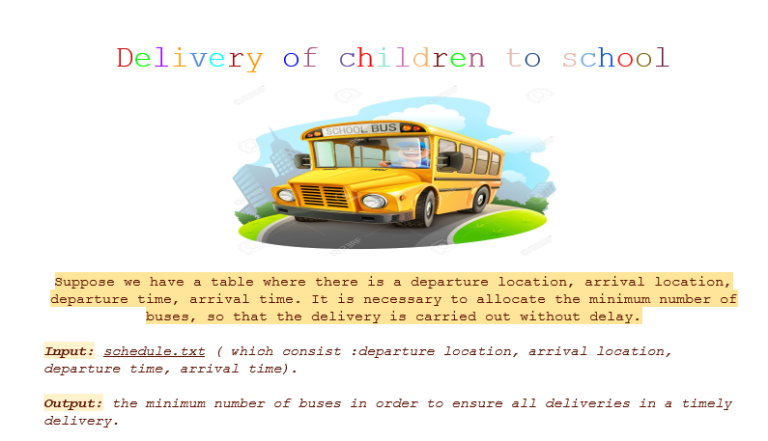
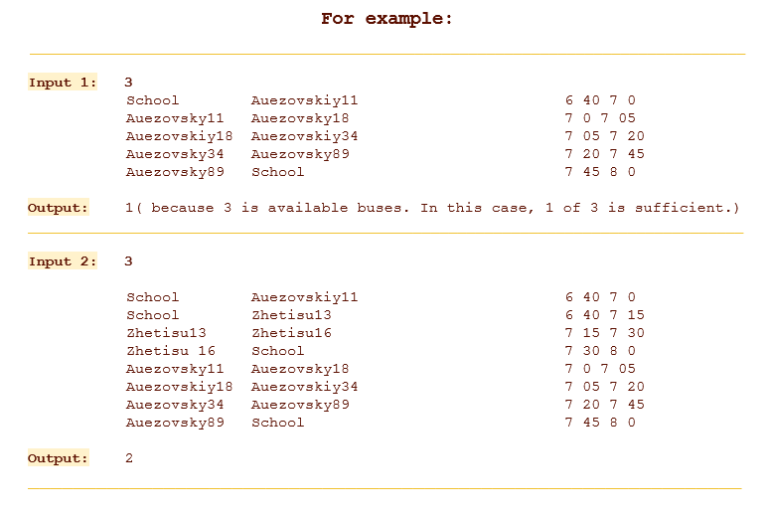
I don't think this is a min-flow max cut problem...
Yes, because min flow can be solved in O(1).
You can frame it as one, I believe. I think you can reduce it to the following problem:
You are given $$$n$$$ boxes of varying dimensions $$$l_i \times w_i \times h_i$$$, and we say that box $$$i$$$ can be nested in box $$$j$$$ iff $$$l_i \lt l_j$$$, $$$w_i \lt w_j$$$, and $$$h_i \lt h_j$$$. You can stack nesting, i.e. if box $$$i$$$ can be nested in box $$$j$$$ and box $$$j$$$ in box $$$k$$$, then, you can nest $$$i$$$ into $$$j$$$ and $$$j$$$ into $$$k$$$, meaning neither box $$$i$$$ nor box $$$j$$$ is visible anymore. Given our $$$n$$$ boxes, we want to nest the boxes in such a way to reduce the total number of visible boxes.
The above problem appeared on my algorithms homework, and the solution used max flow.
I think the solution is cool but I don't actually want to write it, because I'm still not convinced that this problem isn't OP's homework problem (he posted it before with a download link to the image, and it was called "Assignment7.pdf").