


Recently one of my friends shared this problem with me. I really found this beautiful and thought of giving it a share.I won't spoil the essence of this problem, but definitely expecting some nice approaches and solutions in the comment.
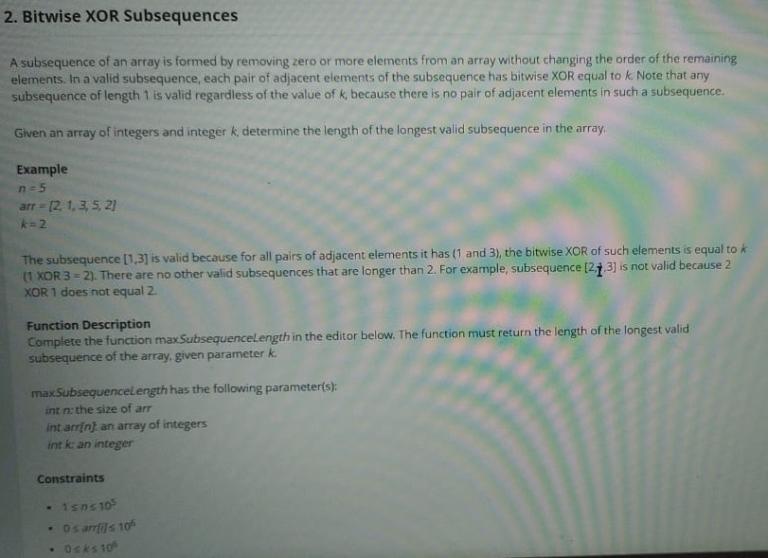


Recently one of my friends shared this problem with me. I really found this beautiful and thought of giving it a share.I won't spoil the essence of this problem, but definitely expecting some nice approaches and solutions in the comment.
| № | Пользователь | Рейтинг |
|---|---|---|
| 1 | Benq | 3792 |
| 2 | VivaciousAubergine | 3647 |
| 3 | Kevin114514 | 3603 |
| 4 | jiangly | 3583 |
| 5 | turmax | 3559 |
| 6 | tourist | 3541 |
| 7 | strapple | 3515 |
| 8 | ksun48 | 3461 |
| 9 | dXqwq | 3436 |
| 10 | Otomachi_Una | 3413 |
| Страны | Города | Организации | Всё → |
| № | Пользователь | Вклад |
|---|---|---|
| 1 | Qingyu | 157 |
| 2 | adamant | 153 |
| 3 | Um_nik | 147 |
| 4 | Proof_by_QED | 146 |
| 5 | Dominater069 | 145 |
| 6 | errorgorn | 141 |
| 7 | cry | 139 |
| 8 | YuukiS | 135 |
| 9 | TheScrasse | 134 |
| 10 | chromate00 | 133 |


Auto comment: topic has been updated by cryo_coder123 (previous revision, new revision, compare).
dp[i] = the longest subsequence from the first i element which has the condition (xor = k) and the last element in the subsequence is arr[i]. then dp[i] = dp[last (arr[i] ^ k)] + 1, and you can save what is the last x.
First if k=0 we can see the answer is the frequency of the element which occurs maximum number of times in the array. Else we can do the following:
First keep track of vector of positions of each element in the array. It is easy to see that the required subsequence must be of the form [x, x^k, x, x^k.....] for some 1<=x<=10^6. So just brute force for each possible value of x and greedily check the subsequence with maximum length we can obtain by using the vector of positions for x and x^k.
Time complexity: O(10^6) + O(n)
Ya did the same thing... have a look at my piece of code