rewhile's blog

By rewhile, 12 months ago, In English

This blog will compile a list of codeforces issues along with all the times Mike has ignored complaints about them

1. Unreasonable delay for viewing submissions [+973]

No MikeMirzayanov reply

2. Cloudflare misconfiguration [+1232]

Posted CF should rename itself to Cloudflare instead of Codeforces by nor

No MikeMirzayanov reply, nor has since deleted all of their blogs on codeforces

3. IP ban + blocked by the administrator [+105]

Happens right after the DDOS of Codeforces Round 1010 (Div. 1, Unrated), I myself also couldn't login that day


No MikeMirzayanov reply, silent fix (+ one extra cloudflare page on login)
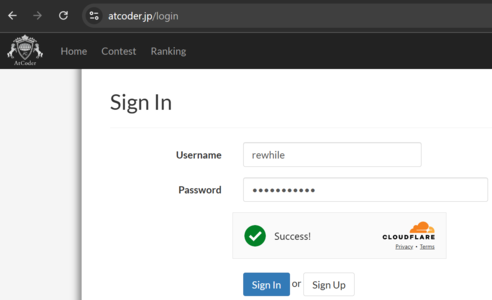
What's up with this abomination of cloudflare usage? I think https://atcoder.jp/login is more reasonable:
4. Recently, your account was used to crawl [+105]

djm03178's account also got flagged as crawling bot for joining codeforces educational round hacking phase

No MikeMirzayanov reply, radio silent as always

5. Hacking issues

Couldn't hack today by sorry12000 where he couldn't get points hacking A

This also affected dorijanlendvaj. 2 years later he lost 50 points due to an interactor bug but offered no rejudge

No MikeMirzayanov reply

6. API issues

If you've used a rating predictor, for example carrot (40000 users as of April 2025)

You might have noticed that it doesn't work for a long period of time. This is because Mike enabled cloudflare even for apis during contest, which got a workaround in meooow25/carrot#67

It worked for a while again until he started to take down the user.ratedList api during contest too:

MikeMirzayanov did make a comment about this api 3 years ago. However, it seems like there was no further communication.

∞. The list could stop here

Despite almost graduating from university, when I type c in browser it autocompletes to codeforces.com instead of chatgpt.com

It is not unreasonable to ask for accountability when CF has become the de-facto competitive programming community website.

Full text and comments »

  • Vote: I like it
  • +770
  • Vote: I do not like it

By rewhile, 14 months ago, In English
  • Vote: I like it
  • +219
  • Vote: I do not like it

By rewhile, 7 years ago, In English

Original post : [Tutorial] Sack (dsu on tree)

In this post, I am trying to explain every line of dsu on tree code.

The reason is the same as blog 51139 when I first learn it.

How many vertices in the subtree of vertex v has some property in $$$O(n \ log \ n)$$$ time (for all of the queries)?

For example:

Given a tree, every vertex has a color. The query is how many vertices in the subtree of vertex v are colored with color c?

First, calculate the size of the subtree of every vertex, it can be done with a single dfs $$$(sz[v] = v + all(sz[child \ of \ v]))$$$

void dfs_size(int v, int p) {
	sz[v] = 1;
	for (auto u : adj[v]) {
		if (u != p) {
			dfs_size(u, v);
			sz[v] += sz[u];
		}
	}
}

Code:

void dfs(int v, int p, bool keep) {
	int Max = -1, bigchild = -1;
	for (auto u : adj[v]) {
		if (u != p && Max < sz[u]) {
			Max = sz[u];
			bigchild = u;
		}
	}
	for (auto u : adj[v]) {
		if (u != p && u != bigchild) {
			dfs(u, v, 0);
		}
	}
	if (bigchild != -1) {
		dfs(bigchild, v, 1);
		swap(vec[v], vec[bigchild]);
	}
	vec[v].push_back(v);
	cnt[color[v]]++;
	for (auto u : adj[v]) {
		if (u != p && u != bigchild) {
			for (auto x : vec[u]) {
				cnt[color[x]]++;
				vec[v].push_back(x);
			}
		}
	}
	// there are cnt[c] vertex in subtree v color with c
	if (keep == 0) {
		for (auto u : vec[v]) {
			cnt[color[u]]--;
		}
	}
}

Explanation :

$$$cnt[c]$$$ in $$$dfs(v)$$$ will be answered for query in vertex v with the color c

each time we do dfs in the subtree of v, we will keep all nodes in the subtree of v in $$$vec[v]$$$,

update information (color count for each node) from subtree child while adding a node to $$$vec[v]$$$.

boolean keep denote if we are working on the subtree of $$$bigchild \ (keep = 1)$$$ or $$$smallchild \ (keep = 0)$$$

void dfs(int v, int p, bool keep)

let say we are at subtree v

int Max = -1, bigchild = -1;
for (auto u : adj[v]) {
	if (u != p && Max < sz[u]) {
		Max = sz[u];
		bigchild = u;
	}
}

First, we will find a big child using pre-calc $$$sz[u]$$$.

Note that the big child of vertex v is the child with max subtree size

for (auto u : adj[v]) {
	if (u != p && u != bigchild) {
		dfs(u, v, 0);
	}
}

if (bigchild != -1) {
	dfs(bigchild, v, 1);
	swap(vec[v], vec[bigchild]);
}

then call recur for small child $$$(keep = 0)$$$ then big child $$$(keep = 1)$$$

then : $$$vec[v] = vec[big \ child] + v + all(vec[small \ child])$$$

obviously, $$$vec[big \ child]$$$ and $$$vec[small \ child]$$$ are calculated before

because we only care about current subtree, we can swap $$$vector[big \ child]$$$ and $$$vector[v]$$$

so that $$$vector[v]$$$ have bigchild information. The complexity of swap vector is $$$O(1)$$$

and current cnt array contain only bigchild information (read $$$if(keep == 0)$$$ explain part below)

$$$vec[v] = vec[big \ child]$$$

vec[v].push_back(v);
cnt[color[v]]++;

next, add information of vertex v.

$$$vec[v] = vec[big \ child] + v$$$

for (auto u : adj[v]) {
	if (u != p && u != bigchild) {
		for (auto x : vec[u]) {
			cnt[color[x]]++;
			vec[v].push_back(x);
		}
	}
}

$$$vec[v] = vec[big \ child] + v + all(vec[small \ child])$$$

now that $$$vec[v]$$$ is full fill, add small child to $$$vec[v]$$$ and update cnt array also

(keep in mind that bigchild information didn't get deleted so that we only need to add small child)

if (keep == 0) {
	for (auto u : vec[v]) {
		cnt[color[u]]--;
	}
}

go down to small child, we have to delete its information about color count so that

the query answer of v's first child subtree won't affect second and so on. (because we are using global array)

That is also the reason why we have to call small child before big child recur

(to make bigchild and small child answer not overlap)

Note:

this answer doubt in the comment, feel free to ask

cnt is a global array

we process small child first clear them from the global array, solve big child then add all small child again

Because some problems like count distinct values in subtree can't be solved if we have a contribution

from other nodes when we are at some node only it's subtree children data must be in the global array

we need to have separate information for big and small children.

we can't just work in a single entity because of the time complexity otherwise it will be $$$O(n^2)$$$, see prove below

Complexity?

for (auto u : adj[v]) {
	if (u != p && u != bigchild) {
		for (auto x : vec[u]) {
			cnt[color[x]]++;
			vec[v].push_back(x);
		}
	}
}

add small child took $$$O(n \ log \ n)$$$ overall. why?

let call $$$y = vec[big \ child].size, \ x = vec[small \ child].size \ (y \geq x)$$$

let consider a vertex u $$$(1 \leq u \leq n)$$$

merge it to the bigger child so the size of vec[] of the subtree contain u

becomes $$$x + y \geq x + x = 2x$$$. So each time we merge to parent subtree

the size increase at least twice when adding and total size is only n so

we cannot add a node more than $$$log(n)$$$ time

we have n vertex u so the complexity becomes $$$O(n \ log \ n)$$$

if (keep == 0) {
	for (auto u : vec[v]) {
		cnt[color[u]]--;
	}
}

because we only deleting information of subtree when $$$keep = 0$$$ (small subtree)

which is the same as when we add it (now delete instead of add) so the complexity is $$$O(n \ log \ n)$$$

so overall complexity is $$$O(n \ log \ n)$$$

Example:

600E - Lomsat gelral

solution

Practice:

visit original blog :>

Full text and comments »

  • Vote: I like it
  • +100
  • Vote: I do not like it