


King Triton really likes watching sport competitions on TV. But much more Triton likes watching live competitions. So Triton decides to set up a swimming competition in the kingdom Merfolk. Thousands of creatures come to take part in competition, that’s why it is too difficult to take the first place. For the King’s beloved daughter Ariel this competition is the first in her life. Ariel is very kind, so she wants to give a lot of gold medals. Ariel says, that it is unfair to make a single ranking list for creatures that are so different. It is really a good result to be the fastest small fish without tail in Merfolk! Ariel chooses k important traits (such as size, tailness, rapacity and so on). A creature can either possess a trait or not (there are no intermediate options). A score is given for each creature (it doesn’t matter how it was calculated) and the list of possessed traits f1, ..., fy is also given. Ariel wants to know the place occupied by creature a in a competition among creatures, who have the same traits h1, ..., ht. So if creature a doesn’t have a trait hi, then all creatures in the competition are without this trait. If creature a has a trait hi, then all creatures in the competition have this trait. Other traits doesn’t matter. The winner of the competition is a creature with the maximum score.
The first line contains n (1 ≤ n ≤ 104) and k (1 ≤ k ≤ 10). The next n lines contain information about creatures: score (1 ≤ score ≤ 109), y (0 ≤ y ≤ k) — the number of possessed traits, and y numbers fi (1 ≤ fi ≤ k) — ids of possessed traits. All fi in one line are different. The next line contains m (1 ≤ m ≤ 105) — the number of queries from Ariel. The next m lines describe queries: a (1 ≤ a ≤ n) — the id of a creature, then t — the number of traits, then t numbers hi. All hi in one line are different.
For each query output the place of a creature a in ranking list amount the corresponded creatures. If several creatures have the same score all of them take the same place.
3 2
100 1 1
50 1 2
30 2 1 2
12
1 2 1 2
1 1 1
1 1 2
1 0
2 0
2 1 1
2 1 2
2 2 2 1
3 0
3 2 1 2
3 1 2
3 1 1
1
1
1
1
2
1
1
1
3
1
2
2
3 2
100 0
10 0
100 0
3
1 0
2 0
3 0
1
3
1
Finally, Megamind has devised the perfect plan to take down his arch-nemesis, Metro Man! Megamind has designed a pair of circular power bracelets to be worn on his left and right wrists. On each bracelet, he has inscribed a sequence of magical glyphs (symbols); each activated glyph augments Megamind’s strength by the might of one grizzly bear!
However, there’s a catch: the bracelets only work when the subsequences of glyphs activated on each bracelet are identical. For example, given a pair of bracelets whose glyphs are represented by the strings “metrocity” and “kryptonite”, then the optimal activation of glyphs would give Megamind the power of 10 grizzly bears:
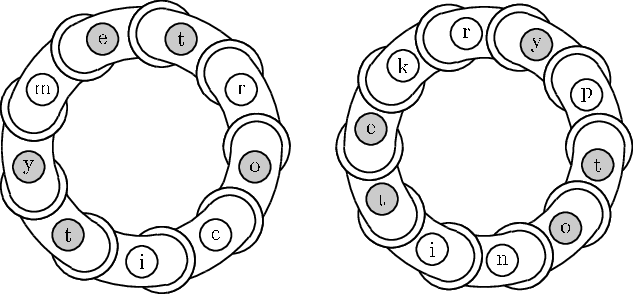
On the first bracelet, the letters “etoty” are activated in clockwise order; the same letters are activated in counterclockwise order on the second bracelet. Generally, the ordering of the letters is important, but the orientation of the activated subsequence on each bracelet (i.e., clockwise or counterclockwise) may or may not be the same—and don’t forget that the bracelets are circular!
Help Megamind defeat Metro Man by determining the optimal subsequences of glyphs needed to activate his bracelets.
The input file will contain one space-separated pair of strings s and t, corresponding to the sequences of glyphs on Megamind’s left and right power bracelets, respectively. Each string will consist of only lowercase letters (‘a’-‘z’). The length of each input string will be between 1 and 1500 characters, inclusive.
Print a single integer: the maximum power (in units of grizzly bears) that Megamind will be able to achieve by activating glyphs on his bracelets.
metrocity kryptonite
10
megamind agemdnim
16
metroman manmetro
16
megamindandmetroman metromanandmegamind
32
Farmer John and Bessie have devised a new exercise game for the cows. The cows are running on a circular track of length M (2 ≤ M ≤ 109) starting from the same position. The game proceeds in N (1 ≤ N ≤ 14) rounds using a deck of 8N cards each with a number Xi (0 ≤ Xi < M) written on it.
Each round FJ moves the top 8 cards into a separate pile and selects either the top 4 or bottom 4 cards for Bessie to play with. Bessie then chooses either the top 2 cards or bottom 2 cards of the 4 cards FJ selected. After this FJ calls out the number on the top card, Xtop, and the cows run a distance of R·Xtop, where R is the total distance the cows have run so far. Bessie then calls out the number on the bottom card, Xbottom, and the cows run a distance of Xbottom.
FJ is concerned that after the exercise the cows will be too tired to get back to the beginning of the track if they end up too far away. He believes if the cows end up more than a distance of K (0 ≤ K ≤ ⌊ M / 2⌋) from their starting position they won't be able to get back home.
It is guaranteed that if FJ plays correctly, he will always be able to ensure the cows can come home, irrespective of the moves made by Bessie! For each round, your task is to determine which half of the cards FJ should choose such that no matter what Bessie does from that point on, FJ can always get the cows home. Bessie will then make the move provided in the input and you can then continue onto the next round. Note that even though Bessie's moves are provided to you in the input, you are to specify moves for FJ that would have worked no matter what Bessie chooses (so it is effectively as if FJ does not really know what Bessie will do during her moves).
Line 1: Three space-separated integers N, M, K
Line 2: A string of N characters. If the i-th character is 'T', it means Bessie will select the top 2 cards in the i-th round. Otherwise, the i-th character will be 'B' to indicate Bessie will select the bottom 2 cards in the i-th round.
Lines 3..N + 2: Each line contains eight integers representing the 8 cards to be used that round from top to bottom.
A string of N characters where the i-th character is 'T' if FJ should choose the top 4 cards or 'B' if FJ should choose the bottom 4 cards in the ith round. If there are multiple ways to get the cows home, choose the lexicographically first (that is, the string that is alphabetically smallest).
2 2 0
TT
1 0 0 0 0 0 0 1
0 1 1 1 0 0 1 0
TB
The cows must end up exactly where they started to be able to come home. Note that FJ is not aware of what choices Bessie is going to make beforehand. If FJ did know, he could have chosen the bottom half each time.
You are given a set of N vectors, each vector consists of K integers. Vector X is equivalent to Y (denoted X ≡ Y) iff there exist a bijection  and an integer r, such that
  for each i in the range [0..K - 1].
For example, (1, 2, 2, 3) ≡ (22, 3, 4, 22), with r = 2 and f(22) = 2, f(3) = 3 and f(4) = 1. But (22, 3, 22, 4) is not equivalent to (1, 2, 2, 3).
How many pairwise nonequivalent vectors are there in a given set of N vectors?
First number contains T (T ≤ 10), number of test cases. Each test case consists of the following. First line consists of N and K (1 ≤ N ≤ 10000, 1 ≤ K ≤ 100). N lines follow, the i-th containing K integers describing the i-th vector. The vector values are from the range [0, 109].
Output one number: the number of different vectors.
2
3 4
22 3 4 22
1 2 2 3
22 3 22 4
5 5
3 3 3 0 3
8 4 4 4 0
1 1 1 1 1
1 1 8 6 1
1 3 3 3 5
2
3
You are given two non-empty strings S and T of equal lengths. S contains the characters 0, 1 and ?, whereas T contains 0 and 1 only. Your task is to convert S into T in minimum number of moves. In each move, you can:
1. change a 0 in S to 1
2. change a ? in S to 0 or 1
3. swap any two characters in S
As an example, suppose S = 01??00 and T = 001010. We can transform S into T in 3 moves:
• Initially S = 01??00
• Move 1 – change S[2] to 1. S becomes 011?00
• Move 2 – change S[3] to 0. S becomes 011000
• Move 3 – swap S[1] with S[4]. S becomes 001010
• S is now equal to T
The first line of input is an integer C (C ≤ 200) that indicates the number of test cases. Each case consists of two lines. The first line is the string S consisting of ‘0’, ‘1’ and ‘?’. The second line is the string T consisting of ‘0’ and ‘1’. The lengths of the strings won’t be larger than 100.
For each case, output the case number first followed by the minimum number of moves required to convert S into T. If the transition is impossible, output - 1 instead.
3
01??00
001010
01
10
110001
000000
Case 1: 3
Case 2: 1
Case 3: -1
Mislav and Marko have devised a new game, creatively named Rotate. First, Marko imagines a number sequence of length N and divides it into sections, with each section containing K numbers (K evenly divides N). The first section contains numbers in the first K positions in the sequence, the second section the following K positions, and so on.
Then, Marko asks Mislav to apply a number of operations on the sequence, with each operation being one of the following two types:
Notice that an operation of type 2 can change the numbers belonging to each section. After applying all the operations, Mislav reveals the final sequence to Marko. Marko's task is finding Mislav's starting sequence. He has asked you for help.
The first line of input contains three positive integers: N (1 ≤ N ≤ 105), the length of the sequence, K (1 ≤ K ≤ 105), the size of each section, and Q (1 ≤ Q ≤ 105), the number of operations.
Each of the following Q lines contains two integers: A (1 ≤ A ≤ 2), the operation type, and X ( - 105 ≤ X ≤ 105), the number of positions to rotate by. A negative number represents rotation to the left, while a positive one represents rotation to the right.
The last line of input contains N space-separated integers Zi (0 ≤ Zi ≤ 105) representing the final sequence (after applying all operations).
The first and only line of output must contain the required starting sequence.
4 2 2
2 2
1 1
3 2 1 0
0 1 2 3
8 4 4
1 3
1 15
1 -5
2 -1
6 10 14 19 2 16 17 1
6 10 14 1 2 16 17 19
9 3 5
1 1
2 -8
2 9
1 1
2 -4
3 1 8 7 4 5 2 6 9
5 3 6 9 7 1 8 2 4
Clarification of the first example: the starting sequence is 0 1 2 3. After the first operation, the sequence is 2 3 0 1, and after the second operation, it becomes 3 2 1 0. Ths corresponds to the final sequence.
You are given a sequence A consisting of N integers. We will call the i-th element good if it equals the sum of some three elements in positions strictly smaller than i (an element can be used more than once in the sum).
How many good elements does the sequence contain?
The first line of input contains the positive integer N (1 ≤ N ≤ 5000), the length of the sequence A.
The second line of input contains N space-separated integers representing the sequence A ( - 105 ≤ Ai ≤ 105).
The first and only line of output must contain the number of good elements in the sequence.
2
1 3
1
6
1 2 3 5 7 10
4
3
-1 2 0
1
The island nation of Flatopia is perfectly flat. Unfortunately, Flatopia has a very poor system of public highways. The Flatopian government is aware of this problem and has already constructed a number of highways connecting some of the most important towns. However, there are still some towns that you can't reach via a highway. It is necessary to build more highways so that it will be possible to drive between any pair of towns without leaving the highway system.
Flatopian towns are numbered from 1 to N and town i has a position given by the Cartesian coordinates (xi, yi). Each highway connects exactly two towns. All highways (both the original ones and the ones that are to be built) follow straight lines, and thus their length is equal to Cartesian distance between towns. All highways can be used in both directions. Highways can freely cross each other, but a driver can only switch between highways at a town that is located at the end of both highways.
The Flatopian government wants to minimize the cost of building new highways. However, they want to guarantee that every town is highway-reachable from every other town. Since Flatopia is so flat, the cost of a highway is always proportional to its length. Thus, the least expensive highway system will be the one that minimizes the total highways length.
The input consists of two parts. The first part describes all towns in the country, and the second part describes all of the highways that have already been built.
The first line of the input contains a single integer N (1 ≤ N ≤ 750), representing the number of towns. The next N lines each contain two integers, xi and yi separated by a space. These values give the coordinates of ith town (for i from 1 to N). Coordinates will have an absolute value no greater than 10000. Every town has a unique location.
The next line contains a single integer M (0 ≤ M ≤ 1000), representing the number of existing highways. The next M lines each contain a pair of integers separated by a space. These two integers give a pair of town numbers which are already connected by a highway. Each pair of towns is connected by at most one direct highway.
Write to the standard output a single line for each new highway that should be built in order to connect all towns with minimal possible total length of new highways. Each highway should be presented by printing town numbers that this highway connects, separated by a space.
If no new highways need to be built (all towns are already connected), then the output should be empty.
9
1 5
0 0
3 2
4 5
5 1
0 4
5 2
1 2
5 3
3
1 3
9 7
1 2
1 6
4 9
5 7
8 3
7 3
Given an n × m rectangular tile with each square marked with one of the letters W, I, and N, find the maximal number of triominoes that can be cut from this tile such that the triomino has W and N on the ends and I in the middle (that is, it spells WIN in some order). Of course the only possible triominoes are the one with three squares in a straight line and the L-shaped ones, and the triominoes can't overlap.
First line contains two integers n and m with 1 ≤ m, n ≤ 22. The next n lines contain m characters each (only the letters W, I and N).
Output a single integer: the maximum number of nonoverlapping WIN-triominoes.
4 4
WIIW
NNNN
IINN
WWWI
5
5 5
NINWN
INIWI
WWWIW
NNNNN
IWINN
5
World’s economy depression of the 2008 affected everybody in the world and harmed a lot of businesses.
But Rich Scrooge McDuck’s business suffered most of all. His gold factories started yielding a loss and even went bankrupt. Moreover, the US government revealed that Scrooge was involved in illegal mortgage practices. He had no other option but to leave USA and go abroad. You know what? He chose Russia!
– Uncle Scrooge, we want to try Moscow underground, buy tickets for us! — said Billy and Willy, who had come on their holidays to visit their poor uncle.
– Okay, wait a moment, please — uncle Scrooge answered pensively. He tried to figure out how to spend the least possible money and please his nephews at the same time.
Since Scrooge has never liked mathematics, he needs your help. It is known that Billy and Willy stay in Moscow for n days. They like underground and want to spend some of days to explore it (one trip a day). All the rest days they are going to visit Gorky Park. To prevent squabbles between Billy and Willy, Scrooge needs to give them separate tickets even if they go to underground together. At the end of each day nephews should return their tickets back to uncle. Scrooge has special relations in Moscow underground and can buy tickets for A passages and B days cheaper than they are sold to ordinary people. Certainly, he wants to buy minimum possible number of tickets, so he needs to determine which tickets to give Billy and Willy in the morning. You are hired to help McDuck solve this tricky problem!
Note that the single ticket allows you to use underground no more than A times and the number of days between the first and the last passage should be less than B.
In the first line of the input there is an integer n (1 ≤ n ≤ 200) and integers A and B (1 ≤ A, B ≤ 20). The second and third lines contain numbers a1, a2, ..., an and b1, b2, ..., bn, respectively ( ). Billy uses the underground on the i-th day if and only if ai = 1. Willy uses the underground on the i-th day if and only if bi = 1.
Output one number — the minimum number of tickets that Scrooge should buy for Billy and Willy.
2 5 5
1 1
0 0
1
2 5 5
1 0
0 1
1
11 20 10
1 1 1 1 1 1 1 1 1 1 1
1 0 0 0 0 0 0 0 0 0 0
3