


You have a tree of $$$N$$$ vertices. Vertices are enumerated by sequential integers from 1 to $$$N$$$, and the $$$i$$$-th vertex contains the variable $$$A_i$$$. Initially $$$A_i$$$ = 0 ($$$1 \le i \le N$$$).
You have to process $$$Q$$$ queries. Each query is one of the following:
- "1 $$$u$$$ $$$v$$$": Root the tree at vertex $$$u$$$, consider the subtree of vertex $$$v$$$, and for each vertex $$$i$$$ in the subtree of $$$v$$$, increase $$$A_i$$$ by one.
- "2 $$$u$$$ $$$v$$$": For each vertex $$$i$$$ in the unique simple path from $$$u$$$ to $$$v$$$, increase $$$A_i$$$ by one.
- "3 $$$v$$$": Print $$$\displaystyle \sum\limits_{i=1}^N \mathrm{dist} (v, i) \cdot A_i$$$, where $$$\mathrm{dist} (x, y)$$$ is the number of edges in the path from vertex $$$x$$$ to vertex $$$y$$$.
The first line contains an integer $$$N$$$, the number of vertices ($$$1 \le N \le 2 \cdot 10^5$$$).
The next $$$N - 1$$$ lines contain the description of the tree. Each such line contains two integers $$$u$$$ and $$$v$$$ separated by a space, meaning that there is an edge connecting $$$u$$$ and $$$v$$$ ($$$1 \le u, v \le N$$$). It is guaranteed that the resulting graph is a tree.
The next line contains an integer $$$Q$$$, the number of queries ($$$1 \le Q \le 2 \cdot 10^5$$$).
The next $$$Q$$$ lines contain queries, one per line. Each query is given in one of the formats described above ($$$1 \le u, v \le N$$$). You may assume that there is at least one query of type "3".
For each query of type "3", print the result on a separate line.
5
4 2
2 5
1 5
1 3
5
2 2 4
3 4
2 1 5
2 5 5
3 2
1
5
A tree with $$$N$$$ vertices is given. Vertices are numbered sequentially from $$$1$$$ to $$$N$$$. The $$$i$$$-th edge connects vertices $$$A_i$$$ and $$$B_i$$$, and has weight $$$C_i$$$, for $$$1 \leq i \leq N - 1$$$.
The teleport distance between two vertices of the tree is the maximum weight of the edge on the shortest path connecting them. The teleport distance between a vertex and itself is defined as $$$0$$$.
People living on the tree want to hold $$$N$$$ meetings. The $$$i$$$-th meeting is attended by people living in the vertices numbered from $$$1$$$ to $$$i$$$. This year, because of the spread of coronavirus, the meeting participants will arrive at $$$X$$$ selected locations, and then connect via Internet from these locations.
More formally, for each meeting, we will choose $$$X$$$ pairwise distinct vertices $$$v_1$$$, $$$v_2$$$, $$$\ldots$$$, $$$v_X$$$. Once the vertices are determined, each person will move to one of the vertices $$$v_1$$$, $$$\ldots$$$, $$$v_X$$$ with the minimum teleport distance to it. Let us define the meeting cost for the given $$$X$$$ and $$$i$$$ as the maximum of teleport distances for meeting participants. We will select the vertices $$$v_1$$$, $$$\ldots$$$, $$$v_X$$$ in such a way that the meeting cost is minimal possible.
The value of $$$X$$$ depends on the coronavirus situation, and may vary from $$$1$$$ to $$$K$$$. To prepare for the meeting in advance, write a program that, for each of the $$$N$$$ meetings, finds the sum of the meeting costs for all possible values of $$$X$$$ from $$$1$$$ to $$$K$$$, inclusive.
The first line of input contains two integers $$$N$$$ and $$$K$$$: the number of vertices and the upper limit for $$$X$$$, respectively ($$$1 \leq K \leq N \leq 3 \cdot 10^5$$$).
The following $$$N - 1$$$ lines describe the tree. Each of these lines contains three integers, $$$A_i$$$, $$$B_i$$$, and $$$C_i$$$, telling that there is an edge between vertices $$$A_i$$$ and $$$B_i$$$ with weight $$$C_i$$$ ($$$1 \leq A_i, B_i, C_i \leq N$$$). It is guaranteed that the resulting graph is a tree.
Print $$$N$$$ lines. On line $$$i$$$, print the sum of meeting costs of $$$i$$$-th meeting for all $$$X$$$ from $$$1$$$ to $$$K$$$, inclusive.
10 4
5 1 2
1 6 4
6 2 1
2 8 9
8 3 5
3 4 8
4 10 9
10 9 8
9 7 7
0
4
13
21
23
23
30
31
33
34
8 3
7 3 4
4 5 2
3 6 1
6 8 6
8 5 1
2 5 8
1 5 2
0
8
14
16
16
16
18
18
There are $$$N$$$ points on a plane: $$$P_1$$$ $$$(x_1, y_1)$$$, $$$P_2$$$ $$$(x_2, y_2)$$$, ..., $$$P_N$$$ $$$(x_N, y_N)$$$. Each point has a color denoted by an integer from $$$1$$$ to $$$K$$$.
Consider a square with edges parallel to coordinate axes. The square is colorful if it contains points of all $$$K$$$ colors inside or on its border. It is allowed for the square to have edge length $$$0$$$, thus covering just a single point.
Find a colorful square with the minimum side length, and print that length.
The first line contains two integers $$$N$$$ and $$$K$$$ ($$$2 \le N \le 10^5$$$, $$$2 \le K \le N$$$).
Then $$$N$$$ lines follow. The $$$i$$$-th of these lines contains three integers, $$$x_i$$$, $$$y_i$$$, and $$$c_i$$$: the coordinates of the $$$i$$$-th point and its color, respectively ($$$1 \le x_i, y_i \le 2.5 \cdot 10^5$$$, $$$1 \le c_i \le K$$$). You may assume that there is at least one point for each of $$$k$$$ colors.
Print one integer: the answer to the problem.
5 2
4 2 1
5 3 1
5 4 2
4 5 2
3 8 2
1
5 3
4 2 1
5 3 1
5 4 2
4 5 2
3 8 3
5
4 2
1 1 1
1 1 1
1 1 2
1 1 2
0
Dongkyu is trying to design a single-sided printed circuit board (PCB for short). A PCB is composed of pads on which components can be mounted, and conductive tracks connecting the pads. You can think of a PCB as an infinite two-dimensional plane, a pad as a point on the plane, and a track as a connected polyline on the plane.
In the circuit that Dongkyu wants to design, the $$$2n$$$ pads are arranged horizontally. The $$$i$$$-th pad from the left is located at coordinate $$$(i - 1, 0)$$$. Each pad is assigned a label: an integer between $$$1$$$ and $$$n$$$, inclusive. For each $$$1 \le i \le n$$$, there are exactly 2 pads labeled with $$$i$$$.
Dongkyu needs to draw $$$n$$$ tracks to connect the pairs of pads with the same label. Each track must be a polyline consisting of segments of positive integer lengths, such that each segment is parallel to one of the coordinate axes. They start and end at the points representing the pads. No two tracks may share a common point.
Given the number of pads and the labeling, write a program to design the circuit.
The first line of input contains a single integer $$$n$$$ ($$$1 \le n \le 1000$$$).
The second line contains $$$2 n$$$ integers $$$p_i$$$ ($$$1 \le p_i \le n$$$). Here, $$$p_i$$$ is the label on the $$$i$$$-th pad from the left. It is guaranteed that each integer between $$$1$$$ and $$$n$$$ appears exactly twice in the labels.
If it is impossible to design a circuit conforming to the limitations described in the statement, print "NO".
Otherwise, print "YES" on the first line. Then, on the next $$$n$$$ lines, output the descriptions of $$$n$$$ tracks in order of increasing label number of the pads they are connecting.
Each track must be a polyline starting from the leftmost of the two connected pads. The description of a track starts with one integer $$$L_i$$$ ($$$1 \le L_i \le 10$$$) describing the number of segments forming the track. Each segment is described by one letter for the direction, followed by a positive integer for the segment length. The directions are: 'D' — down (decreasing $$$y$$$), 'U' — up (increasing $$$y$$$), 'R' — right (increasing $$$x$$$), and 'L' — left (decreasing $$$x$$$). The segments must be listed from the starting pad to the ending pad in the order they are connected.
Each polyline must have no self-intersections and no self-touchings. Different polylines must have no common points. The resulting coordinates of the vertices of the polylines must be not greater than $$$10^4$$$ by absolute value. Separate letters and integers with spaces. Check the sample output to clarify the format.
If there is more than one solution, any one of them will be accepted.
4
1 2 3 4 1 2 3 4
YES
3 U 1 R 4 D 1
5 D 1 L 2 U 3 R 6 D 2
5 D 2 R 6 U 3 L 2 D 1
3 D 1 R 4 U 1
4
1 2 3 4 1 3 2 4
NO
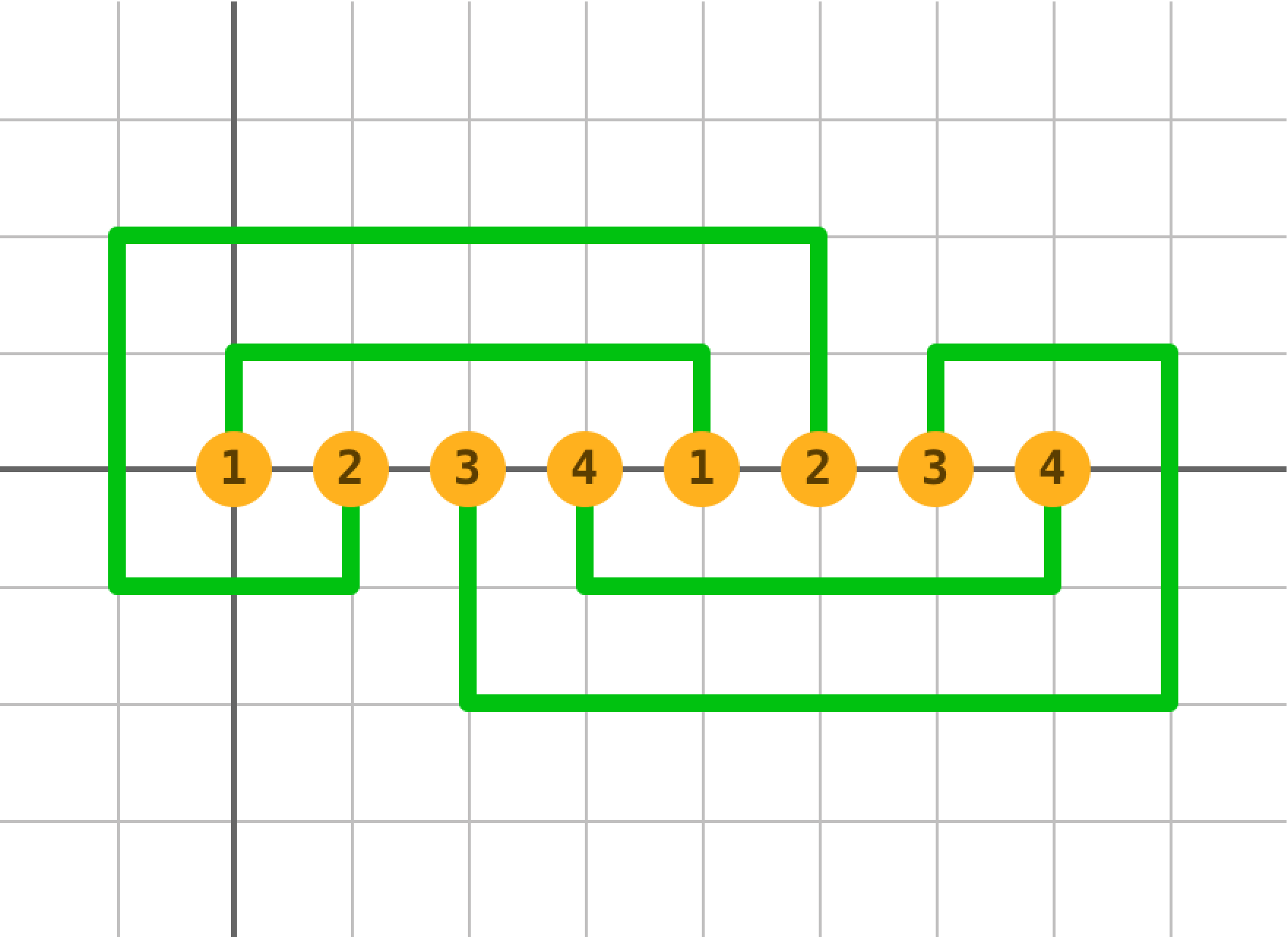
One of the possible circuits for sample 1 is shown at the picture. In sample 2, we cannot connect the pads so that the different tracks do not intersect.
Given are two integer sequences: $$$\{a_i\}$$$ of length $$$N - 1$$$ and $$$\{c_i\}$$$ of length $$$N$$$. Let us build a tree $$$T_{N}$$$ with $$$N$$$ vertices in the following way:
- $$$T_{1}$$$ is a tree made up of only vertex $$$1$$$.
- For $$$i \gt 1$$$, $$$T_{i}$$$ connects vertex $$$i$$$ to one of the vertices of $$$T_{i - 1}$$$. The probability that vertex $$$j$$$ will be chosen is $$$\displaystyle \frac{a_j}{a_1 + \cdots + a_{i - 1}}$$$. The length of the added edge is then calculated as $$$c_i + c_j$$$.
- When $$$T_{N}$$$ is built, the process stops.
You are given $$$Q$$$ queries. Each query is a pair of vertices. For each query $$$(u, v)$$$, calculate the expected distance between $$$u$$$ and $$$v$$$ in $$$T_{N}$$$.
The first line of input contains two integers $$$N$$$ and $$$Q$$$: the number of vertices and the number of queries, respectively ($$$2 \leq N, Q \leq 3 \cdot 10^5$$$).
The second line contains $$$N - 1$$$ integers $$$a_1$$$, $$$a_2$$$, $$$\ldots$$$, $$$a_{N - 1}$$$ ($$$1 \leq a_i \leq 2000$$$).
The third line contains $$$N$$$ integers $$$c_1$$$, $$$c_2$$$, $$$\ldots$$$, $$$c_N$$$ ($$$1 \leq c_i \leq 2000$$$).
Each of the following $$$Q$$$ lines describes one query and contains two integers $$$u$$$ and $$$v$$$ separated by a space: numbers of vertices to find the expected distance ($$$1 \leq u, v \leq N$$$).
It can be proven that each answer is a rational number and can be written in the form $$$\mathit{ans}_i = \frac{p_i}{q_i}$$$, where $$$p_i$$$ and $$$q_i$$$ are coprime non-negative integers and $$$0 \lt q_i \lt 10^9 + 7$$$. For each query, print the integer $$$(p_i \cdot q_i^{-1}) \bmod (10^9 + 7)$$$.
5 7
1 1 1 1
1 2 4 8 16
1 3
2 5
4 3
1 5
3 3
4 5
1 2
7
666666697
15
666666697
0
333333366
3
5 4
17 19 23 29
2 3 5 7 11
1 2
3 4
5 2
3 5
5
927495315
106531441
450222593
There is a connected graph $$$G$$$ consisting of $$$N$$$ vertices and $$$M$$$ weighted undirected edges. In $$$G$$$, the weight of the path is obtained by XORing the weights of all edges in the path. Note that it is allowed to walk along one edge multiple times, in this case, you are XORing the weight that number of times.
For vertices $$$u$$$ and $$$v$$$, let $$$d (u, v)$$$ be the maximum weight of a path from $$$u$$$ to $$$v$$$.
You need to answer $$$Q$$$ queries of the following form:
Given $$$l$$$ and $$$r$$$, for all $$$i$$$ and $$$j$$$ such as $$$l \leq i \lt j \leq r$$$, find the XOR of the values of $$$d (i, j)$$$.
The first line contains three integers, $$$N$$$, $$$M$$$, and $$$Q$$$ ($$$1 \leq N, M, Q \leq 10^5$$$).
Each of the following $$$M$$$ lines contains three integers, $$$u$$$, $$$v$$$, and $$$w$$$, describing an edge of weight $$$w$$$ connecting vertices $$$u$$$ and $$$v$$$ ($$$1 \le u, v \le N$$$, $$$0 \le w \lt 2^{30}$$$). Note that multiple edges and loops are allowed in this task.
Each of the following $$$Q$$$ lines describes one query and contains two integers $$$l$$$ and $$$r$$$ ($$$1 \leq l \lt r \leq N$$$).
For each query, print the answer on a separate line.
8 10 7
1 2 662784558
3 2 195868257
3 4 294212653
4 5 299265014
6 5 72652580
6 7 29303370
7 8 183954825
2 1 752722885
5 3 197591314
8 4 877461873
4 8
5 7
6 7
2 3
7 8
3 4
2 7
0
713437792
738051848
716356296
736682272
1003204975
987493236
Consider an array $$$A$$$ of length $$$N$$$. You are planning to do several queries: for a segment $$$[i, j]$$$ of the array, find the maximum value on that segment of the array. The query for the indices $$$i$$$ and $$$j$$$ will be done $$$Q_{i, j}$$$ times.
But the array is not given, and you are going to build it right now.
For each $$$i$$$ from $$$1$$$ to $$$N$$$, you can select one of $$$K_i$$$ different values $$$V_{i, j}$$$ as the value of $$$A_i$$$, and the respective costs of choosing these values are $$$C_{i, j}$$$.
After all queries, your score will be the sum of the results of all the interval queries you are planning to do, minus the cost of choosing the values $$$A_i$$$. Find the maximum possible score that can be achieved.
First line of the input contains one integer $$$N$$$ ($$$1 \leq N \leq 300$$$).
Then $$$N$$$ lines follow. The $$$i$$$-th of those lines contains integers from $$$Q_{i, i}$$$ to $$$Q_{i, N}$$$ ($$$0 \leq Q_{i, j} \leq 999$$$). The query for the maximum element in the array between $$$A_i$$$ and $$$A_j$$$ inclusively shall be performed exactly $$$Q_{i, j}$$$ times.
After that, the input describes possible values of $$$A_i$$$ for each $$$i$$$ from $$$1$$$ to $$$N$$$. The $$$i$$$-th description has the following format:
- The first line contains a positive integer $$$K_i$$$: the number of possible values for $$$A_i$$$.
- Each of the following $$$K_i$$$ lines contains two integers $$$V_{i, j}$$$ and $$$C_{i, j}$$$: a possible value and the cost of picking that value, respectively ($$$0 \leq V_{i, j} \leq 10^8$$$, $$$0 \leq C_{i, j} \leq 10^{13}$$$).
It is guaranteed that the sum of $$$K_i$$$ is at most $$$3 \cdot 10^5$$$.
Print one integer: the maximum possible score.
5
1 0 2 2 0
0 2 2 0
2 2 2
1 2
0
2
0 27
1 19
2
7 25
1 1
2
8 7
4 18
2
8 7
4 4
2
0 25
4 26
78
2
1 1
1
2
1 100
2 50
1
1 100
-145
A hotspot is a physical location where people can generally use Wi-Fi to access the Internet through a wireless local-area network (WLAN) with a router connected to an Internet service provider. Most people call these places "Wi-Fi hotspots". Public hotspots are typically created from wireless access points, shortly, APs. Specifically, a hotspot is a zone within distance $$$r$$$ from where an AP is installed. In other words, it is a circle with radius $$$r$$$ centered at the location of AP.
In a city, there is a long straight road. The APs are already installed along the road. The city officials need to set the radii of hotspots. Then, for any two different APs, the hotspots created from them should not overlap, but at their boundaries, they can meet. As a special case, if the radius of a hotspot is zero, and another hotspot contains it inside, then the two hotspots overlap, and it should not happen. But even if the radius of hotspot is zero, the hotspot can touch a boundary of another hotspot.
The city officials are trying to set the radii of hotspots such that their total coverage area is as large as possible. Thus, they shall maximize the sum of areas of hotspots, simply, the sum of squares of radii of hotspots. To achieve the goal, some radii of hotspots may be set to zero.
The road is considered as a line on the plane, and the locations of APs installed on the road are points on the line. Write a program that, given $$$n$$$ points on the line, will determine the radii of non-overlapping hotspots such that the sum of squares of these radii is maximum possible.
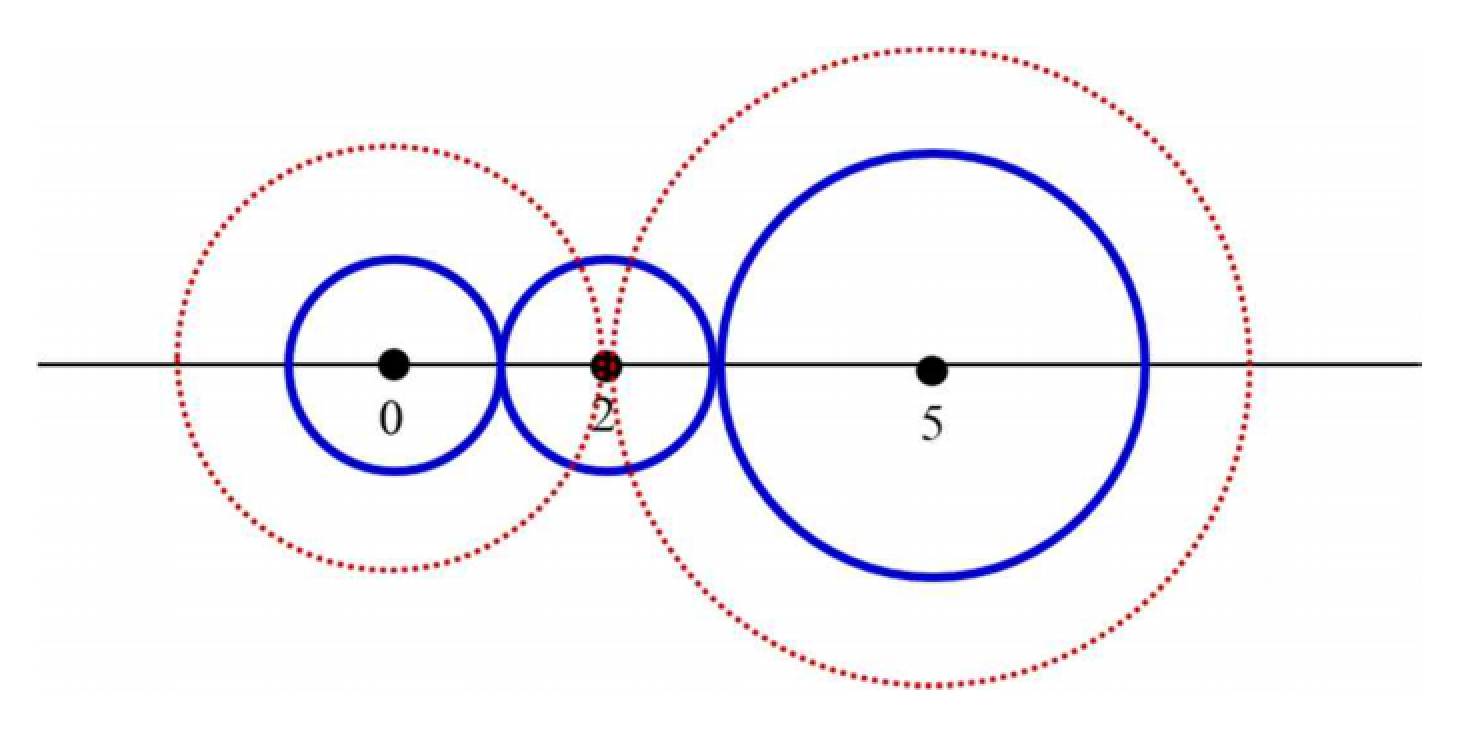
For example, there are three APs located at $$$0$$$, $$$2$$$, and $$$5$$$, respectively, in the above figure. As a candidate, the blue and red hotspots are given. The radii of the blue hotspots are $$$1$$$, $$$1$$$, and $$$2$$$, from left to right. Then the sum of squares of radii is $$$6$$$. But for the red hotspots, their radii are $$$2$$$, $$$0$$$, and $$$3$$$, from left to right. Thus, the sum of squares of radii is $$$13$$$, which is the maximum.
The first line of input contains an integer $$$n$$$, the number of APs ($$$2 \le n \le 3 \cdot 10^5$$$). The second line contains $$$n$$$ distinct space-separated integers in strictly increasing order representing the locations of APs on the line, where the integers are between $$$0$$$ and $$$10^9$$$, inclusive.
Print one integer: the maximum sum of squares of radii of hotspots.
3
0 2 5
13
4
0 1 3 6
10
5
5 7 12 13 15
9
Given an integer array $$$A$$$ of size $$$N$$$, the shuffle operation is defined as follows.
- Initially, you create an empty integer array $$$B$$$.
- Then, while $$$A$$$ is not empty, you remove either the leftmost or rightmost element of $$$A$$$, and append the value to the right in $$$B$$$.
- If $$$A$$$ is empty, replace $$$A$$$ with $$$B$$$ and stop.
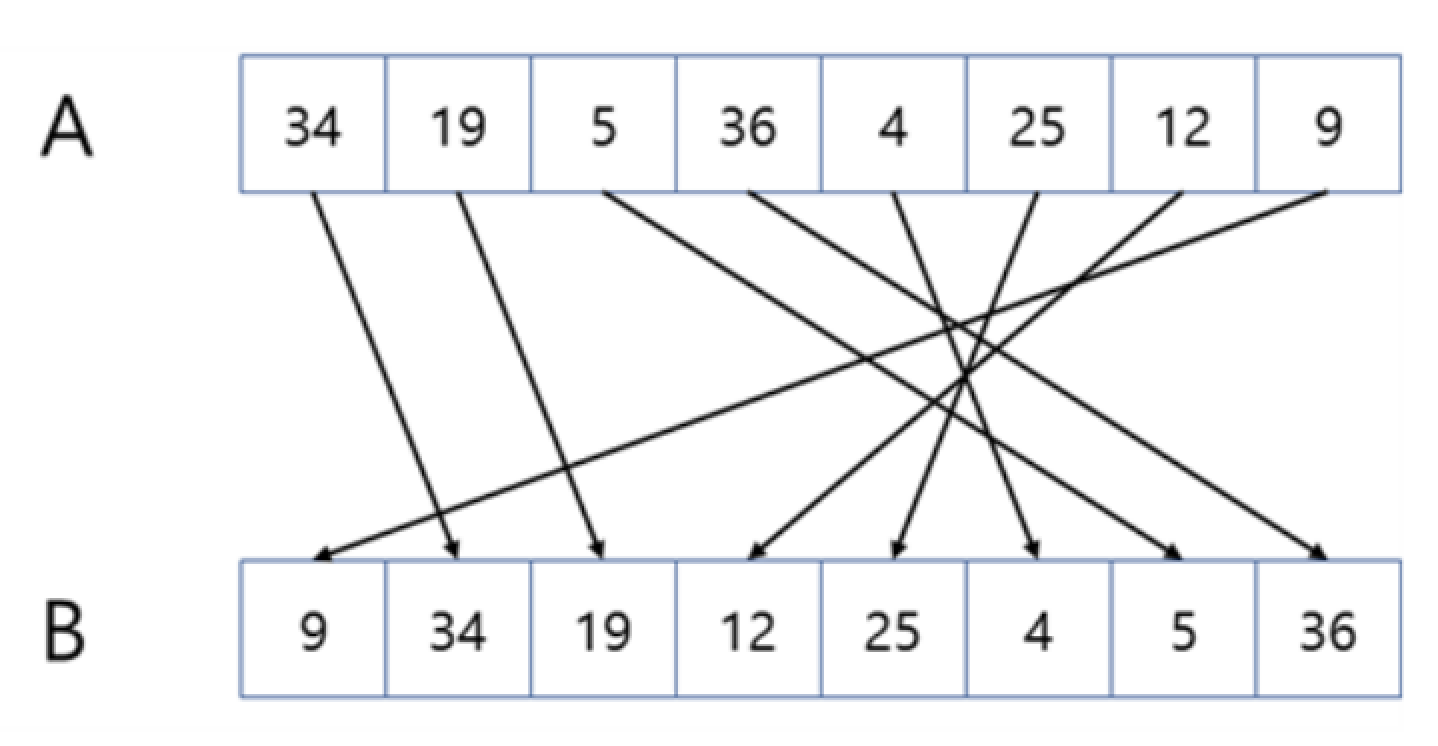
If the shuffle operation is performed as shown in the picture above, the value of the array $$$A$$$ is changed as follows:
$$$$$$(34,\, 19,\, 5,\, 36,\, 4,\, 25,\, 12,\, 9) \to (9,\, 34,\, 19,\, 12,\, 25,\, 4,\, 5,\, 36)\text{.}$$$$$$
Let $$$A_i$$$ be the $$$i$$$-th element of array $$$A$$$. When the condition "if $$$1 \le i \lt j \le N$$$, then $$$A_i \le A_j$$$" is established, it is said that array $$$A$$$ increases monotonically.
Write a program that, given an integer array $$$A$$$ of size $$$N$$$, calculates the minimum number of shuffle operations required to make the array $$$A$$$ monotonically increasing.
The first line of input contains one integer $$$N$$$, the number of elements in array $$$A$$$ ($$$1 \le N \le 3 \cdot 10^5$$$).
The second line contains $$$N$$$ integers $$$A_1, \ldots, A_N$$$: the initial values of elements of array $$$A$$$ ($$$1 \le A_i \le 10^9$$$).
Output the minimum number of shuffle operations required to make the array $$$A$$$ monotonically increasing.
3
2 2 5
0
6
1 5 8 10 3 2
1
Junkyeom and his friends Myung and Myeong are planning to hold a programming contest with one gold (first place), two silver (places 2 and 3), and four bronze medals (places 4, 5, 6, 7).
The sponsors gave $$$N$$$ gift cards for the contest, $$$i$$$-th of them costs $$$A_i$$$. Each medalist shall be awarded exactly one card. Let $$$P_i$$$ be the prize for the card awarded to the contestant taking $$$i$$$-th place. The distribution is considered fair if the following two inequalities are held:
$$$$$$ P_1 \ge P_2 \ge P_3 \ge P_4 \ge P_5 \ge P_6 \ge P_7 $$$$$$
and
$$$$$$ P_1 \lt P_2 + P_3 \lt P_4 + P_5 + P_6 + P_7\text{.} $$$$$$
Given the values $$$A_i$$$, find out if a fair distribution of prizes exists. If it does, print the maximum possible sum of $$$P_i$$$ for a fair distribution.
The first line of input contains one integer $$$N$$$, the number of gift cards ($$$7 \le N \le 5 \cdot 10^5$$$).
The second line contains $$$N$$$ integers $$$A_i$$$: the prizes for the cards ($$$1 \le A_i \le 2 \cdot 10^8$$$).
If a fair distribution of prizes is impossible, print $$$-1$$$.
Otherwise print one integer: the maximum possible total prize of the fairly distributed gift cards.
7
1 2 3 4 5 6 7
-1
8
1 2 3 4 5 6 7 8
35
10
5 5 5 5 5 5 10 5 5 5
35
Today, $$$N$$$ projects are scheduled to be posted at Songjuk Haksa. Jongyoung and his friends don't want to do a lot of work, so they decided to share the projects and implement them.
The project $$$i$$$ can be accessed at time $$$L_i$$$ and shall be implemented at time $$$R_i$$$ or earlier, but the students' learning ability is not very good, so work on the project consumes all the available time.
In addition, a student cannot solve several projects at the same time, so if a student selected two projects $$$i$$$ and $$$j$$$, $$$R_i \lt L_j$$$ or $$$R_j \lt L_i$$$ must be satisfied. Also, students are not very interested in hard work, so each student will work on a maximum of two projects.
A group of $$$M$$$ strong students want to collectively implement as many projects as possible. Help them decide which projects each student needs to solve. If there are multiple possible ways, you may choose any one of them.
The first line of input contains two integers $$$N$$$ and $$$M$$$, the number of projects and the number of students, respectively ($$$1 \leq M \leq N \leq 3 \cdot 10^5$$$).
Each of the following $$$N$$$ lines contains two integers $$$L_i$$$ and $$$R_i$$$: the start and end time of $$$i$$$-th project ($$$1 \leq L_i \lt R_i \leq 10^9$$$).
Print $$$N$$$ integers. The $$$i$$$-th of those integers must be the number of student (from $$$1$$$ to $$$M$$$) who will handle project $$$i$$$. If no student will do project $$$i$$$, output $$$0$$$ instead.
The number of implemented projects must be the maximum possible. If there are several possible solutions, print one any of them.
7 5
9 10
7 9
3 4
9 10
2 6
8 9
5 8
3 2 2 5 5 4 1
2 2
1 2
3 4
1 1
2 1
1 2
2 3
1 0