


Given a grid with $$$n$$$ rows and $$$n$$$ columns, there is exactly one black cell in the grid and all other cells are white. Let $$$(i, j)$$$ be the cell on the $$$i$$$-th row and the $$$j$$$-th column, this black cell is located at $$$(b_i, b_j)$$$.
You need to cover all white cells with some L-shapes, so that each white cell is covered by exactly one L-shape and the only black cell is not covered by any L-shape. L-shapes must not exceed the boundary of the grid.
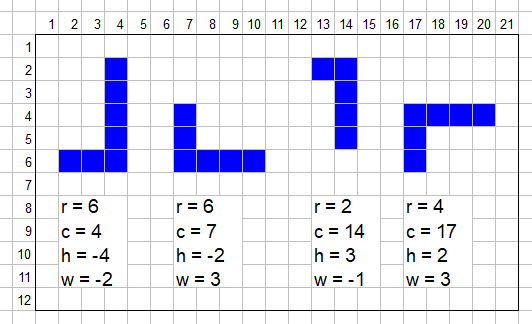
More formally, an L-shape in the grid is uniquely determined by four integers $$$(r, c, h, w)$$$, where $$$(r, c)$$$ determines the turning point of the L-shape, and $$$h$$$ and $$$w$$$ determine the direction and lengths of the two arms of the L-shape. The four integers must satisfy $$$1 \le r, c \le n$$$, $$$1 \le r + h \le n$$$, $$$1 \le c + w \le n$$$, $$$h \ne 0$$$, $$$w \ne 0$$$.
- If $$$h \lt 0$$$, then all cells $$$(i, c)$$$ satisfying $$$r + h \le i \le r$$$ belong to this L-shape; Otherwise if $$$h \gt 0$$$, all cells $$$(i, c)$$$ satisfying $$$r \le i \le r + h$$$ belong to this L-shape.
- If $$$w \lt 0$$$, then all cells $$$(r, j)$$$ satisfying $$$c + w \le j \le c$$$ belong to this L-shape; Otherwise if $$$w \gt 0$$$, all cells $$$(r, j)$$$ satisfying $$$c \le j \le c + w$$$ belong to this L-shape.
The following image illustrates some L-shapes.
There is only one test case in each test file.
The first line contains three integers $$$n$$$, $$$b_i$$$ and $$$b_j$$$ ($$$1 \le n \le 10^3$$$, $$$1 \le b_i, b_j \le n$$$) indicating the size of the grid and the position of the black cell.
If a valid answer exists first output Yes in the first line, then in the second line output an integer $$$k$$$ ($$$0 \leq k \leq \frac{n^2-1}{3}$$$) indicating the number of L-shapes to cover white cells. Then output $$$k$$$ lines where the $$$i$$$-th line contains four integers $$$r_i$$$, $$$c_i$$$, $$$h_i$$$, $$$w_i$$$ separated by a space indicating that the $$$i$$$-th L-shape is uniquely determined by $$$(r_i, c_i, h_i, w_i)$$$. If there are multiple valid answers you can print any of them.
If there is no valid answer, just output No in one line.
5 3 4
Yes
6
5 1 -1 3
1 2 1 3
3 1 -2 1
4 3 -1 -1
4 5 1 -1
2 5 1 -2
1 1 1
Yes
0
We illustrate the first sample test case as follows.


