


Problem: E. Grid Coloring.
Next, I will present an approach achieving a max penalty of $$$2$$$.
Cases like $$$1\times m$$$ and $$$n\times 1$$$ grids are straightforward; we omit the details.
Next, consider constructing a solution for $$$3\times 3$$$:
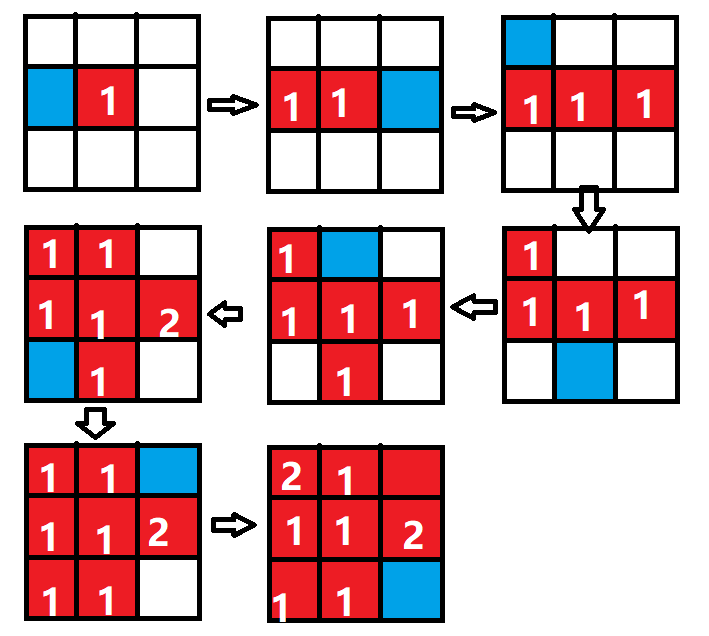
The blue cell represents the last colored cell, and red cells are already colored.
This $$$3\times 3$$$ solution ensures the top-right and bottom-right cells have penalty $$$0$$$. In the inductive step from $$$k\times k$$$ to $$$(k+2)\times (k+2)$$$, we require that the top-right and bottom-right cells of the $$$k\times k$$$ solution also have penalty $$$0$$$.
The expansion from $$$k \times k$$$ to $$$(k+2)\times k$$$ is shown below:

Specifically: The three cells near the central axis use a special pattern. Other cells are colored in the order: top-left, bottom-left, top-right, bottom-right.
This increases the penalty of the original $$$k\times k$$$'s bottom-right cell by $$$1$$$. For the two new rows, the first $$$\frac{k-3}{2}$$$ cells have penalty $$$1$$$, the $$$\frac{k-1}{2}$$$-th cell has penalty $$$2$$$, the next $$$\frac{k-3}{2}$$$ cells have penalty $$$1$$$, and the last cell has penalty $$$0$$$.
Next, expanding $$$(k+2)\times k$$$ to $$$(k+2)\times (k+2)$$$:

Specifically: The three cells near the central axis use a special pattern. Other cells are colored in the order: top-left, bottom-left, top-right, bottom-right. Finally, the four corner cells use a special pattern.
Thus, we inductively construct $$$(k+2)\times (k+2)$$$ from $$$k\times k$$$. Since the bottom-right cell of the $$$k\times k$$$ solution has penalty $$$0$$$, the only change to the original $$$k\times k$$$ grid is increasing one cell's penalty from $$$0$$$ to $$$1$$$. None of the new cells have penalty $$$3$$$. Hence, we obtain a valid solution for any $$$k\times k$$$.
Transforming an $$$n\times n$$$ or $$$m\times m$$$ solution into $$$n\times m$$$ only requires operating on one pair of opposite edges (details omitted).
Thus, we obtain a valid solution for any $$$n\times m$$$.
Below is a reference illustration showing the penalty for each cell in a $$$7 \times 7$$$ grid colored using this method:

If anyone needs the code, I might be able to write it this weekend.


