


** بسم الله والحمدلله والصلاة والسلام على رسول الله **
Bahnasy Tree
GitHub Repository: Bahnasy-Tree
Bahnasy Tree is a dynamic tree that represents a sequence of length $$$N$$$ (positions $$$1..N$$$). It is controlled by two parameters:
- $$$T$$$ ( threshold ): the maximum fanout a node is allowed to have before we consider it "too wide".
- $$$S$$$ ( split factor ): used when splitting; computed from the node size using the smallest prime factor (SPF). If $$$S \gt T$$$, we fallback to $$$S = 2$$$.
The tree supports the usual sequence operations (find by index, insert, delete) and can be extended to support range query / range update by storing aggregates (sum, min, etc.) and optionally using lazy propagation.
1) Node meaning and the main invariant
Each node represents a contiguous block of the sequence. If a node represents a block of length sz, then its children partition this block into consecutive sub-blocks whose lengths sum to sz.
The key invariant is: every node always knows the sizes of its children subtrees (how many leaves are inside each child).
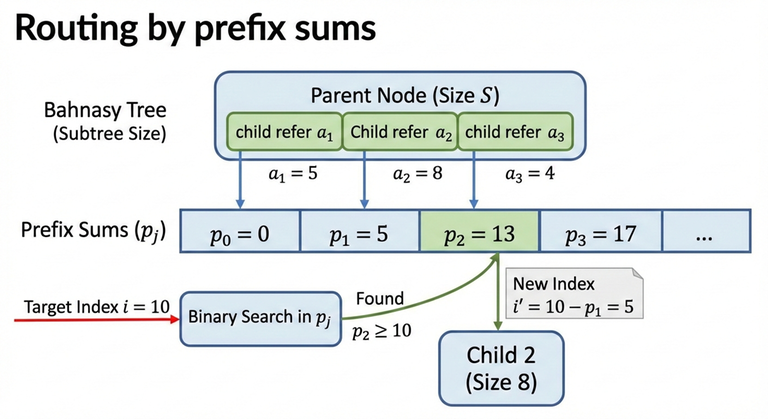
2) Prefix sizes (routing by index)
Assume a node has children with subtree sizes:
Define the prefix sums:
To route an index $$$i$$$ (1-indexed) inside this node:
- Find the smallest $$$j$$$ such that $$$p_j \ge i$$$.
- Go to that child (and convert $$$i$$$ into the child-local index by subtracting $$$p_{j-1}$$$).
Because $$$p_j$$$ is monotone, this is done using binary search ("lower bound on prefix sums").
3) Building the tree (global split using SPF)
Start with a root node representing $$$N$$$ elements.
For a node representing $$$n$$$ elements:
- If $$$n \le T$$$: stop splitting and create $$$n$$$ leaves under it.
- If $$$n \gt T$$$: split it into $$$S$$$ children:
- $$$S = \mathrm{SPF}(n)$$$
- If $$$S \gt T$$$, use $$$S = 2$$$
- Distribute the $$$n$$$ elements among those $$$S$$$ children (almost evenly), then recurse.
This guarantees that during the initial build, every internal node has at most $$$T$$$ children.
4) Find / traverse complexity
Define:
- $$$D$$$: the depth (number of levels).
- At each level, routing uses binary search on at most $$$T$$$ children, so it costs $$$O(\log_2 T)$$$.
Therefore:
In a "fully expanded" $$$T$$$-ary tree shape, depth is about:
So a direct expression is:
Now simplify using change-of-base:
Multiplying both sides by $$$\log_2 T$$$ gives:
So the final form is:
5) Insert, local overflow, and local split
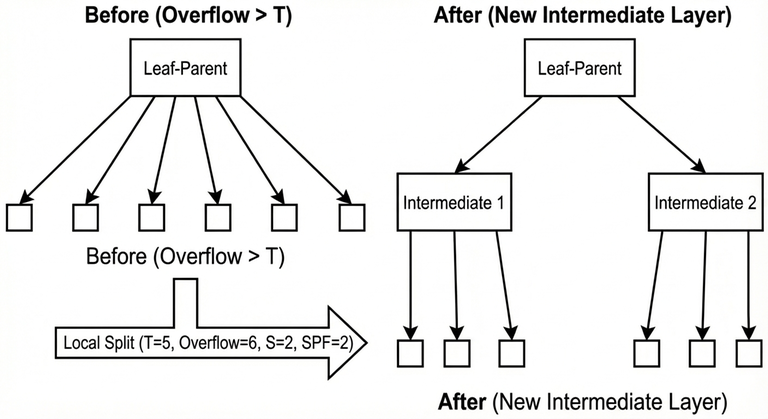
Insertion happens at leaf level. After inserting a new element, the "leaf-parent" (the node whose children are leaves) increases its number of children.
As long as the leaf-parent still has at most $$$T$$$ children, nothing structural is required.
When the leaf-parent exceeds $$$T$$$ children, a local split is performed:
- A new intermediate layer is created between the leaf-parent and its leaves.
- The old leaves are grouped into $$$S$$$ buckets (where $$$S$$$ is computed by the same SPF rule capped by $$$T$$$).
This restores a bounded fanout and keeps future routing efficient.
Complexity of one local split
A local split creates about $$$\mathrm{SPF}(T+1)$$$ intermediate nodes and reconnects about $$$T+1$$$ leaves, so ignoring the SPF term, the time is:
Insert complexity
Insert cost is:
- Routing: $$$O(\log_2 N)$$$
- Plus possible local overflow handling: $$$O(T)$$$
So the worst-case insert is:
6) Delete complexity
Deletion also consists of:
- Routing to the target: $$$O(\log_2 N)$$$
- Removing it from the leaf-parent's ordered child list (bounded by the same width idea), so $$$O(T)$$$
So the worst-case delete is:
7) Why rebuild is needed
Repeated insertions concentrated in the same area can create a "deep path" because local splits keep adding intermediate layers.
Consider the worst case where local splits behave like $$$S=2$$$:
- After a local overflow, the leaves are grouped into 2 buckets of size about $$$T/2$$$.
- To overflow one bucket again and force another local split deeper, it takes about $$$T/2$$$ further insertions in that same region.
- Therefore, each new additional level costs about $$$T/2$$$ insertions.
If the current depth is $$$D$$$ and the tree is considered valid only while $$$D \le T$$$, then the number of insertions needed to reach the invalid depth threshold is approximately:
In the worst case (starting from $$$D = 0$$$):
When the tree becomes invalid, it is rebuilt.
8) Rebuild time
A rebuild does:
- Collect leaves into an array of size $$$N$$$.
- Reconstruct the tree from scratch using the global split rule.
The rebuild time is proportional to the number of nodes created.
Leaf level: $$$N$$$ nodes.
Previous levels shrink geometrically, so the maximum total node count is bounded by:
Therefore rebuild cost is:
9) Total cost of rebuilds across $$$Q$$$ operations
In the worst case, rebuild happens every $$$\Theta(T^2)$$$ insertions concentrated in one place.
So number of rebuilds is approximately:
Each rebuild costs $$$O(N)$$$, therefore total rebuild time across all operations is:
For operation costs in the same worst-style view, insertion can be treated as $$$O(T)$$$ due to local split work, so the operation part is:
Thus a total bound is:
10) Choosing a good $$$T$$$
A common practical choice is:
Because plugging $$$T = N^{1/3}$$$ into the rebuild term:
and the operations term $$$QT$$$ becomes:
so both terms become the same order:
In practice (based on testing), good values often fall in the range:
with higher values helping insertion-heavy workloads and lower values helping query-heavy workloads.
11) Worst-case tests and mitigation
Worst-case behavior happens when a test is engineered to keep inserting in exactly the same place so the tree reaches a depth close to $$$T$$$, and then many operations are issued around that hot region.
Common mitigations:
- Randomize $$$T$$$ each rebuild within a safe exponent range (e.g. $$$N^{0.27}$$$ to $$$N^{0.39}$$$).
- Randomize the rebuild target (instead of rebuilding exactly at depth $$$T$$$, rebuild at $$$(0.5/1/2/3/4)\cdot T$$$).
12) Implementations
Minimal structure-only implementation (split / split_local / find / insert / delete):
general_structure.cpp
Full implementation (find/query/update/insert/delete + rebuild):
non_generic_version.cpp
Benchmark results
Stress-testing results comparing Bahnasy Tree implementations against Treap and Segment Tree showed full agreement (no diffs) across all test suites.
| Test suite | Bahnasy variant | Reference | Tests | Bahnasy avg time | Reference avg time |
|---|---|---|---|---|---|
| All operations | non_generic_version.cpp | treap_fast.cpp | 105 | 0.202s | 0.193s |
| Point update + query | bahnasy_point_update.cpp | segTree_point_update.cpp | 18 | 0.303s | 0.218s |
| Range update + query | bahnasy_range_update.cpp | segTree_range_update.cpp | 12 | 0.274s | 0.236s |
Full benchmark logs and automated testing scripts are available in the GitHub repository under tools/ and reports/.
Tutorials:


