


→ Обратите внимание
→ Трансляции
→ Лидеры (рейтинг)
| № | Пользователь | Рейтинг |
|---|---|---|
| 1 | Benq | 3792 |
| 2 | VivaciousAubergine | 3647 |
| 3 | Kevin114514 | 3603 |
| 4 | jiangly | 3583 |
| 5 | turmax | 3559 |
| 6 | tourist | 3541 |
| 7 | strapple | 3515 |
| 8 | ksun48 | 3461 |
| 9 | dXqwq | 3436 |
| 10 | Otomachi_Una | 3413 |
| Страны | Города | Организации | Всё → |
→ Лидеры (вклад)
| № | Пользователь | Вклад |
|---|---|---|
| 1 | Qingyu | 157 |
| 2 | adamant | 153 |
| 3 | Um_nik | 147 |
| 4 | Proof_by_QED | 146 |
| 5 | Dominater069 | 145 |
| 6 | errorgorn | 141 |
| 7 | cry | 139 |
| 8 | YuukiS | 135 |
| 9 | TheScrasse | 134 |
| 10 | chromate00 | 133 |
→ Найти пользователя
→ Прямой эфир


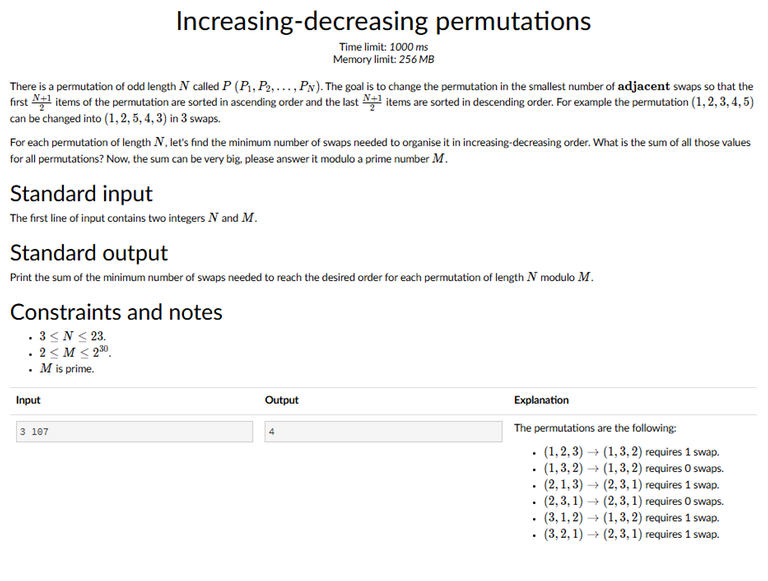


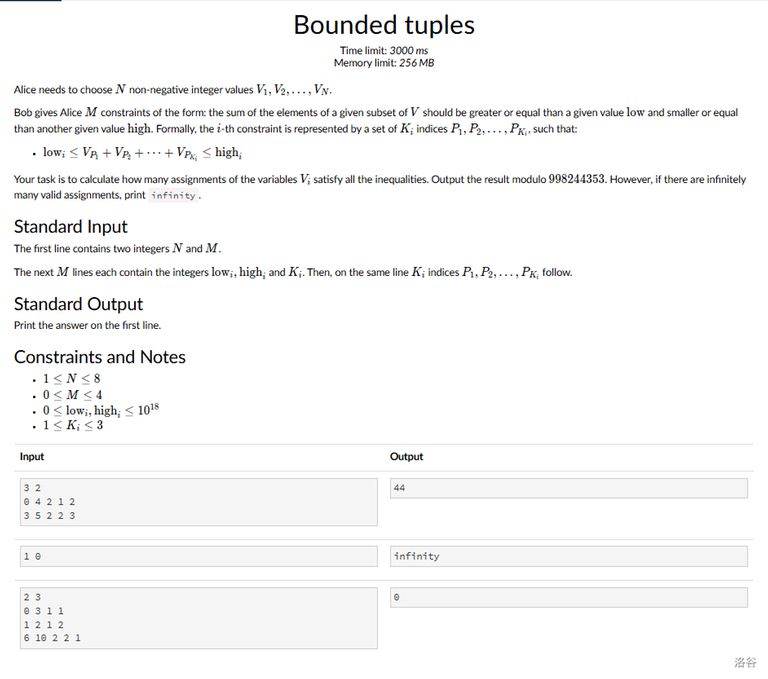
There are $$$n$$$ points on the line, the position of $$$i$$$ th point is $$$p[i]$$$. there are Q querys. you will got a segment which length is $$$D[i]$$$, ask at least how many segments are needed to cover all points.
$$$ 1 \le n \le 10^5 $$$, $$$ 1 \le p[i] \le 10^9 $$$, $$$ 1 \le q \le 10^5 $$$

Codeforces (c) Copyright 2010-2026 Михаил Мирзаянов
Соревнования по программированию 2.0
Время на сервере: 21.04.2026 14:04:05 (g2).
Десктопная версия, переключиться на мобильную.
При поддержке


