




| № | Пользователь | Рейтинг |
|---|---|---|
| 1 | Benq | 3792 |
| 2 | VivaciousAubergine | 3647 |
| 3 | jiangly | 3631 |
| 4 | Kevin114514 | 3574 |
| 5 | maroonrk | 3521 |
| 6 | strapple | 3515 |
| 7 | Radewoosh | 3461 |
| 8 | tourist | 3428 |
| 9 | turmax | 3378 |
| 10 | Um_nik | 3376 |
| Страны | Города | Организации | Всё → |
| № | Пользователь | Вклад |
|---|---|---|
| 1 | Qingyu | 162 |
| 2 | adamant | 148 |
| 3 | Um_nik | 146 |
| 4 | Dominater069 | 143 |
| 5 | errorgorn | 141 |
| 6 | cry | 138 |
| 7 | Proof_by_QED | 136 |
| 8 | YuukiS | 135 |
| 9 | chromate00 | 134 |
| 10 | soullless | 133 |


this problem appeared in the latest ieeextreme contest and it had a segtree beat like solution , dont remember it cuz i suck at DS stuff
I have wondered of this for a long time! I'm so happy someone brought it up
I found a sqrt-ish solution. (Sorry, I still don't know latex.)
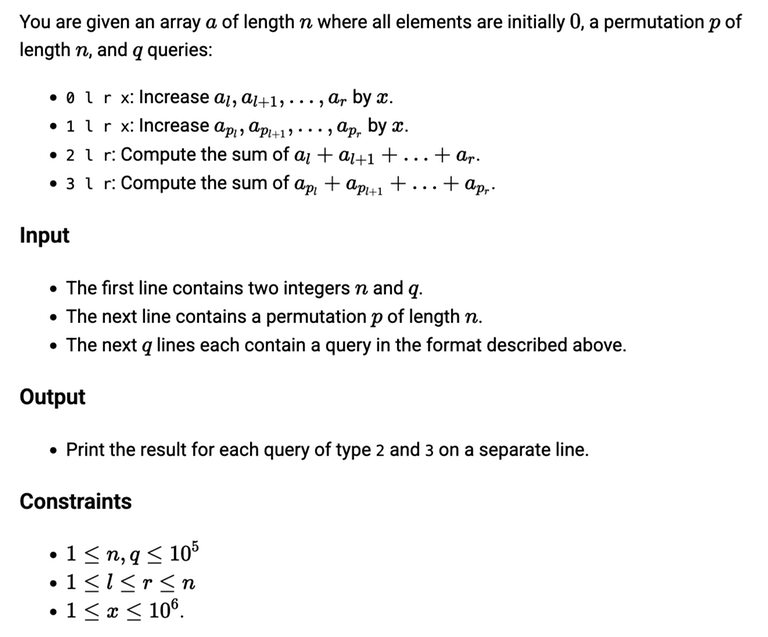
First, we divide all queries into s blocks. Then, in each block, we will answer queries one by one. To answer a query, we will look at how much each update contributes. For same type queries (0 and 2, or 1 and 3), it's trivial, but for different type updates it's a bit harder. We have to calculate how many x in [l, r] contained in [p_l, p_r]. It can be done with a persistent segment tree (for p array, count how many values in range [lq, rq] is smaller or equal to r, and substract the same value for (l-1)). Persistent segment tree can be calculated at the beginning. After all queries are completed in a block, we will calculate all changes to the array in again O(|block|logN). In total, picking block size as sqrt(N), we will have O(Nsqrt(N)logN) complexity. (Then, we will hope it passes the tests :).)
Idea 1: Since each add operation and query operation is independent, we can independently calculate the contributions for
0 → 2,0 → 3,1 → 2, and1 → 3. After computing these four contributions, simply sum all the answers together.Idea 2: For
0 → 2and1 → 3, a simple segment tree can be used for maintenance.Idea 3: For
0 → 3, construct an arrayb, whereb[i] = a[p[i]]. Then divide both arraysaandbintosqrt(n)blocks. For each pair of blocks, calculate how much the sum of the corresponding block inbwould change if a block inaundergoes a global+1. Maintain this information using prefix sums. During modification operations:For the contribution of a whole block of a to a single point of b, since p is a permutation, a point of b can only be obtained by transferring a point of a. It is only necessary to check the value of the full block of a that has been modified.
1 → 2, the operations are almost identical to those for0 → 3.By following this approach, the complexity is
O(n^1.5)without including logarithmic factors.I used GPT for the translation, but I assure you that the thought process is human-sourced and not AI-generated garbage.