


Thanks to ToxicPie9 for proofreading and emotional support.
Recently, I was thinking about JOISC 2025 Space Thief. And there is a part where you need to do divide and conquer on a tree, where you need to split the edges of the tree into two components where the edges are both connected.
Basically, we consider an interactive problem on a tree where there is a hidden edge. We are allowed to ask queries of the form $$$(v,N_v)$$$ where $$$v$$$ is a vertex of the tree and $$$N_v$$$ is a set of neighbouring edges of $$$v$$$. Then the query returns to us whether the hidden edge is in the subtree of one of $$$N_v$$$ when we root the tree at $$$v$$$.
We maintain a set of edges that the hidden edge can be in. In each query, we try to split the set of edges into two parts and ask a query to separate them.
In the worst case, we replace the set of edges by the larger component.
Let $$$R$$$ be the maximum ratio of the larger component.
In this blog by maomao90 and the last section of this blog by errorgorn (yes I am citing myself, deal with it), it was shown that $$$R \lt \frac{2}{3}$$$. And it is quite clear that this limit is tight when we consider a node with $$$3$$$ children each of size roughly $$$\frac{n}{3}$$$.
But a natural question to ask is about the amortized lower bound $$$\tilde R$$$.
In this comment by lrvideckis, it was shown that $$$\tilde R \gt \frac{1}{\sqrt{3}}$$$ amortized.
More confusingly, in funnyhat on a Singapore local judge, it was claimed in the editorial that $$$\tilde R \lt \frac{1}{\sqrt{3}}$$$. I was in the editorial session for that problem. The claim seemed shaky but I did not think too much about it.
But now that I thought about it again, I think that $$$\tilde R \lt \frac{1}{\sqrt{3}}$$$ is wrong because I believe I have a construction for which $$$\tilde R \gt \frac{1}{\varphi}$$$.
Because I know that opening a calculator is annoying, I will write that $$$\frac{3}{2}=1.5$$$, $$$\varphi \approx 1.618$$$ and $$$\sqrt{3} \approx 1.732$$$.
Motivation
The reason why a full ternary tree gives us such a low bound on $$$\tilde R$$$ is because the value of $$$R$$$ at each step alternates between $$$\frac{2}{3}$$$ and $$$\frac{1}{2}$$$.
Suppose the current node has $$$3$$$ children of sizes $$$a\le b\le c$$$. Then after two moves, we can always guarantee that our search space is at most size $$$b$$$. To make $$$b$$$ as large as possible it is clearly best to make $$$b=c$$$.
Now suppose the current node has $$$3$$$ children $$$A,B_1,B_2$$$ of sizes $$$a,b,b$$$ where $$$a\le b$$$.
Then after one move, we reduce to a case where we our search space is $$$A \cup B_1$$$, $$$A \cup B_2$$$ or $$$B_1 \cup B_2$$$. In the last case, we can clearly split the search space exactly in half the next move.
So we should focus on the first two cases where the search size is $$$a+b$$$. To construct the worst case we can simply make $$$B_1=B_2$$$.
We want $$$B_1$$$ to split into two subtrees such that we create a similar situation where the centroid of $$$A \cup B_1$$$ has $$$3$$$ children of sizes $$$c,d,d$$$ where $$$c\le d$$$. Here $$$a=d$$$ and $$$b=c + d$$$.

So we can set up the equations $$$\frac{a}{b} = \frac{c}{d}$$$, $$$a=d$$$ and $$$b=c+d$$$ to obtain $$$\frac{d}{c+d} = \frac{c}{d}$$$ which simplifies into $$$x^2+x-1=0$$$ where $$$x = \frac{c}{d}=\frac{\sqrt 5-1}{2} = \frac{1}{\varphi}$$$.
So if you reduce the search space into size $$$a + b$$$, you get $$$\tilde R = \frac{1+\varphi}{1+2\varphi} = \frac{1}{\varphi}$$$ and if you reduce the search into size $$$b + b$$$ and then $$$b$$$, you get $$$\tilde R = \sqrt{\frac{\varphi}{1+2\varphi}} = \frac{1}{\varphi}$$$.
But honestly, I'm not really sure how to prove that there is no better strategy given such a test case. But I'm quite convinced that this test case probably gives us $$$\tilde R \gt \frac{1}{\varphi}$$$.
Explicit Construction
Knowing this, it should not be too hard to explicitly construct a general case tree for this pattern.
It will be related to Fibonacci numbers.
Let $$$F$$$ be a family of trees where the number of vertices in $$$F_i$$$ is approximately the $$$i$$$-th Fibonacci number.
$$$F_0$$$ is the empty tree and $$$F_1$$$ is a single node.
$$$F_i$$$ is defined recursively by joining an additional node to the centroids of $$$F_{i-1}$$$ and $$$F_{i-2}$$$.
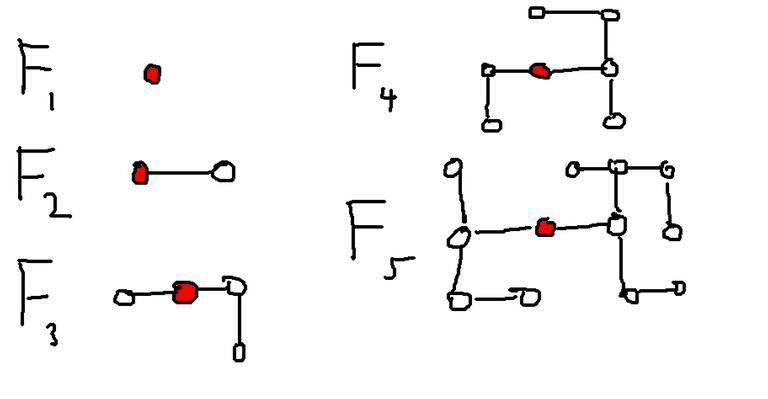
In the above image, centroids are colored in red.
Well, $$$|F_i| = |F_{i-1}| + |F_{i-2}| + 1$$$ it is not really the Fibonacci sequence.
The first few values of $$$|F_i|$$$ is $$$0,1,2,4,7,12,20,33,\ldots$$$ which is like Fibonacci numbers $$$-1$$$.
Does it really break funnyhat?
Yes, I managed to make the author's AC code use $$$23$$$ queries (where 22 gets the full score).
Note that I had to change the definition of $$$F_i$$$ a bit so that $$$F_0$$$ is now a single node instead of an empty tree. This is because now $$$F_{23}$$$ has about $$$0.93 \cdot 10^5$$$ nodes which squeezes better in the constraints of the problem. The original construction above was only able to force $$$22$$$ queries.
You can compile the author's solution with the additional files provided in the problem's attachments to verify that it does indeed use $$$23$$$ queries.
Open Problems
(**Open Problem 1**) How to prove that $$$\tilde R \gt \frac{1}{\varphi}$$$ actually holds for this Fibonacci tree? SOLVED
jeroenodb told me the proof that $$$\tilde R \gt \frac{1}{\varphi}$$$. He has given me permission to write it here.
Let $$$C(T)$$$ denote the minimum number of queries we require to solve tree $$$T$$$.
We make two observations:
- If there is a node $$$x$$$ of degree $$$2$$$ in the tree connected to vertices $$$a$$$ and $$$b$$$, we can make a new tree $$$T'$$$ where $$$x$$$ is deleted and we add an edge between $$$a$$$ and $$$b$$$. Then $$$C(T') \leq C(T)$$$.
- If $$$T'$$$ is any connect subgraph of tree $$$T$$$, then $$$C(T') \leq C(T)$$$.
Then we will prove that $$$C(F_i) \geq i-2$$$ by induction, to show that indeed $$$\tilde R \geq \frac{1}{\varphi}$$$. For $$$i \leq 2$$$, the claim is clearly true.
The graph of $$$F_i$$$ looks like this.

By case work, we can prove that we can force a recursion into a superset of one of the graphs $$$X_1 \cup a \cup b \cup Y$$$, $$$X_2 \cup b \cup Y$$$ and $$$X_1 \cup a \cup b \cup X_2$$$.
The case work is if $$$v$$$ is chosen to be not $$$b$$$, we will take the subtree that contains $$$b$$$. If $$$v$$$ is $$$b$$$, then we can take the union of two subtrees of children of $$$b$$$.
And because of our previous two observations, we know that $$$C(X_1 \cup a \cup b \cup Y),C(X_2 \cup b \cup Y),C(X_1 \cup a \cup b \cup X_2) \geq C(F_{i-1})$$$.
Therefore, we know that $$$C(F_i) \geq C(F_{i-1}) + 1$$$.
(**Open Problem 2**) Can we improve the bound $$$\frac{1}{\varphi} \lt \tilde R \lt \frac{2}{3}$$$? SOLVED.
Golovanov399 shown in the first comment on the blog that $$$\tilde R \lt \frac{1}{\varphi}$$$.
Conclusion
Because all open problems have been resolved (rather quickly I might add), we actually shown that $$$\tilde R = \frac{1}{\varphi}$$$. Maybe I should have thought about this more before I posted the blog. But I think I really would not have believed that the upper bound of $$$\tilde R$$$ could have been improved.
Time to update all our libraries I guess?


To answer your second question, I think we can always achieve dividing by $$$\varphi$$$ in one move or by $$$\varphi^2$$$ in two moves, here's why:
As usual, we have a centroid, let's just try to pick subtrees until they contain more than $$$1 - 1/\varphi$$$ of all edges. If they now contain at most $$$1/\varphi$$$ edges, then we just ask about these subtrees and, no matter what, get at most $$$1/\varphi$$$ edges on the next move. So now we assume that it's not the case. Let $$$a$$$ be the number of edges before we exceeded $$$1-1/\varphi$$$, $$$b$$$ be the number of edges in the last subtree that overflowed this and also $$$1/\varphi$$$, and $$$c$$$ be the number of remaining edges. We have $$$a \lt 1-\frac{1}{\varphi}$$$, $$$c \lt 1-\frac{1}{\varphi}$$$. Let $$$A$$$, $$$B$$$ and $$$C$$$ denote the corresponding sets of edges. Consider two cases.
$$$b \leq \max(a, c)$$$. WLOG let's say $$$a\geq b$$$. Then we do as described in the post: on the first try we ask about $$$A\sqcup B$$$ (if the hidden edge is not there, then $$$c \lt 1/2 \lt 1/\varphi$$$). On the second try we separate them, the worst case is we got $$$a \lt 1 - \frac{1}{\varphi} = \frac{1}{\varphi^2}$$$.
If $$$b \gt \max(a, c)$$$, then either $$$b$$$ alone is between $$$1-1/\varphi$$$ and $$$1/\varphi$$$ -- in which case we just ask about $$$B$$$ and proceed, or, if it's not, then we can swap $$$A$$$ and $$$B$$$ and have the previous case.
Although I don't know if you were referring to $$$\tilde{R}$$$ obtained in any specific class of algorithms, like where we always pick a centroid and choose its subtrees (it's probably not the case in what I described -- we separate $$$A$$$ from $$$B$$$ in a very specific way).
Yes, I wasn't thinking about $$$\tilde R$$$ in any specific algorithm. But wow, I genuinely didn't think that $$$\tilde R \lt \frac{2}{3}$$$ was possible. So I guess we can use $$$\log_\varphi$$$ instead of $$$\log_\frac{3}{2}$$$ in such interactives from now on)
I think you can simplify your proof to only consider $$$b \lt 1 - \frac{1}{\varphi}$$$ and $$$b \gt 1 - \frac{1}{\varphi}$$$?
In the first case, all subtrees are $$$ \lt \frac{1}{\varphi^2}$$$. You can determine which of the $$$3$$$ subtrees the hidden vertex is in $$$2$$$ queries.
In the second case, $$$1 - \frac{1}{\varphi} \lt b \lt \frac{1}{2}$$$, so the larger subtree has size at most $$$\frac{1}{\varphi}$$$ which we can reduce to in at most one query.
I am not sure how exactly you bounded $$$b \lt \frac{1}{\varphi}$$$ unless you meant $$$b \lt \frac{1}{2} \lt \frac{1}{\varphi}$$$.
Edit: Ok I changed the name of the blog post)
To implement this, inspired by this blog, I believe you can do:
The reasoning why it works is again similar to that blog: consider the first guy which makes
tot+A[x]>1/phiand think about the case whenA[x]>1-1/phiversus whenA[x]<1-1/phiTo implement that if statement, notice given long longs
a,b:a/b<1/phiis equivalent toa * a < b * (b - a)https://github.com/programming-team-code/programming_team_code/blob/main/trees/edge_cd.hpp
Nice blog! Anyway you mentioned about JOISC 2025 Space Thief, and I'm the person who wrote this editorial (which will be published in the near future), so I'd like to leave a comment about it.
For "Space Thief", we can do $$$R = \frac{2}{3}$$$ (or $$$\tilde{R} = \frac{1}{\varphi}$$$ as in the blog) using $$$2$$$ queries, or can do $$$R = \frac{1}{2}$$$ using $$$3$$$ queries. However, if we combine them, one can prove that we can achieve "$$$\tilde{R} \leq 0.7549$$$ per query", which is equivalent to $$$\tilde{R} \leq 0.5699 \lt \frac{1}{\varphi}$$$. I just wanted to point out that the bound can actually improve in some problems :)
finally not a Cheater blog