


Some small countries do very well at the IOI — is that luck, culture, money, or a training system?
Or maybe because some developed countries don't care about IOI at all, so there is no investment in it? If that's the case in your country, please leave a comment. By the way, why do you think that is?
See the first 20 countries at the IOI website (the full list is here):
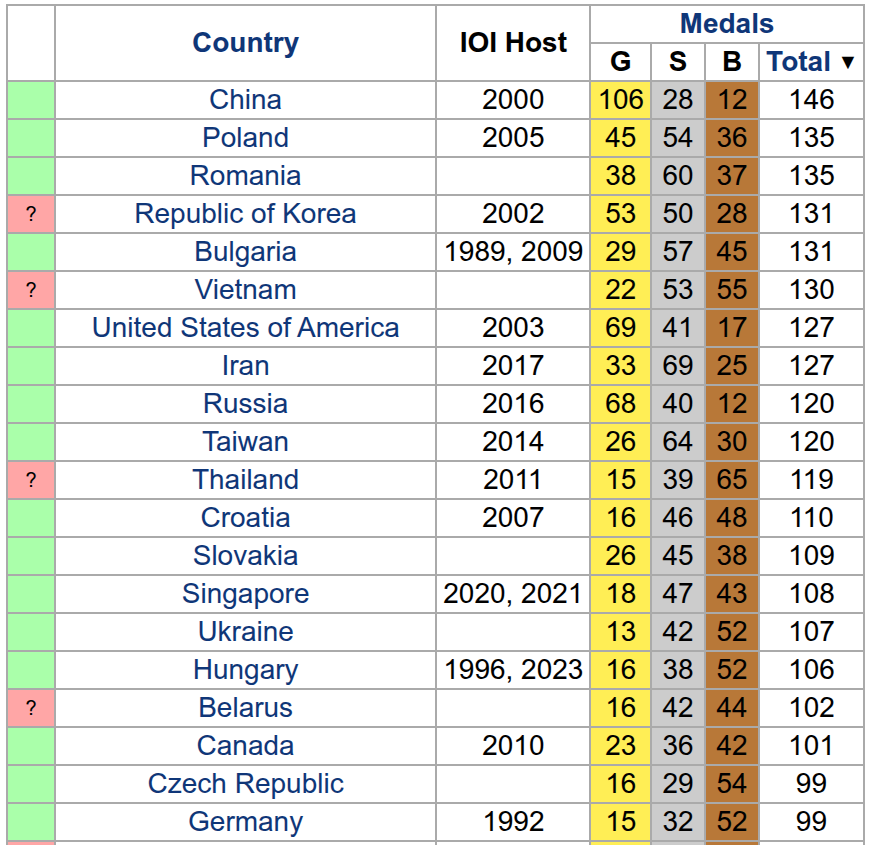
The first 20 countries at the IOI
Also, this is the diagram showing the relation between a country’s IOI rank and its GDP per capita. A higher GDP per capita usually means the country is more developed and people have a good standard of living, so they can invest in areas that are not essential for survival. As you can see, there is no meaningful correlation between these two parameters!
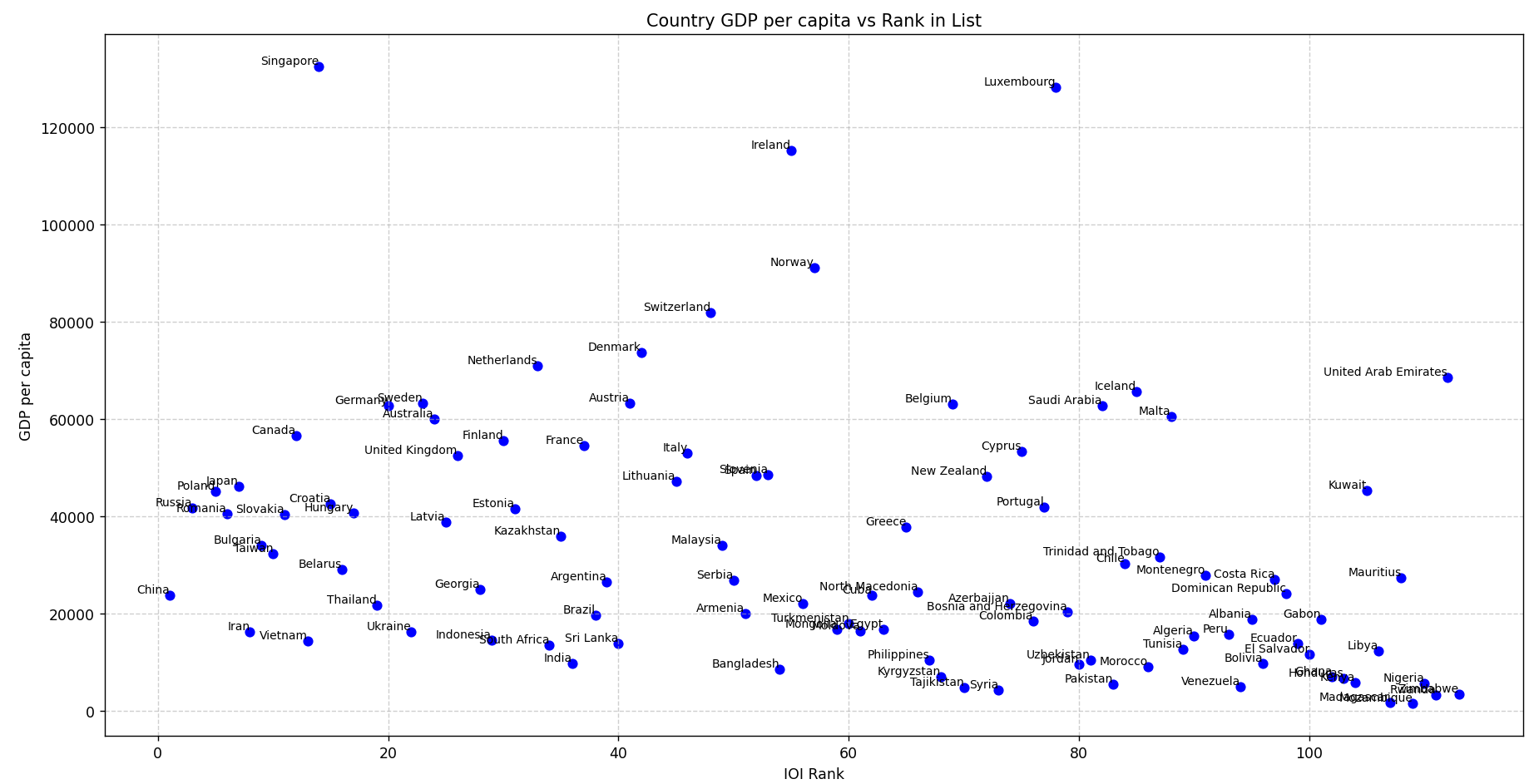
Correlation between GDP per capita and IOI rank (click to see high quality photo)
Knowing the experience of other countries and the reasons behind their good results would help the community benefit from others’ experiences and grow CP in all countries.
Please share with us why your country is great or not great at IOI.
Let me start by telling you the story behind our success in Olympiads, including IOI. Iran is very good at Olympiads, as you may know. We took third place in five main important international Olympiads, considering overall performance. To find the root cause, we should go back in time. Iran participated in the IMO for the first time in 1985. The President at the time was a supporter of Olympiads and elites. The result was great. Shortly, a few laws were passed in favor of Olympiads:
- National gold medal winners can enter any university without participating in the university entrance exam. The number of gold medals is twice the team size, e.g., there are eight gold medals for the Iran National Informatics Olympiads.
- Other national medal winners (around 40 people in each Olympiad) get 20% added to their final score in the university entrance exam. This is a huge number.
Giving such big advantages to people who try for Olympiads made big communities participate in Olympiads. For example, around one hundred thousand Iranian students participated in Olympiads last year. Seven thousand of them participated in the Informatics Olympiad.
I made a YouTube Short describing the politics of our high schools regarding the IOI.


Well, India isn’t good at IOI because it weighs JEE (entrance exam) over Olympiad prep. I’ve heard that countries like China and Russia have dedicated honour classes for really bright students, nothing like this exists in Indian schools.
When I was in India, I heard that some universities are admitting students who won International Medals without JEE. Enigma27 Can you please describe more?
odds of getting admitted via olympiads than through JEE are too low. i dont know the exact details, but i think the olympiad teams usually consists of less than 10 students. so out of a large pool of students, you have really low chances of making it, specially in a country like india with 1.4B population. through JEE, around 16,000 students are admitted into IITs. so, JEE becomes the obvious choice over olympiads. secondly, awareness about olympiads in india is really low.
Yes, they are. In fact, I was gonna mention this, but like thevyomanaut mentioned it's so irrelevant that I chose not to.
Basically it works like this:
IITGN is the only college here with actual respectable olympiad admissions, the rest felt like they were doing it just for the sake of doing it.
If you do the math, they still admit much more people (in %) through olympiads than through JEE.
IIIT Hyderabad also admits people through IOITC, but they have a stupid interview process which is very random. I was asked questions on physics, chemistry and, surprisingly, linguistics. Basically everything unrelated to OI.
The rules just changed from this year I think they will allow the medal winners without JEE.
I don't think that is the main issue to be honest. You can't get into top universities in India with IMO gold as well, but still India's performance in it is far better compared to IOI. The main reason for this is lack of awareness. While 7000 people participated in Informatics olympiad in Iran, only 700 participated in it from whole India. Obviously if less people participate -> less competition -> low results.
This is an important factor too yes
Math is way more widespread than OI, which is an entirely new paradigm. Math is taught in schools, so yeah, it makes sense why we'd have more participants. It's still not surprisingly as competitive as I would've expected, but yeah, it is definitely bigger than OI
The key here is it's not just about spreading awareness, it's about making OI feel as native as math (which can't be done without active school intervention)
Although students study math in school, they still don't know about "real" maths olympiads. I think awareness is the solution here, not necessarily school intervention. Earlier maths olympiad was not this popular, It only became popular after some youtube channels spread awareness and coachings started to recognize it and encouraged students to prepare for it. Almost all coachings provide math olympiad preparation, However there is no culture like that for IOI.
We haven't always been very strong at math, for example if you look at a few years before 2020, our performance was very average. For this reason, I don't think it really depends on the number of participants, because even before 2020, we had similar number of participants. It mainly depends only on how good are your top 6, or 10, or 20. For example, I personally don't think our average camp skill is too different from 2019 or 2020, but the average team skill is of course, much higher.
I think awareness is a very important factor. We experienced in Iran that small cities can perform very well after they get to know about Olympiads. Like they had no national medal before, and they start getting medals in a year or two after somebody awares them.
I can't say about China, but Russia's system is actually built to only seek for talents. If you're not getting 1st place prizes and gold medals in every contest, tournament and olympiad, then you're likely to be in dustbin of history. All in all, it is easier to teach and help four people than to thousands
You gotta use the real "GDP:" PPP
In Pakistan, all contestants at the IOI were from the same school, SundarSTEM School.
The School chose students good at maths. We have international tutors, training, teaching, and guiding the students for the IOI.
I'm from the first batch. :)
and the reason for being ranked 80+ is that Pakistan only particpated 2 years(2024,2025) and the universities here don't care about your medals
It's probably just IQ + culture
I think it's probably because of culture and I feel bad about it besides the administration never took such push to change it here in Bangladesh, we lack community in high schools probably till 12th maybe 99.99% students know nothing about informatics
Btw, here is the correlation between national $$$IQ$$$ and IOI rank if anyone is wondering. The correlation is $$$|r| \approx .68$$$. I'm not quite sure why you don't provide the correlations for your scatterplots (this is the second time you've done this), but I think it is clear that the correlation between $$$IQ$$$ and IOI rank is higher than the correlation between $$$GDP$$$ and IOI rank. This is probably because $$$IQ$$$ is a cause of both $$$GDP$$$ and IOI rank, so looking at the latter correlation is looking at two effects.
Some caveats: I just googled IOI country rank and clicked on the first page, so that's where the data came from. I also had to omit a few countries that Richard Lynn didn't have $$$IQ$$$ data for, such as Macao, China (I'm not sure if this is a country or what). I also didn't include the ones that don't exist anymore, like Yugoslavia. Overall, $$$n = 106$$$.
The correlation might be slightly deflated, as there is some range restriction near the right side of the graph. Specifically, there was no way to differentiate between the countries with no medals at all, so I guess they were just sorted in alphabetical order on the page. I still have included them, but this is important to note.
I wouldn't say an $$$|r| \approx .7$$$ correlation is , especially since I have provided the most evidence-based cause of IOI success here (for now).
In Bangladesh, many young students are interested in programming, but few know about IOI, and most lack support from family or school. Even among high school students, very few pursue competitive programming. We face two main problems: 1) lack of support, and 2) academic pressure and limited time. Parents, teachers, and society often don’t value technology, so they discourage CP. Even with family support, students often lack proper guidance or mentors. Those who succeed usually grind alone, relying on luck and skill. We have potential, but these barriers prevent us from unlocking it.
He was such a big supporter of Olympiads and elites that still Olympiad participants and elites flee the country because of him. C'mon.
Maybe I could share some insights about China, though I’m not one of those who have the ability to participate in the IOI. So, I can only share some reasons that apply to all OIers in China.
First, the huge population definitely brings a lot of benefits. There are about 27,000 students participating in the provincial-level contest for high school students (CSP-S). Note that middle school and elementary school students can also join. If we include CSP-J, which is for younger students, the total number reaches about 65,000 students who are all studying informatics olympiad (OI). And you only need to select 4 people from all of them—I suppose that’s not really a hard problem.
Another important reason relates to culture. In China, education is highly valued because most parents see studying as the only and best way to move up the social ladder—specifically, through the highly competitive college entrance examination. If you achieve a high score in OI (for example, by ranking in the top 50 at the National Olympiad in Informatics, or NOI), you can gain admission to China’s best universities without taking the entrance exam. Even if you rank around 100th at the provincial level, you can still receive some benefits during university admissions. In the past, this meant direct admission to good universities; now, it usually means being admitted with a score reduction of about 10–20 points (the maximum score is 750). So, it’s not hard to understand why many parents encourage their children to study OI.
With so many people studying OI and all striving to achieve high scores in contests, there will definitely be some truly talented and hardworking students who get selected to compete in the IOI.
Additionally, schools also have a strong incentive to foster outstanding OI performers. Excellent competition results not only enhance the school’s reputation but also help attract better students. High rankings in contests like CSP-S and NOI are seen as markers of educational quality, which in turn draws more talented and motivated applicants. This creates a positive cycle where strong OI programs contribute to the school’s overall competitiveness.
I think that Germany could definitely do better.
First of all, most European countries' universities (with the exception of the UK, which seems to care about a multitude of factors) value your grades at school over your Olympiad results, yet many students in Europe would prefer to stay in Europe, so naturally, we invest more time into that. However, the German school system, for example, forces you to study a broad variety of subjects instead of few subjects in-depth, contrary to the Chinese or the UK system. Because of the high value of our school grades, we don't have much time for IOI training, resulting in less topics being covered.
Secondly, Germany's IOI training qualification process is complicated and tedious, involving a long-term competition, the Bundeswettbewerb Informatik, which is much more similar to writing an actual scientific paper than to the IOI. Then, from the top 70 of participants in that, we choose people through actual IOI-style qualification contests.
Finally, to be honest, in my opinion, the training isn't the best for encouraging people to participate in it. People travel for hours to live in cheap hostels for a few days, write two to three contests and depart again. It could be made much more attractive — we do have sponsors.
I don't know about the correlations, but I must express that the ranking method you have chosen is somewhat perplexing. I would definitely put a 69-41-17 split over 22-53-55, it makes little sense to order countries by total number of medals.
If anybody is curious, I tried dividing all medal counts by the number of participations for that particular country and sorting lexicographically by (G, S, B). Probably, an even better method would be to include only the last ~20 (or even less) years, but I think I've had enough of bs4 for today...
this is some very interesting statistics you crafted!
Usually there are a few strong schools behind the strong IOI performance, each school has at least one dedicated rock start teacher.
At first I found their rank highly related to the most right column of the medal table, but then I realized my mistake.
You can easily conclude that all top 10 countries have a national olympiad and have a good team selection method.
The way I see it to make progress is by encouraging participation in olympiads, like:
And it depends on those 4 things how good are they provided.
Nice observation. Do you have a source showing countries giving money prizes?
Well, I discussed this with GPTs most of the time, and they provided me the reference websites.
Some Codeforces blogs and Reddits discussed this:
To improve the plot, you should flip the rank (0 is worse) and the axes, so it's more readable since we want to "predict" how good the rank is from the GDP.
Also, it would be good to see a plot with the GDP instead of the GDP per capita, like a country composed of only 10 random billionaires clearly wouldn't win the IOI.
Another thing that I observe is that if you remove the countries that have obtained a high GDP due to politics or geography, rather than being an industrial or intellectual power, {such as UAE, Kuwait, Saudi Arabia (oil), Mauritius (tax haven), Iceland (I think geography helped a lot there)}, you get a much better correlation of GDP per capita with IOI rank.
I think the rank is more correlated with the scientific culture of the country, or more specifically the "science olympiad culture" which is correlated with GDP in general, not unlike the "sports olympiad culture" where you see the same trend.
Edit: I made a plot of a linear model based on log(population) and log(GDP per capita) https://imgur.com/a/MJVk0Dt