


Hello Codeforces!
We are excited to share a massive update for the Repovive extension. Our goal remains the same: to provide an all-in-one toolkit for Competitive Programmers. Whether you are upsolving, practicing, or competing, we want to make your life easier.
This update comes in two parts: features that are Live Now in the store, and a sneak peek at ground-breaking features Coming Soon (currently in review).
TLDR; Check the AI Coach Chrome Extension Here: Repovive Competitive Programming
Live Now: Multi-Model AI, Dark Mode & More
The latest version published to the store brings significant power-ups:
1. The Trinity of AI Coaches: ChatGPT + DeepSeek + Gemini
Why settle for one when you can have three? The AI Coach now supports ChatGPT and DeepSeek alongside the existing Gemini integration. - Stuck on a problem? Get hints, code explanations, or complexity analysis from your favorite LLM. - Switch between models seamlessly to get different perspectives on a solution.
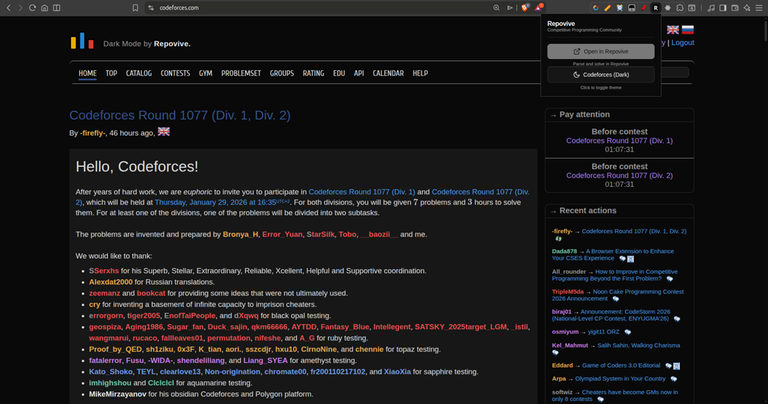
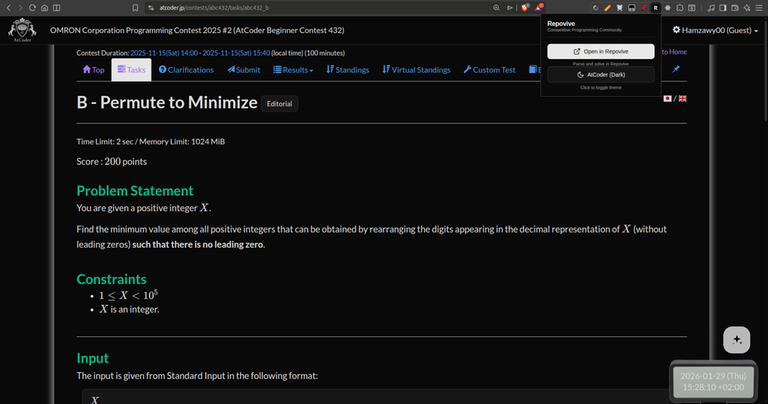
2. Native Dark Mode (Codeforces & AtCoder)
Save your eyes during those late-night upsolving sessions. We've added a highly requested Dark Mode that works beautifully on both Codeforces and AtCoder. - Automatically injects a sleek dark theme. - Toggleable via the extension settings.
3. Private Group Support
Repovive AI Coach now works inside Private Groups!
(Note: Solution fetching for private groups is currently limited, but the editor and other tools are fully functional).
4. Code Editor Improvements
We've squashed annoying bugs related to language selection in the embedded editor. Your coding experience should be smoother than ever.
In Review (Coming Very Soon)
We have another update currently waiting for approval that introduces features you won't find anywhere else:
1. Live Rating Predictor
Predict your rating changes directly on the Codeforces standings page. No need to wait for the system update!

2. Problem Rating Predictor (New!)
This is a game-changer. Ever practiced on Gym mashups or unrated problems and wondered "What rating is this?" Our new Problem Rating Predictor uses AI to estimate the difficulty rating of any problem, even if it doesn't have an official tag.

Install / Update
Get the latest version here: Repovive Competitive Programming
As always, we love your feedback. Let us know which AI model you find best for competitive programming!
Happy Coding!


Auto comment: topic has been updated by Hmzaawy (previous revision, new revision, compare).
Auto comment: topic has been updated by Hmzaawy (previous revision, new revision, compare).
Auto comment: topic has been updated by Hmzaawy (previous revision, new revision, compare).
Auto comment: topic has been updated by Hmzaawy (previous revision, new revision, compare).
Auto comment: topic has been updated by Hmzaawy (previous revision, new revision, compare).
How will the Problem Rating Predictor estimate the ratings?
The Core Concept
The system estimates how difficult a problem is by analyzing who solved it. The key insight: - If mostly high-rated users solve it → problem is easy - If mostly low-rated users solve it → problem is hard
- If all users solve it → problem is trivial (rating = 0) - If no users solve it → problem is impossible (rating = 5000)
The Algorithm
Step 1: Gather Participant Data
Step 2: Count Solvers vs Total
Step 3: Binary Search for Problem Rating
The expected solvers formula: ``` For each participant with rating R: P(solves problem rated X) = 1 / (1 + 10^((X — R) / 400))
Expected_Solvers = sum of all these probabilities ```
Step 4: Binary Search Loop
Example
Say a problem had: - 50 total contestants - 30 people solved it - Average solver rating: 1800 - Average non-solver rating: 1500
The algorithm asks: "At what rating would exactly 30 out of 50 users be expected to solve this?"
Answer: ~1600 (roughly halfway between solver and non-solver average)
Key Formula Deep Dive
Sorry, but can you explain that why we gotta run it >1 times?
Firefox version please :D
OK!