


The ICPC CLI Symposium during World Finals 2025 and the presentation during the NAC 2026 suggested the idea of bringing partial scoring problems to ICPC contests. Based on my understanding, the NAC judge team is announced to have a medium-level task with subtasks/partial scores included in NAQ 2026 / NAC 2027.
As a judge/chief judge for several Asia EC regionals over the past few years, I've been eager to introduce more innovative ideas in regional contests. However, I feel the idea may lead to some non-trivial changes regarding problem-setting and competition strategy. Over the past few days, we, along with many other judges, coaches, and contestants, had several discussions about this proposal.
Since I have yet to see any discussions of this idea on any public forums, I've decided to post this blog. What are your thoughts?


I dont know much about icpc but when i look at standings its often multiple teams with the same solve count differentiated only by their penalty time. I think having subtasks would be great for that , emphasizing the difference of solving ability rather than difference of speed.
I think it would be really bad. Part of the fun of ICPC is strategizing what tasks to do first, and partial points would completely eliminate that.
difference in speed also makes part of a team's solving ability? if that is the logic used then increasing the time of the contest should also make sense
Nah, I don't really like partial scores problem. I think the most interesting part of solving an ICPC format problem is finding the best algorithm, not trying to get 3 out of 4 subtasks.
I love this idea! Allowing partial scoring will make ICPC a lot more interesting and fun.
I think including only one partially scored problem in a contest could make it more interesting, but if there are multiple partially scored problems, penalty would become far less significant.
in my opinion, ICPC is to find the best algorithms to completely solve the problem, not about "biting" to get scores out of subtasks. I find ICPC very fascinating because of this scoring system (not really about penalty, i hate penalty but it's for the leaderboard though =)))))
I liked my experience in IOI-style contests much more than ICPC style ones, as they allow to approach some problems incrementally and it's more rare that you feel stuck. In other words, having detailing scoring helps to not under-perform if your strategy is good but you are unlucky with a problem.
However, the points management is an important part of the strategy, and having public leaderboard removes this part of the challenge. For public standings contest, codeforces C1/C2/C3 problem split looks like a better alternative to me.
Another thing is, not clear how to make the change without making all contest points-based. Basically, if you have 1-2 problems with scores and the rest is 0/100, the knapsack of possible scores has little variety so we'll see the same points across all the teams likely, so not even useful as a tie breaker.
What can work though is a heuristics (!) problem that is a tie breaker. but afaik getting non-zero on heuristics is time consuming usually so it would hurt the real contest part.
What a terrible idea. Subtasks work in IOI because there are 3 problems for 5 hours.
I think allowing partial scoring will make icpc more interesting,it will make participants focus on (Best Solution);Not the fast solution .
Isn't "full correctness" the point of the ICPC format? And If you only solve the problem by getting full scores, I don't see why it is not a Best Solution but a Fast solution.
Yeah, I see your point,and I respect it.
I think I've had some discussion during the World Finals 2025 with some people about subtasks in ICPC. One use I could see for it is that you could add some subtasks to easy problems. Usually regionals (and even world finals) now have some "trivial" problems. Problems which are meant to be solved by almost all teams. For the top teams this can basically just waste some precious time to work on the harder problems, all the more when the easy problems still require implementation while not being so hard.
With subtasks you could balance the easy problems to be slightly harder (and use slightly fewer), while giving easier subtasks which should be more approachable. When the penalty time rule is balanced right, for good teams the strategy would not change much: Just solve the easy problems in full as fast as possible. While giving more fun stuff to do in the lower parts of the scoreboard, except banging your head against a much harder problem immediately.
There are of course way more extreme uses of subtasks, but this wouldn't disrupt the strategy that much while being a nice addition.
I'm happy to chat with anyone who has questions, concerns, or suggestions about this idea. I'm busy today and don't check Codeforces often, but feel free to reach out to me at evouga@cs.utexas.edu or on the ICPC Discord servers.
For those who may not know, Etienne (evouga2) is the chief judge of the NAC and the proposer/presenter in both of these presentations.
There have been some discussions since the announcement released in NAC. I have participated in many of these discussions, and also willing to chatting about my opinion with people. I notice that most discussions are about the influence on contest strategies, or whether this truly resolves the issue from the motivation, i.e. giving people (especially with lower ranking) more things to do.
As I have commented, I would like address one of my biggest concerns here again. From a contest logistics and governance perspective, we cannot rely on a newly introduced rule being used sparingly or only affecting a limited subset of teams or competitions. Once partial scoring is incorporated into the ICPC format, it becomes entirely legitimate to design a contest with, say, six partially scored problems. At that point, the system is effectively indistinguishable from IOI (with a live scoreboard), and the uniqueness of ICPC is fundamentally compromised.
More generally, when introducing a new rule, we should not only consider its intended purpose, but also how it behaves under unrestricted or even adversarial usage. If a rule can be legally “abused” in a way that alters the core semantics of the contest, then that is a design concern in itself.
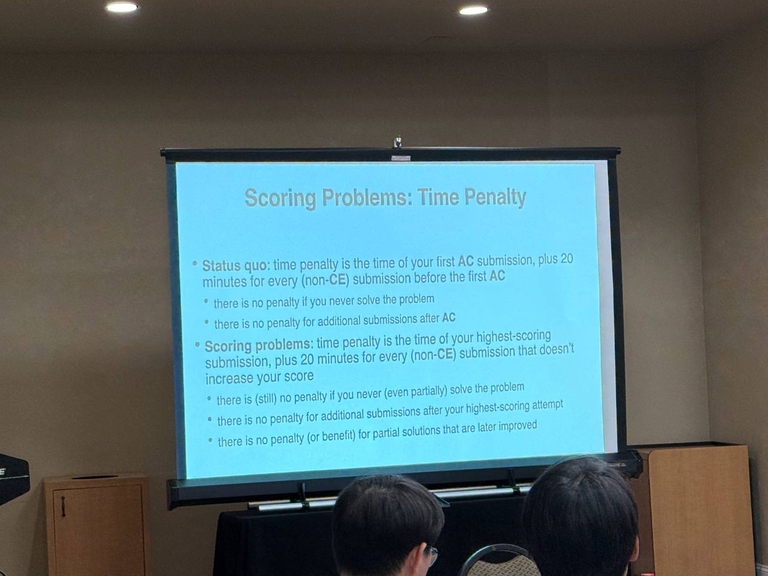
A related point is the penalty system. In the current ICPC format, the penalty mechanism is a particularly elegant and meaningful component, both for contestants and for audience. Partial scoring, if not very carefully constrained, risks blurring the notion of a “solve” and thereby undermining the role and interpretability of penalties.
Finally, even with respect to the original motivation (e.g., improving engagement for weaker teams), partial scoring does not come for free — it still requires careful design of the scoring structure. For example, if a team spends significant effort to obtain a small fraction of points (say, 0.2), it is not clear that this meaningfully differs from simply adjusting the difficulty curve of the easier problems. In that sense, it is not obvious that partial scoring is the most direct or effective tool for achieving the stated goal. Another point worth mentioning related to this motivation is (Thanks to wygzgyw's reminder), whether the survey of such phenomenon (to both contestants in/outside NA regions, also judges) is conducted, we believe it is quite necessary to see more proofs about this maybe before actually proposing changes to adding in a new rule?
TLDR: What's your thought on an ICPC contest with 6 partial-score problems, with difficulties similar to, say IOI. After altering the rule, this is by definition a legit ICPC contest.
Last few words: I understand people love changes (Bill said something like "change is good" in NAC coach meeting), especially in such an era that everything is related with AI. But changes does not guarantee solutions and sometimes even giving it a try may cause negative impacts that is not revertible. That's why we always need to be careful.
Where in the NAPC server? I don't see where this discussion is taking place, but feel free to @ me and I'm happy to discuss the points you brought up.
OK let me come to you at a point when NAC is done.
I'm no expert on this topic, but from my perspective, if there are subtasks for many problems, it can be really tricky to set the scores for them. For example, why is it 10 scores for the first subtask for problem A, but 20 scores for the first subtask for problem B? Why is it better to solve the 3 subtasks in A and 2 subtasks in B than solve the whole problem C? As the problemset is larger, score distribution only gets trickier.
And if there is bias from the problem setter about the difficulties of the problem (because he is more familliar with some topics and not others or something), it may add some kind of bias on the result of the contest, too. This problem also grows as the problemset gets larger.
And the ICPC game may become more about how to decide "which subtask to solve" instead of "which problem to solve", and 10+ problems in subtasks only add to this complexity, which I don't think is about making advance in problem solving.
I think subtasks on ICPC contests is an absolutely terrible idea. Greatly increases the complexity of strategy and resource allocation, makes leaderboards much harder to read, introduces a lot of noise, will basically destroy time penalty system and doubles the effort needed for preparing a contest. Subtasks work well for individual contests with 3 problems, but won't on team contests with 13 problems. Binary scoring is a fundament of this format
I think there can be a balance between there being way too many subtasks and problems being all or nothing. I think there should be subtasks if/only if there is some level of effort/skill required to find the partial solution, so it actually does reward solving ability. Like I'm thinking the equivalent of easy version hard version on Codeforces, instead of USACO/IOI style where there's often a subtask for a brute force that doesn't have really a point in my opinion (literally everyone will get it).
Perhaps we need to make some adjustments based on the partial tasks, because it's too difficult to allocate 13 questions within five hours—this would definitely disrupt the rhythm of problem-solving. It might be better to reduce the number of questions to eight or extend the competition time (though that could be exhausting).
nah , dont make it similar to platforms like hacker rank etc. Just get better at thinking the best possible approach to solve a specific problem lol. NO SHORTCUTS!!
From the comment section, it seems there's an assumption that "subtask" -- a specific form of partial scoring used in IOI -- was suggested. I was onsite at NAC 2026 as an MIT team coach, and I think that assumption is incorrect.
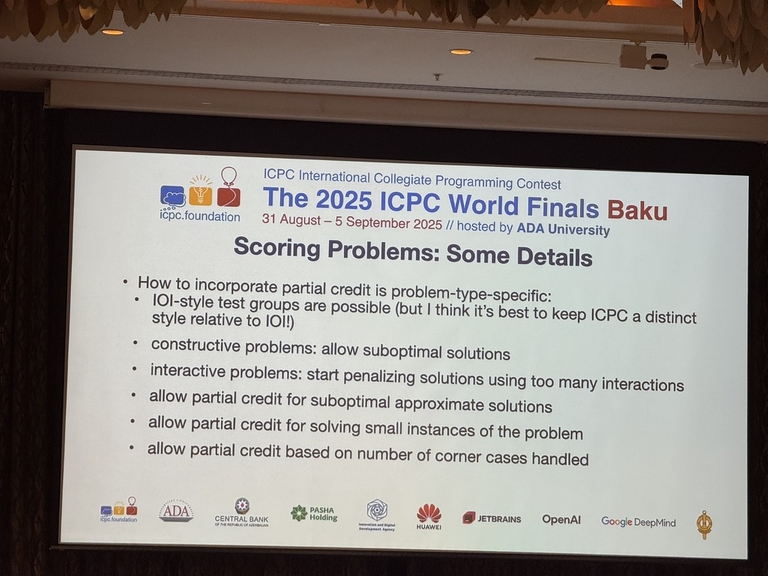
Please take a look at the first picture from the WF 2025. Subtasks are listed as a "possibility", but it is stated that ICPC is not trying to mimic IOI. I see it more as a fractional scoring, where the score is calculated as an average or a minimum across the test data.
Additionally, the goal of this suggestion is to assist the lower-ranked teams, not the best teams. Specifically, this is designed for teams that cannot solve more problems, so they can have some tasks to do and keep themselves occupied.
One example I was told is the Mob Grinder problem from last NAC. Here, if one constructs a suboptimal pattern, the problem can assign a fractional score based on the difference between the required and actual pattern counts.
My opinion is similar to many of the commentators here. Unlike IOI scoring, which can possibly work if there are 5 problems, the suggestion as is would not work, no matter how many problems there are. It will devastate the standings for lower-ranked teams and erode trust in the contest's ranking system. It would not assist them in solving problems, but rather lure them into premature optimization that distracts them from solving the actual problem.
I am very much concerned about the suggestion and would like to continue this comment much longer, but unfortunately, my load prevents me from doing that, so I'll keep it short.
Not as good as Easy/Hard version of a problem, splitting into two tasks, not one.
Except for IOI, partial scores are designed for heuristic contests, not ICPC.