


is it true that  ?
?
→ Pay attention
Before contest
Codeforces Round 1097 (Div. 1, Based on Zhili Cup 2026)
03:51:18
Register now »
Codeforces Round 1097 (Div. 1, Based on Zhili Cup 2026)
03:51:18
Register now »
*has extra registration
Before contest
Codeforces Round 1097 (Div. 2, Based on Zhili Cup 2026)
03:51:17
Register now »
Codeforces Round 1097 (Div. 2, Based on Zhili Cup 2026)
03:51:17
Register now »
*has extra registration
→ Top rated
| # | User | Rating |
|---|---|---|
| 1 | Benq | 3792 |
| 2 | VivaciousAubergine | 3647 |
| 3 | Kevin114514 | 3603 |
| 4 | jiangly | 3583 |
| 5 | strapple | 3515 |
| 6 | tourist | 3470 |
| 7 | dXqwq | 3436 |
| 8 | Radewoosh | 3415 |
| 9 | Otomachi_Una | 3413 |
| 10 | Um_nik | 3376 |
→ Top contributors
| # | User | Contrib. |
|---|---|---|
| 1 | Qingyu | 158 |
| 2 | adamant | 151 |
| 3 | Um_nik | 146 |
| 4 | Dominater069 | 144 |
| 5 | errorgorn | 141 |
| 6 | cry | 139 |
| 7 | Proof_by_QED | 136 |
| 8 | YuukiS | 135 |
| 9 | chromate00 | 134 |
| 9 | TheScrasse | 134 |
→ Find user
→ Recent actions


Codeforces (c) Copyright 2010-2026 Mike Mirzayanov
The only programming contests Web 2.0 platform
Server time: May/06/2026 05:13:43 (k2).
Desktop version, switch to mobile version.
Supported by


Just thoughts.
L is left part, R is right part.
L = PL1 + PL2 + ... + PLk
R = PR1 + PR2 + ... + PRk
My theory is for all i = 1..k PLi > PRi.


Induction. Base i = 1.
So for x > 0: PL1 > PR1
And I really don't know what's next (if I'm on the right path).
Yeah, it is true. But proving this is a bit painful. Here is the only way I know:
Reminder: generating function of sequence is formal series
  .
.
Consider amount of ways to split number in sum of distinct numbers. Generating function for this sequence is
 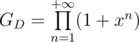 . Now consider number of ways to split number
  in sum of not necessary distinct odd numbers. Generating function for this sequence is
  . Let's multiply each functions by
  . Then first one becomes
  and the second one become
 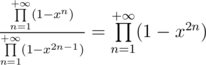 . Thus number of ways to split
  in distinct numbers equals number of ways to split in in odd numbers (you can also prove it with some combinatorics, I guess).
Now consider which is the number of ways to split
  in
in  distinct numbers.
  . Thus if
  then
then  . Then
 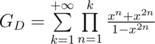 .
.
And with odd numbers part we have . Since
  , we have equation from the statement now.
Understanding of correctness of each transition in proof is left to reader as an excercise ;)