


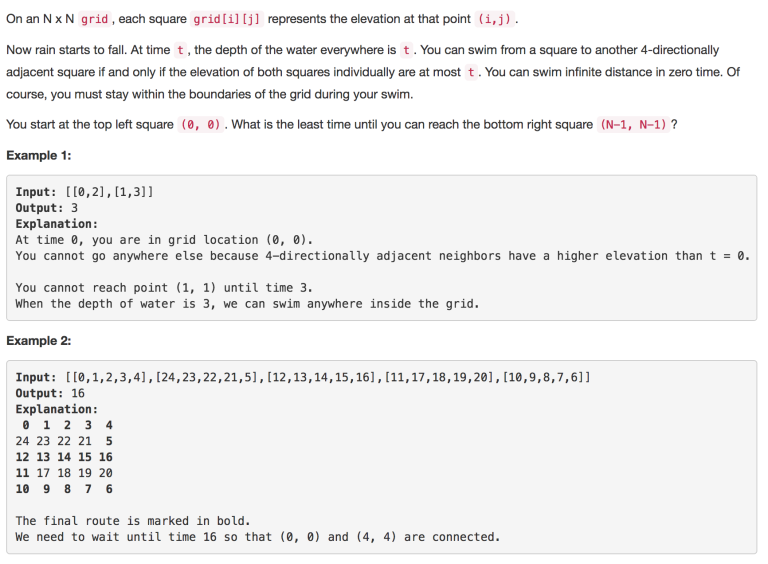
Can someone give some hints? I have absolutely no clue how heap or anything else fits into this? Thank you!


Can someone give some hints? I have absolutely no clue how heap or anything else fits into this? Thank you!
| # | User | Rating |
|---|---|---|
| 1 | Benq | 3792 |
| 2 | VivaciousAubergine | 3647 |
| 3 | Kevin114514 | 3603 |
| 4 | jiangly | 3583 |
| 5 | turmax | 3559 |
| 6 | tourist | 3541 |
| 7 | strapple | 3515 |
| 8 | ksun48 | 3461 |
| 9 | dXqwq | 3436 |
| 10 | Otomachi_Una | 3413 |
| # | User | Contrib. |
|---|---|---|
| 1 | Qingyu | 157 |
| 2 | adamant | 153 |
| 3 | Um_nik | 147 |
| 4 | Proof_by_QED | 146 |
| 5 | Dominater069 | 145 |
| 6 | errorgorn | 141 |
| 7 | cry | 139 |
| 8 | YuukiS | 135 |
| 9 | TheScrasse | 134 |
| 10 | chromate00 | 133 |


I'm not completely sure, but this approach should work — binary search on the final answer.
Assume the answer is <=x. Now, mark arr[i][j]=1 if grid[i][j]<=x and 0 otherwise. Build connected components of 1's in arr. Now the answer is <=x if both the source and destination are 1 and lie in the same connected component of arr. Binary search on x to get your answer.