


Идея: adedalic
Разбор
Tutorial is loading...
Решение (adedalic)
#include<bits/stdc++.h>

using namespace std;

int main() {
#ifdef _DEBUG
	freopen("input.txt", "r", stdin);
//	int tt = clock();
#endif

	int T; cin >> T;
	while(T--) {
		int n, d;
		cin >> n >> d;

		int x, MAG = (int)sqrt(d) + 10;
		for(x = 0; x < MAG; x++) {
			if(x + (d + x) / (x + 1) <= n)
				break;
		}
		cout << (x < MAG ? "YES" : "NO") << endl;
	}

	return 0;
}
1288B - Очередная мемная задача
Идея: Roms
Разбор
Tutorial is loading...
Решение (Roms)
for t in range(int(input())):
	a, b = map(int, input().split())
	print(a * (len(str(b + 1)) - 1))
Идея: BledDest
Разбор
Tutorial is loading...
Решение (Roms)
from math import factorial as fact
mod = 10**9 + 7

def C(n, k):
	return fact(n) // (fact(k) * fact(n - k))

n, m = map(int, input().split())
print(C(n + 2*m - 1, 2*m) % mod)
Идея: BledDest
Разбор
Tutorial is loading...
Решение (BledDest)
#include<bits/stdc++.h>

using namespace std;

int n, m;
vector<vector<int> > a;
int a1, a2;

bool can(int mid)
{
    vector<int> msk(1 << m, -1);
    for(int i = 0; i < n; i++)
    {
        int cur = 0;
        for(int j = 0; j < m; j++)
            if(a[i][j] >= mid)
                cur ^= (1 << j);
        msk[cur] = i;
    }
    if(msk[(1 << m) - 1] != -1)
    {
        a1 = a2 = msk[(1 << m) - 1];
        return true;
    }
    for(int i = 0; i < (1 << m); i++)
        for(int j = 0; j < (1 << m); j++)
            if(msk[i] != -1 && msk[j] != -1 && (i | j) == (1 << m) - 1)
            {
                a1 = msk[i];
                a2 = msk[j];
                return true;
            }
    return false;
}

int main()
{
    scanf("%d %d", &n, &m);
    a.resize(n, vector<int>(m));
    for(int i = 0; i < n; i++)
        for(int j = 0; j < m; j++)
            scanf("%d", &a[i][j]);
    int lf = 0;
    int rg = int(1e9) + 43;
    while(rg - lf > 1)
    {
        int m = (lf + rg) / 2;
        if(can(m))
            lf = m;
        else
            rg = m;
    }
    assert(can(lf));
    printf("%d %d\n", a1 + 1, a2 + 1);
}
Идея: Neon
Разбор
Tutorial is loading...
Решение 1 (pikmike)
#include <bits/stdc++.h>

#define forn(i, n) for (int i = 0; i < int(n); i++)
#define x first
#define y second

using namespace std;

const int N = 300 * 1000 + 13;
const int P = 550;

typedef pair<int, int> pt;

int n;
int a[N];
vector<int> pos[N];
pt ans[N];

int cnt[N];
int tot;

void add(int x){
	++cnt[x];
	if (cnt[x] == 1) ++tot;
}

void rem(int x){
	if (cnt[x] == 1) --tot;
	--cnt[x];
}

int f[N];

void upd(int x){
	for (int i = x; i >= 0; i = (i & (i + 1)) - 1)
		++f[i];
}

int get(int x){
	int res = 0;
	for (int i = x; i < N; i |= i + 1)
		res += f[i];
	return res;
}

int main() {
	int n, m;
	scanf("%d%d", &n, &m);
	forn(i, m){
		scanf("%d", &a[i]);
		--a[i];
	}
	forn(i, m){
		pos[a[i]].push_back(i);
	}

	vector<pt> qr;
	forn(i, n){
		for (int j = 1; j < int(pos[i].size()); ++j)
			qr.push_back(make_pair(pos[i][j - 1] + 1, pos[i][j] - 1));
		if (!pos[i].empty())
			qr.push_back(make_pair(pos[i].back() + 1, m - 1));
	}

	sort(qr.begin(), qr.end(), [](const pt &a, const pt &b){
		if (a.x / P != b.x / P)
			return a.x < b.x;
		if ((a.x / P) & 1)
			return a.y < b.y;
		return a.y > b.y;
	});

	forn(i, n) ans[i] = {i, i};
	forn(i, m) ans[a[i]].x = 0;

	int L = 0, R = -1;
	forn(i, qr.size()){
		int l = qr[i].x;
		int r = qr[i].y;
		if (r < l) continue;

		int x = a[qr[i].x - 1];
		while (L < l) rem(a[L++]);
		while (L > l) add(a[--L]);
		while (R > r) rem(a[R--]);
		while (R < r) add(a[++R]);

		ans[x].y = max(ans[x].y, tot);
	}
	forn(i, m){
		if (i == pos[a[i]][0]){
			ans[a[i]].y = max(ans[a[i]].y, a[i] + get(a[i]));
			upd(a[i]);
		}
	}
	forn(i, n) if (pos[i].empty()){
		ans[i].y = max(ans[i].y, i + get(i));
	}

	forn(i, n) printf("%d %d\n", ans[i].x + 1, ans[i].y + 1);
	return 0;
}
Решение 2 (pikmike)
#include <bits/stdc++.h>

#define forn(i, n) for (int i = 0; i < int(n); i++)
#define x first
#define y second

using namespace std;

const int N = 300 * 1000 + 13;

typedef pair<int, int> pt;

int n;
int a[N];
vector<int> pos[N];
pt ans[N];
int prv[N];

vector<int> t[4 * N];

void build(int v, int l, int r){
	if (l == r - 1){
		t[v].push_back(prv[l]);
		return;
	}
	int m = (l + r) / 2;
	build(v * 2, l, m);
	build(v * 2 + 1, m, r);
	t[v].resize(r - l);
	merge(t[v * 2].begin(), t[v * 2].end(), t[v * 2 + 1].begin(), t[v * 2 + 1].end(), t[v].begin());
}

int get(int v, int l, int r, int L, int R, int val){
	if (L >= R)
		return 0;
	if (l == L && r == R)
		return lower_bound(t[v].begin(), t[v].end(), val) - t[v].begin();
	int m = (l + r) / 2;
	return get(v * 2, l, m, L, min(m, R), val) + get(v * 2 + 1, m, r, max(m, L), R, val);
}

int f[N];

void upd(int x){
	for (int i = x; i >= 0; i = (i & (i + 1)) - 1)
		++f[i];
}

int get(int x){
	int res = 0;
	for (int i = x; i < N; i |= i + 1)
		res += f[i];
	return res;
}

int main() {
	int n, m;
	scanf("%d%d", &n, &m);
	forn(i, m){
		scanf("%d", &a[i]);
		--a[i];
	}
	forn(i, m){
		pos[a[i]].push_back(i);
	}

	vector<pt> qr;
	forn(i, n){
		for (int j = 1; j < int(pos[i].size()); ++j)
			qr.push_back(make_pair(pos[i][j - 1] + 1, pos[i][j] - 1));
		if (!pos[i].empty())
			qr.push_back(make_pair(pos[i].back() + 1, m - 1));
	}

	forn(i, n) ans[i] = {i, i};
	forn(i, m) ans[a[i]].x = 0;

	forn(i, n){
		int cur = -1;
		for (auto it : pos[i]){
			prv[it] = cur;
			cur = it;
		}
	}
	build(1, 0, m);

	forn(i, qr.size()){
		int l = qr[i].x;
		int r = qr[i].y;
		if (r < l) continue;
		int x = a[qr[i].x - 1];
		int cnt = get(1, 0, m, l, r + 1, l);
		ans[x].y = max(ans[x].y, cnt);
	}

	forn(i, m){
		if (i == pos[a[i]][0]){
			ans[a[i]].y = max(ans[a[i]].y, a[i] + get(a[i]));
			upd(a[i]);
		}
	}
	forn(i, n) if (pos[i].empty()){
		ans[i].y = max(ans[i].y, i + get(i));
	}

	forn(i, n) printf("%d %d\n", ans[i].x + 1, ans[i].y + 1);
	return 0;
}
Решение 3 (pikmike)
#include <bits/stdc++.h>

#define forn(i, n) for (int i = 0; i < int(n); i++)

using namespace std;

const int N = 600 * 1000 + 13;

int f[N];

void upd(int x, int val){
	for (int i = x; i >= 0; i = (i & (i + 1)) - 1)
		f[i] += val;
}

int get(int x){
	int res = 0;
	for (int i = x; i < N; i |= i + 1)
		res += f[i];
	return res;
}

int main() {
	int n, m;
	scanf("%d%d", &n, &m);
	vector<int> mn(n);
	iota(mn.begin(), mn.end(), 0);
	vector<int> mx = mn;

	vector<int> a(m);
	forn(i, m){
		scanf("%d", &a[i]);
		--a[i];
		mn[a[i]] = 0;
	}

	vector<int> pos(n);
	forn(i, n) pos[i] = n - i - 1;
	forn(i, n) upd(i, 1);

	forn(i, m){
		mx[a[i]] = max(mx[a[i]], get(pos[a[i]] + 1));
		upd(pos[a[i]], -1);
		pos[a[i]] = i + n;
		upd(pos[a[i]], 1);
	}
	forn(i, n){
		mx[i] = max(mx[i], get(pos[i] + 1));
	}

	forn(i, n) printf("%d %d\n", mn[i] + 1, mx[i] + 1);
	return 0;
}
Идея: BledDest
Разбор
Tutorial is loading...
Решение (BledDest)
#include<bits/stdc++.h>

using namespace std;

const int N = 443;

int n1, n2, m, r, b;
string s1, s2;
int u[N];
int v[N];

struct edge
{
    int y, c, f, cost;
    edge() {};
    edge(int y, int c, int f, int cost) : y(y), c(c), f(f), cost(cost) {};
};

int bal[N][N];
int s, t, oldS, oldT, V;
vector<int> g[N];
vector<edge> e;

void add(int x, int y, int c, int cost)
{
    g[x].push_back(e.size());
    e.push_back(edge(y, c, 0, cost));
    g[y].push_back(e.size());
    e.push_back(edge(x, 0, 0, -cost));
}

int rem(int num)
{
    return e[num].c - e[num].f;
}

void add_LR(int x, int y, int l, int r, int cost)
{
    int c = r - l;
    if(l > 0)
    {
        add(s, y, l, cost);
        add(x, t, l, cost);
    }
    if(c > 0)
    {
        add(x, y, c, cost);
    }
}

int p[N];
int d[N];
int pe[N];
int inq[N];

bool enlarge()
{
    for(int i = 0; i < V; i++)
    {
        d[i] = int(1e9);
        p[i] = -1;
        pe[i] = -1;
        inq[i] = 0;
    }
    d[s] = 0;
    queue<int> q;
    q.push(s);
    inq[s] = 1;
    while(!q.empty())
    {
        int k = q.front();
        q.pop();
        inq[k] = 0;
        for(auto z : g[k])
        {
            if(!rem(z)) continue;
            if(d[e[z].y] > d[k] + e[z].cost)
            {
                p[e[z].y] = k;
                pe[e[z].y] = z;
                d[e[z].y] = d[k] + e[z].cost;
                if(!inq[e[z].y])
                {
                    q.push(e[z].y);
                    inq[e[z].y] = 1;
                }
            }
        }
    }
    if(p[t] == -1)
        return false;
    int cur = t;
    while(cur != s)
    {
        e[pe[cur]].f++;
        e[pe[cur] ^ 1].f--;
        cur = p[cur];
    }
    return true;
}

void add_edge(int x, int y)
{
    add(x, y + n1, 1, r);
    add(y + n1, x, 1, b);
}

void impose_left(int x)
{
    if(s1[x] == 'R')
    {
        add_LR(oldS, x, 1, m, 0);
    }
    else if(s1[x] == 'B')
    {
        add_LR(x, oldT, 1, m, 0);
    }
    else
    {
        add(oldS, x, m, 0);
        add(x, oldT, m, 0);
    }
}

void impose_right(int x)
{
    if(s2[x] == 'R')
    {
        add_LR(x + n1, oldT, 1, m, 0);
    }
    else if(s2[x] == 'B')
    {
        add_LR(oldS, x + n1, 1, m, 0);
    }
    else
    {
        add(oldS, x + n1, m, 0);
        add(x + n1, oldT, m, 0);
    }
}

void construct_bal()
{
    for(int i = 0; i < n1; i++)
    {
        for(auto z : g[i])
        {
            if(e[z].y >= n1 && e[z].y < n1 + n2)
                bal[i][e[z].y - n1] += e[z].f;
        }
    }
}

void find_ans()
{
    int res = 0;
    string w = "";
    for(auto x : g[s])
        if(rem(x))
        {
            cout << -1 << endl;
            return;
        }
    for(int i = 0; i < m; i++)
    {
        if(bal[u[i]][v[i]] > 0)
        {
            bal[u[i]][v[i]]--;
            res += r;
            w += "R";
        }
        else if(bal[u[i]][v[i]] < 0)
        {
            bal[u[i]][v[i]]++;
            res += b;
            w += "B";
        }
        else w += "U";
    }
    cout << res << endl << w << endl;
}

int main()
{
    cin >> n1 >> n2 >> m >> r >> b;
    cin >> s1;
    cin >> s2;
    for(int i = 0; i < m; i++)
    {
        cin >> u[i] >> v[i];
        u[i]--;
        v[i]--;
    }

    oldS = n1 + n2;
    oldT = oldS + 1;
    s = oldT + 1;
    t = s + 1;
    V = t + 1;

    for(int i = 0; i < n1; i++)
        impose_left(i);
    for(int i = 0; i < n2; i++)
        impose_right(i);
    for(int i = 0; i < m; i++)
        add_edge(u[i], v[i]);
    add(oldT, oldS, 100000, 0);
    while(enlarge());
    construct_bal();
    find_ans();
}


Thanks for the nice editorial.
And , Actually am not able to understand how combinatorics is right to use and how it is applied for the Problem C . And also some have solved it using dp , i dont understand that approach either
So, can anyone please help me with my above stated problem.
Thanks in advance
combinatorics — if you have n identical object and r different object number of ways of arrangement is (n+r-1) C r-1 or n+r-1 C n
now in these question n=2*m and r=n and now total number of distribution is (n+2m-1)c(2m) and each distribution can be arranged in ascending order in one way (assuming all boxes identical for one movement and then which ever combination is there u have one way of arrange them in ascending order)
For combinatorics solution of C, we need to find number of non decreasing sequences of length $$$2m$$$ with values between $$$1$$$ and $$$n$$$.
We can convert this problem as follows ( since we want non decreasing values ).
Let $$$x_{i}$$$ denote number of times we take value $$$i$$$ in our sequence. Clearly $$$x_{i} \ge 0$$$. Also,
$$$ x_1 + x_2 + x_3 + ... + x_{n-1} + x_{n} = 2m $$$.
The number of solutions to this is given by, $$$ \binom{n+2m-1}{n-1} = \dfrac{(n+2m-1)!}{(n-1)!(2m)!}$$$. You can read more about Stars and Bars.
Those who haven't understood after reading Stars and Bars what should they consider star and what should they consider bar they can just assume all the position of an array as balls (so we got 2*m ball, right? ) and list all the numbers from 1 to n (inclusive) and think every number as container or a box.
So when you are putting a ball in a box the ball will automatically get the number of the box on it. And you can put as many ball as you want in a box.
so every time we will use all balls and will get different combination from it. And obviously there will be a single permutation for a combination for which after collecting all the balls from the containers(or box!) we can sort them in non-descending order according to their number. :D
Pretty easy, huh? :3
problem i am facing is there might be two sequence whose sorted arrangement produce same result so how can we consider both the sequence as both are same only because we are interested in final sorted sequence. it would be very helpful if someone can explain me this
how can we directly use x1+x2+x3+...+x(n−1)+xn=2m or Stars and bars Theorem here ? isnt there is a condition that the array must be non decreasing sequences ?
The question given in $$$C$$$ is equivalent to "choosing non decreasing sequence of length $$$2m$$$ with values between $$$1$$$ and $$$n$$$".
Proof: If we obtain two sequences, $$$a,b$$$ that satisfy conditions given in question $$$C$$$, then we have $$$a_1 \lt = a_2 \lt = .... \lt = a_{m-1} \lt = a_{m} \lt = b_{m} \lt = b_{m-1} \lt = .... \lt = b_2 \lt = b_1$$$.
Conversely, if we have a sequence of $$$2m$$$ elements, $$$s_1 \lt = s_2 \lt = .... \lt = s_{2m-1} \lt = s_{2m}$$$, then we can make arrays $$$a,b$$$ as $$$a=(s_1, s_2, ..., s_{m})$$$ and $$$b=(s_{m+1}, s_{m+2}, ..., s_{2m-1}, s_{2m})$$$.
Yeah i understand that but my question was as my array must be non decreasing sequences how can i directly use Stars and bars theorm ? isnt that theorm is just randomly choosing repetedly element ?
Oh. Choosing a non decreasing sequence of length $$$L$$$ with elements taking $$$D$$$ distinct values can be modeled as follows.
Sort the $$$D$$$ distinct values. Number them from $$$1$$$ to $$$D$$$. Let $$$x_i$$$ denote number of occurrences of $$$ith$$$ element that we take in the sequence. Then we need $$$x_i \gt = 0$$$, and
$$$ x_1 + x_2 + .... + x_{D-1} + x_{D} = L $$$
Think of it like this, there are $$$L$$$ blank balls in a row, and you need to make $$$D-1$$$ vertical separators between them, and then in $$$ith$$$ segment write value of $$$ith$$$ number on all the balls, this gives a sequence that we require. Two separators can coincide too, so that means we don't take some element at all.
OMG.Thank you so much.. I was not knowing about this Stars and Bars principle.After reading from wikipedia i got it.Thank you so much
Have a look here for Combination with Repitition: https://sites.math.northwestern.edu/~mlerma/courses/cs310-05s/notes/dm-gcomb.
Consider the non-descending sequence given in the editorial. It's a sequence of $$$2m$$$ elements, all between $$$1$$$ and $$$n$$$. The number of ways of building a sequence like that is the answer for our problem. We just need to figure a way of calculating it. So, basically, picking $$$r$$$ elements from a set of $$$n$$$ elements (with replacement, because we can select the same number more than once).
Imagine that, since you are replacing elements, you are "adding" new ones to the set. Each of the $$$r$$$ elements we pick is replaced, except for the last one. In total, $$$r - 1$$$ replacements. The formula is $$${n + r - 1 \choose r}$$$. In this case, $$$r = 2m$$$ (amount of elements to pick). Finally, $$${n + 2m - 1 \choose 2m}$$$.
Your approach of thinking for this problem of combination with replacement seems interesting. However I dont fully understand why that works. Or you can say I'm not able to get this intuition. Can you explain more?
I only know how to understand this using the stars and bars method.
The problems are equivalent! I picked $$$2m$$$ elements from a set of $$$n$$$, with repetitions, right? That's because I considered the sequence of length $$$2m$$$. What if I only considered the amount of times I picked an element, i.e their frequency?
Let's call $$$freq_i$$$ the amount of times I picked the $$$i$$$-th element. It's easy to see that $$$freq_1 + freq_2 + ... + freq_n = 2m$$$. Because $$$2m$$$ is the length of the first sequence.
Now, the question is: how many solutions does this equation have? Any solution can be arranged into two arrays that satisfy the original problem statement. The stars and bars problem will give us the answer: amount of ways to distribute $$$r$$$ identical objects among $$$n$$$ distinct containers. Here, $$$r = 2m$$$. Finally, the formula is (still) $$$n + 2m - 1 \choose{2m}$$$!
Take a look at this comment. The link he posted shows some other problems that are equivalent to stars and bars.
Thank you for the reply.
I am sorry I should have asked my question properly. I already understand how the stars and bars problem relates to solving the problem of combination with replacement.
What I am interested in understand is how you used the intuition of "adding new elements to the set" to consider replacement. i.e. your lines -- Imagine that, since you are replacing elements, you are "adding" new ones to the set. Each of the r elements we pick is replaced, except for the last one. In total, r-1 replacements.
So how does this "adding to the set" thing works to fulfil the replacement issue?
This is just a trick to easily remember the formula. It isn't necessarily right. You can find more explanation here.
I can't understand the number n + 2m — 1, and I don't know r — 1 replacement.why except for the last one? why we can see selection as replacement? Can you explain more clear?Thank you very much.I see it so long but I can't understand.
The number of ways to pick $$$2m$$$ elements from a set on $$$n$$$ elements with repetitions (also called replacement) is given by the closed formula I mentioned above. I recommend that you take a look in this Wikipedia page.
Just explaining my view of it: Replacing an element is adding a new one to the set. We will replace every element we pick, with exception of the last one, because we will have finished the process then. This gives us $$$n + r - 1$$$ choose $$$r$$$. Substitute $$$r$$$ for $$$2m$$$ and you get the formula.
DP Approach:
Consider 2m places to be filled by numbers of range 1 to n and suppose we are at index i and value at (i+1)th index is x so the max value of all the indices less than/equal to i will be x.
Now, we have two cases
1) Assign value of x to ith index and find answer for i-1 places for values in range ( 1 , x ).
2) Find answer for i places for values in range ( 1 , x-1 ).
Base cases:
1) when number of places left is 1 answer will be n (fill it with values from 1 to n).
2) when max value can be 1 answer will be 1 (fill all places with 1).
Recurrence relation num(x,m) = num(x,m-1) + num(x-1,m)
Can you ai<=bi;
Because the question is equivalent to finding a non-decreasing sequence of length 2m where each value lies in [1, n]. So, instead of thinking in terms of two arrays A and B, we now only think in term of a single array and this single array has to satisfy two conditions. i.e. it should be of length 2m and has every value in the range [1, n].
Can you please explain how is the question equivalent to finding a non-decreasing sequence of length 2m?
Why is this giving TLE
I think i have a better solution for A
If not, please let me know
https://pastebin.com/SjQMG52P
can you explain the approach behind it?
So nice solution. And here is the explanation.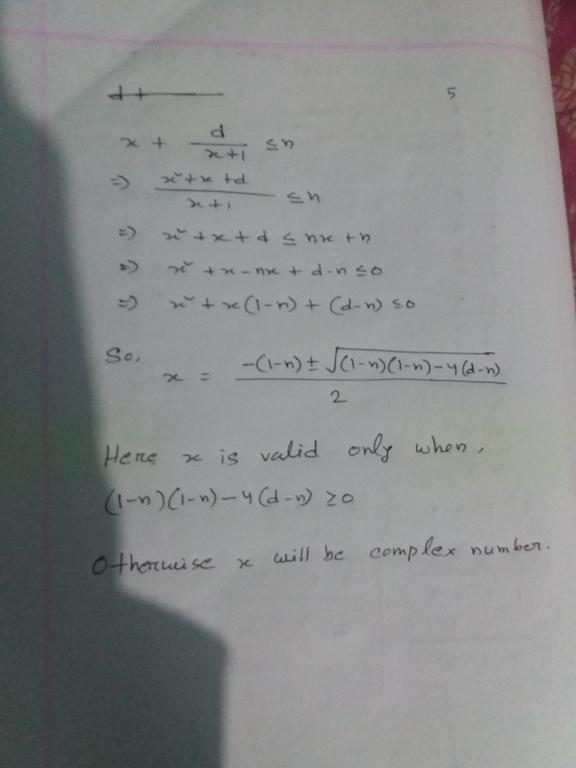
How do you get rid of the ceil function?
x + ceil(d/(x+1))can also be written asceil(x + (d/(x+1))). Forceil(x + (d/(x+1))) <=n,x + (d/(x+1)) <=nholds.Very Nice solution.
I think it doesn't matter if it's ceil or floor as long as there's a solution for x. If there's a solution for x, both ceil and floor will work for this problem.
Persistent segtree in E is mle.
Unfortunate
I managed to fit persistent segment tree (PST) in ML
In my solution there are at most 6*10^5 update queries to PST. Moreover, every query creates O(log) new vertexes and one vertex need 3 integers (it's 12 byte). So, PTS requires 6*10^5*20*12 = 144 MB < 256 MB
I dynamically allocated memory hence each node had an integer and two pointers. But that exceeded memory. Probably i should statically allocate all memory next time.
How to solve D using graph?? (There is graph tag in question!!) if anyone could provide any submission link using graphs that would be very helpful for me,thanks in advance.
Create a graph where each node is a number from $$$0$$$ to $$$(2^m) - 1$$$. There is an edge between $$$u$$$ and $$$v$$$ ($$$u \leq v$$$) if and only if
(u & v) == u. This way, you can go from one bitmask to every other comprehended inside it.When binary searching the answer, for each array on the input you should compute two bitmasks. Let's call them $$$G_{msk}$$$ and $$$L_{msk}$$$. If you are currently trying answer $$$x$$$, then mark elements greater than or equal to $$$x$$$ with a $$$1$$$ on $$$G_{msk}$$$, otherwise $$$0$$$. $$$L_{msk}$$$ is the complement of $$$G_{msk}$$$. That means
L_msk = ~(G_msk).Start a dfs from every $$$G_{msk}$$$ and check if any of it's neighbors is among the $$$L_{msk}$$$. If it is, then you found a pair for current $$$x$$$ as answer. Notice that it means you found two bitmasks such that bitwise or is
(1<<m) - 1.I am having slow rankups XD.
I'm much slower than you. But I don't want to give up ever.
Very nice solution for problem D (fast and compact one). Also very hard to find out such a nice solution like this. Thank for tough problem and its brilliant solution. This helps me learn more about bitmask which I didnt know too much before. Thanks again!
Can someone explain dp approach in problem C
Consider the sequence given in the editorial. I'll call it a "good sequence".
The answer to the problem is the number of ways of building it. Memoize the amount of good sequences you can build from a position $$$pos$$$ given that the last number you used was $$$last$$$. These are gonna be the two states.
Now, we transition through the states: for every number from $$$last$$$ to $$$n$$$, try to use it as the $$$pos$$$-th element of the good sequence.
Submission: 68825881
Would you please tell us(people like me!) how you have created newline in your comment :D
I did (Shift + Enter), but double Enter might do the trick aswell.
In your code..I have seen if pos==m then return 1..let say,if I have 8 in pos-1 then at the last position i have choices of (n-8) then why to return 1
First of all, I use recursive approaches for dynamic programming problems because it's more intuitive to me.
Ok, so you gotta understand that
if(pos == m) return 1is a base case, where I need to stop making recursive calls.The meaning of it is: If the current position for which the function is called is equal to $$$m$$$ — the last position — it means that I was able to build a valid answer until this point. So I need to return $$$1$$$ to increment the answer count.
This is a very common approach for problems that ask you to compute the amount of ways to do something. I hope I was able to explain it clearly, but you should take a look at AtCoder Educational DP Contest.
I'm not a Sports Programming master, so you'll probably learn more by doing it!
nvm i got it
not able to implement (n+2*m-1) C (2m)
please help me how to do it
i tried using tgamma function also as
tgamma(n)=n-1!
Hope this will be helpful. nCr with MOD
Can we use fermat's little theorom to find
ncr%p.Because its giving me wrong answer.Yes that can be used too.
Here is the link: nCr with fermat's little theorem
E can be solved easily using policy based data structure indexed_set and inserting the elements as a pair of negative timestamp of insertion and the index of friend. Every time you remove a friend and insert it at the top, store the max position of current friend, which can be calculated using order_of_key function and adjust the time as -(n+i) where i denotes the ith message, after all the operations loop over all the friends and find the current positions of friends in the set and update max position and min position accordingly.
My Solution : 68882102
Although this is a good trick to know, consider using BIT's instead. They're faster.
your solution modified: 68888920
哈哈
Explained Solution Of Prob. A Using Ternary Search:
May someone please explain B?
By the looks, you know it's a math related problem. So get some paper and write down some equation and solve it. So what is the equation? a*b + a + b = conc(a,b). Now the conc() part is mathematically weird. So you change it into real math. conc(12,23) = 1223 = 1200 + 23. So you are just putting 0s at the end of a, how many? equal to the number of digits that b has that is the length of b, then you are just adding b. So conc(a,b) = a*10^len(b) + b. Now by simple math you have b = 10^len(b) — 1. What does that mean? You started from a*b + a + b = conc(a,b). So if that is true then you have b = 10^len(b)-1, that is b must be equal to some power of 10 minus 1. you know that "some power" is the length of b. and (some power of 10) — 1 is always 9,99,999 etc. You can pick b = 9, 99, 999 or any such number. Then for every a, a*b + a + b = conc(a,b) is true. So all we need to find is how many 9, 99, 999 or this type of number there is within the given range of 1 to b, and you know for each of this kind of number , every possible a is a valid answer. For example, for the input 4 11, you know between 1 to 11 only 9 is a valid b. and for that b every a from 1-4 is a valid answer. so your answer is 1*4 = 4.
I haven't understood this part of problem A tutorial -> "Since the ceiling function is monotonically increasing so we can assume that ⌈f(x)⌉≤⌈f(x+1)⌉ for all x>=sqrt(d)"
You first need to understand concavity. Try my explanation
f(x) = x + d / (x+1)^2, differentiate to get the rate of change, f'(x) = 1 — d / (x+1)^2 . When the rate of change is positive the function is increasing. Here, when x >= sqrt(d), d / (x+1)^2 is always < 1, thus 1 — d / (x+1)^2 is always positive. So the function increases without ever decreasing (monotonically increasing) and that means for any x >= sqrt(d), f(x) <= f(x+1).
f(x) = x+d/(x+1) => f'(x) = 1 — d/(x+1)^2. So as we are considered about positive slope then 1-d/(x+1)^2 >= 0 and form here we should get x >= sqrt(d) -1. so where is this -1 then?
x >= sqrt(d) — 1 is actually the absolute correct equation. But without math, just by looking (which of course saves time) we could say for x >= sqrt(d) function f starts to increase monotonically so if we just run a loop from 0 to sqrt(d) and check for each value if it satisfies the condition is enough. But if your upper bound is sqrt(d)-1 that is correct too.
This competition is great!
why does this 68940816 for prob A fail on test 50! I have used the values of x that would give minimum.
Use double instead of float.
can some one explain the first approach in E and what does the following mean in the editorial "You are just required to count the number of distinct values on some segments."
Let's say you want to count the maximum place for friend 4. Consider the sequence
4 1 3 1 5 4
After the first 4, person 4 is in position 1. Then person 1 moves ahead of them, then 3 moves ahead of them. When 1 messages again, he doesn't move ahead of 4, because he's already ahead. Finally, person 5 moves ahead of 4. So because the segment between the 4's contains 3 distinct values moves, person 4 moves down 3 positions. Thus, for each friend, identify the segments between messages, count the number of unique values of a, and take the largest of them.
I had a solution that's a good deal simpler than persistent segment trees, by exploiting the offline nature of the queries. First, a sweep gives another array p such that p[i] is the previous time a[i] messaged (so a[p[i]] = a[i], or p[i] = -1). Each query now takes the form of "how many values of i (l <= i < r) satisfy p[i] < y". I sort these queries by y, and also sort the elements of p by y, then do a sweep that updates and queries a Fenwick tree.
Incidentally, one doesn't need to treat the initial state separately. Just prepend n, n-1, n-2, ..., 1 to the given sequence: the initial state is consistent with having received that sequence of messages.
can we solve this using only segment tree (Not persistent segment tree) . We can make segment tree of size m and for each number store the position in array of m where it appears . query for each consecutive positions . Like suppose m is 4 1 3 1 5 4 . Make segment tree of this array and suppose for 4 , we can query (1,5) , (5,5) for finding number of distinct integers between them .
See this answer.
Why does problem A pass if we brute force from 1 to n ...very weak test set https://mirror.codeforces.com/contest/1288/submission/68953916 this is my submission that passed
edit: got it...it was my mistake...such an input is not possible that should give tle
I wrote some brood for A, and found what: Let's have some val = n/2; So lets check if our condition with x = val is true; Is it okey, and if yes, why it works?) https://mirror.codeforces.com/contest/1288/submission/68785380
I really liked $$$C$$$. I collected the ideas from many folks and wrote an editorial myself for the $$$C$$$ here.
Here is my code to all the problems that I solved for this contest, if anybody wants to refer.
How can we count the number of distinct values on some segments using segment tree with vectors in node? (In editorial of problem E, "The constraints allow you to do whatever you want: segtree with vectors in nodes, Mo, persistent segtree (I hope ML is not too tight for that)." ) Can someone explain the segment-tree approach?
I think people typically refer to it as a merge sort tree (should be googlable). It's usually used to answer the queries of kind: given $$$L, R$$$ and $$$X$$$, find the number of values less than $$$X$$$ on a range $$$[L; R]$$$ of an array.
So let's rephrase our subtask to these terms. Build an array $$$prev$$$ such that $$$prev_i$$$ is the index of the previous occurrence of the value $$$a_i$$$ or $$$-1$$$ if there is none. Now $$$query(L, R, L)$$$ on an array $$$prev$$$ will count only the values which have their previous occurrence to the left of the query segment. So for each unique value only its first occurrence in the segment will be counted. Thus the result of the query is the number of distinct values on a segment.
My second solution is the example of the implementation.
I see, thank you very much! It seems that we can apply this way to online queries.
Can you please explain how to do the task if we have online queries ?
I think we can deal with online queries using the same approach pikmike referred, because in this approach we don't need to sort given queries.
How can we handle updates too ?
Do you mean updates of values in an array? I refer to only an array whose values are fixed. (Online query means we cannot get next queries before we answer a current query.)
Yes I mean if I update values in an array too. I got your explanation about online queries.
Anyone use BIT for counting number of different number in a given segment for dealing with E :)))?
You can also solve E in $$$O((n+m)+m\cdot logn)$$$ by using an ordered set.
You first initialize min and max values of a number to the position where they originally are, and keep a list of keys of the elements. When placing an element to the top, you look at its order in the set and take the maximum of that and its max value now. You change its min value to 1, and its key to something, that is smaller, than all other keys. You also check the maximum of max values and order of elements at the end of the procedure.
ordered set is $$$O(\log n)$$$ per query. That's literally my third solution but slowed down by using ordered set instead of BIT.
I might be wrong but I would say that ordered set is easier, because you don't have to get the idea of reversing the order of people.
Hi, I had a fairly basic(and probably a stupid doubt). But I tried to run a Brute Force for Problem D in the contest and it gave me a TLE. However, as per my calculation, the complexity of my algorithm is O(m*m*n). Since m<=8 and n<=3*10^5, it shouldn't do that(as in throw a TLE).
Can somebody explain what am I calculating incorrectly? Here's the submission link: https://mirror.codeforces.com/contest/1288/submission/68810165
In your program, you switched up the variables; m is what n is in the problem statement and n is what m is. So m is max $$$ 3\cdot 10^5 $$$ and n is max 8. This means, that your $$$ O(m^2) $$$ solution gets TLE. Also, it's not wise to declare arrays with variable sizes, it can cause errors depending on which C++ version and compiler you are using. You can look the details up online. I would recommend using vectors.
"If we want to verify that the answer is not less than x, we have to choose two arrays such that bitwise OR of their masks is (2^m)−1". Can someone please explain this line to me given in editorial of problem D.
What we are doing is replacing every value in every array with 1 if it is at least x, and 0 otherwise. For example, if we had arrays {1,2,3,4,5} and {6,5,4,3,2}, and x=4 then these would become {0,0,0,1,1} and {1,1,1,0,0}. These are our "bitmasks." If we OR every pair of values at the same index for these two arrays, we get {1,1,1,1,1}. Interpreting this as a string of a binary number is where we get that this is one less than a power of two, in this case 2^5-1.
Guys in https://mirror.codeforces.com/problemset/problem/1288/B this problem can (8,9) or (7,9) be answers. 8 * 9 + 8 + 9 = 89 7 * 9 + 7 + 9 = 79 5 * 9 + 5 + 9 = 59 ???
It is asking how many solutions there are, it is not asking for you to provide a solution.
Yes, according to the problem statement, of course.
I think I'm correctly implementing a Merge Sort Tree for E, giving me O((m+n)log(m+n)) complexity. Can anyone who understands Java help me understand why I'm getting TLE? Thanks!!
https://mirror.codeforces.com/contest/1288/submission/69596326
Never mind; not sure how to delete a message but got it up and running
Beautiful combinatoric solution for C, I love it! I used dp with some kind of weird optimization (calculating prefix sum in the dp matrix). Then it goes to $$$O(n^2m)$$$ and got passed... 70214567
Alternative dp solution for C:
Let's have dp[diff][index] where diff the possible B index — A index. Notice that because the value of the next index for A can never get smaller and the value of the next index for B can never get bigger, the difference will either stay the same or get smaller. For the transition loop from newDiff = 0, to newDiff <= diff. Notice that with the current diff, newDiff can occur (diff — newDiff + 1) times, so we have to multiply it -> dp[diff][index] += nextDp(newDiff, index+1) * (diff — newDiff + 1). So we just sum of these values for the current dp state. The answer will be the sum of dp[x][0], for 0 <= x < n (if you do it recursively).
My code for D is significantly shorter and doesn't use binary search, running in $$$O(nm2^m)$$$ and barely squeaking past time limit.
Basically, for each subset of columns $$$S$$$, I find the maximum across all rows for the minimum element in that subset -- let's call that $$$MaxMin(S)$$$ -- and store whichever row ID gives us that maximum. Then, I loop over all the subsets of columns again. For each subset, I take the minimum of $$$MaxMin(S)$$$ and $$$MaxMin(S^c)$$$, and whichever subset maximizes that minimum is the correct one to take. I find whatever row ID gave us $$$MaxMin(S)$$$ and whatever one gave us $$$MaxMin(S^c)$$$ and print those two.
Maybe code can explain it better. My code is here.
I solved Problem C: Two Arrays ( 1288C - Two Arrays ) with O(n). Kindly have a look if anyone is interested. 75613441
is there any other approach of D!! i don't like BS
Hello, I have a doubt in problem A as the given function has a unimodal graph. I was solving it with a ternary search. As everyone must be aware that there is a condition in a while loop of ternary search. The condition is while(high-low>=3) I found that when I wrote ternary search solution it was giving the wrong answer then I changed that 3 in the condition to 11 it was still giving the wrong answer but on much later test case and when I finally changed it to 100 it got accepted. Can anyone please tell me why it is happening?
As far as I know while(high-low>=x) reduces your search space such that you will finally have x+1 points from [low, high] and the minimum of the function is guaranteed to be in this range.
code failing at test case 6, X = 11 code failing at test case 34, X = 20 code accepted X = 100
Did you figure out ?
Really beautiful solution for problem E. I got the idea about to think for maximum only before its query and at the end, but i think i read the editorial too soon :/
For anyone like me, who neither got Stars and Barns nor any of the comments, try This.
Points to note: The following are equivalent:
The number of combinations of n objects taken r at a time with repetition.
The number of ways r identical objects can be distributed among n distinct containers.
Its n+r-1 C r..
Combinatorics CODE
Combinatorics is Not where I shine !
We simply need to create an array such that a1<=a2<=a3....<=am<=b1<=b2...<=bm.
We will consider it as a single array of length 2m.
Now, create dp[n+1][2*m+1]. (1 indexed).
dp[i][j] represents how many combinations/arrays are possible of length j and the present/current value of jth index is i.
for each dp[i][j] we add all dp[1...i][j-1] i.e. if the current number in jth position is i, then the element in the previous position could be [1...i]. Hence add them all.
DP CODE
E solution using 1 BIT and pbds ordered_set 94656203
E is very simple if you use an ordered set.
So according to problem lets put a1 a2 a3 a4 a5...an on an number line.
Now our b1 should be after a1 on number line(b1>a1) similarly b2 should be after than a2 but b1 should be also after b2 (b1>b2).
So our Number line looks like a1 a2 a3 a4....an bn bn-1 bn-2 .... b1
Now if we observe Carefully then we need to focus only on an( as it is max of a array and will be min of b array(bn can be equal to an) )
So for all i we have to calculate the no of sorted arrays that we can make of length m which have max element as i
Also calculate the no of arrays of length m that have min element as i
Now lets i be our max value of a array then no of ways for this i will be no of times when i,i+1,i+2,,n is minimum for an array which we have calculated above
For more understanding here is my 214402250
I have added Comments
For problem c,as in editorial consider the sequence as a1,a2,a3,..am,bm,bm-1,...b1 now imagine if you have a sequence which is non decreasing you can always form a and b arrays by dividing it from the middle,so question goes down to solving number of non decreasing sequences of length 2m,so since say u use numbers from 1....n with a1 no of 1,a2 no of 2,a3 no of 3s so now a1+a2+a3+a4+a5+..an=2m....(n+2m-1 C n-1)
It's quiet like Euler candy division's problem