


I was giving online exam on hackerearth. The problem statement is 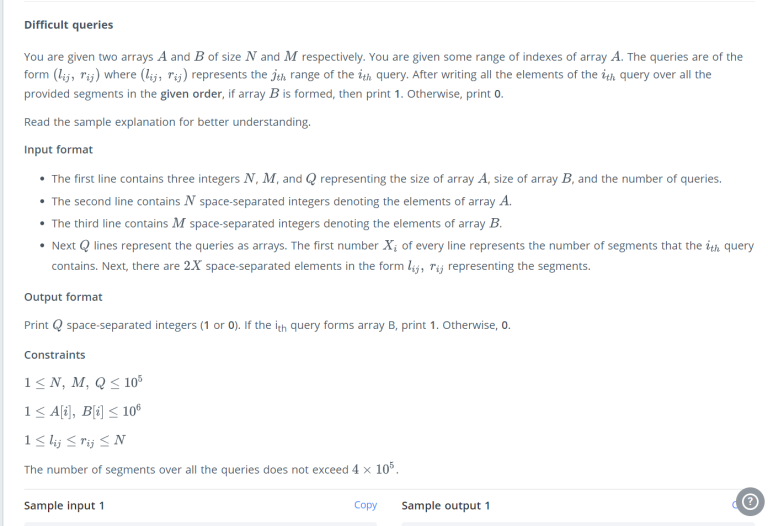
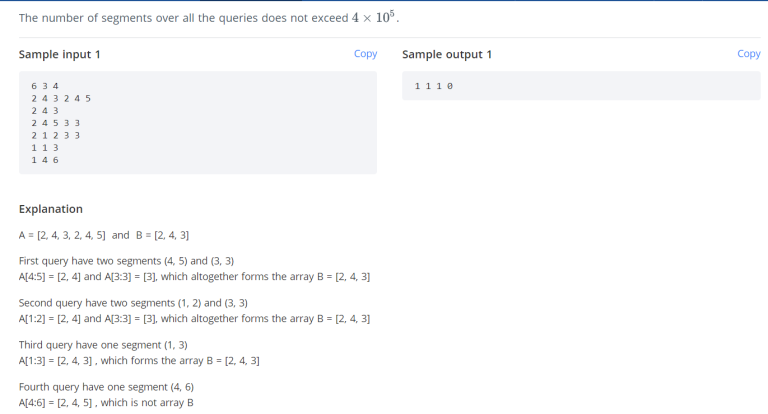
Note: It has already ended few days back.


| # | User | Rating |
|---|---|---|
| 1 | Benq | 3792 |
| 2 | VivaciousAubergine | 3647 |
| 3 | Kevin114514 | 3603 |
| 4 | jiangly | 3583 |
| 5 | turmax | 3559 |
| 6 | tourist | 3541 |
| 7 | strapple | 3515 |
| 8 | ksun48 | 3461 |
| 9 | dXqwq | 3436 |
| 10 | Otomachi_Una | 3413 |
| # | User | Contrib. |
|---|---|---|
| 1 | Qingyu | 157 |
| 2 | adamant | 153 |
| 3 | Um_nik | 147 |
| 4 | Proof_by_QED | 146 |
| 5 | Dominater069 | 145 |
| 6 | errorgorn | 141 |
| 7 | cry | 139 |
| 8 | YuukiS | 135 |
| 9 | TheScrasse | 134 |
| 10 | chromate00 | 133 |


At first, I thought of using polynomial rolling hash function. But since we have integral values, there will be high probability of collision. So, couldn't able to verify its truthfulness.
I can't come up with a better solution, but I think you can use suffix array to compare 2 substrings in O(log(n)) instead of hash. Nevertheless, hash still works pretty well if you use 2/3 mods. (and seems to be easier to implement too?)
I solved it using the above solution during contest and it passed all tests :)
In the contest, I submitted a brute force solution and even that passed, which means that test cases were quite weak.
Very true, I was doubtful that hashing would work, then I thought oh wait I am on hackerearth not on codeforces, walla ac, lol.
Still I guess double hashing or triple hashing would reduce the collision probability.