


Discussion Thread of CodeNation Innovation Labs Hiring Challenge held on 26 January 2021.
PROBLEM 1 :-
Statement
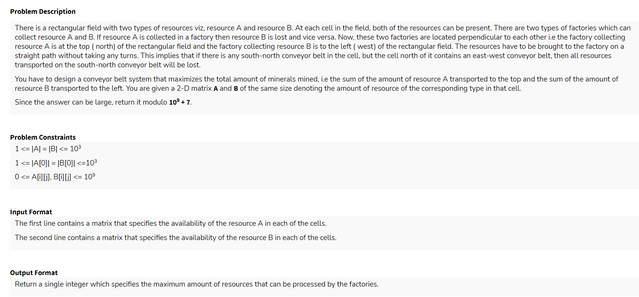
Sample Test Cases
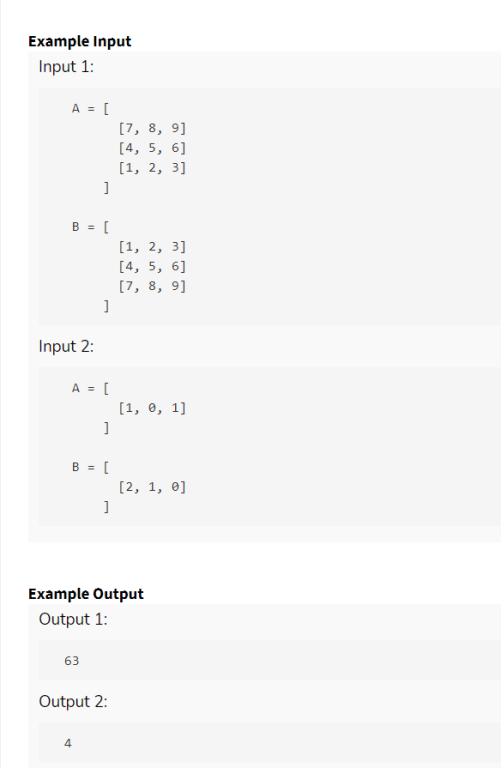
Extra Test Case
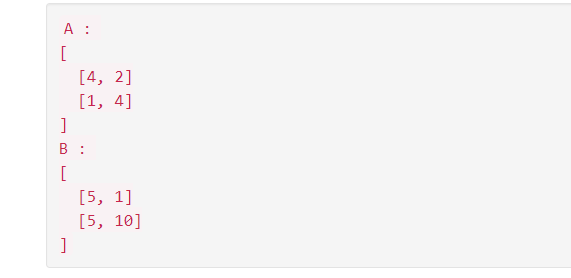
PROBLEM 2 :-
Statement
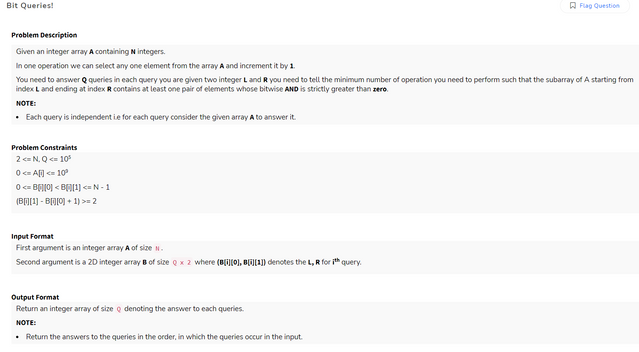
Sample Test Cases
PROBLEM 3 :-
Statement
Sample Test Cases
PROBLEM 4 :-
Statement
Sample Test Cases
PROBLEM 5 :-
Statement
Sample Test Cases
PROBLEM 6 :-
Statement
Sample Test Cases
PS :- THE CONTEST HAS ENDED. THOSE WHO HAVE PARTICIPATED CAN SHARE THEIR SOLUTIONS. INTERESTED NON — PARTICIPANTS CAN ALSO SHARE THEIR APPROACHES.


Video Editorial with Scoring Distribution: https://youtu.be/8tEXXSc351c
Problem 1:
Observation 1: Notice that the left arrows will form a prefix of any row. L U L can be made L U U without affecting anything. Observation 2: The number of left arrows will decrease as we go from the bottom row to the top row.
These 2 solutions lead to a $$$O(N\cdot M)$$$ DP where N, M are the dimensions of the rectangle.
Problem 2:
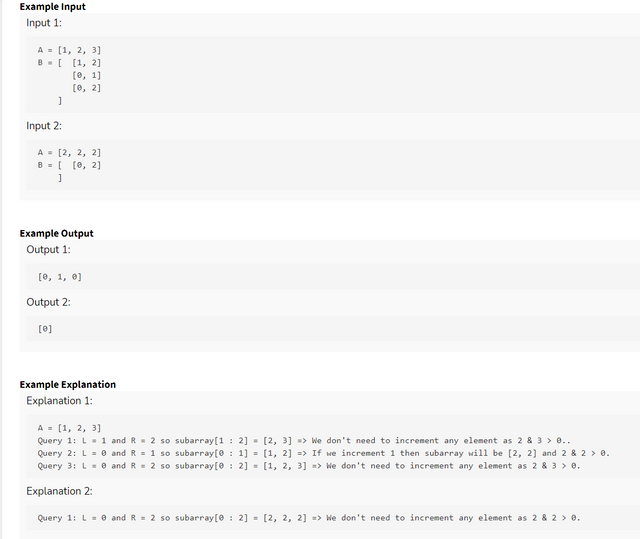
Observation 1: If any bit is set in >= 2 numbers in the range, answer is 0. So we can compute prefix frequencies for each bit. Observation 2: Answer will atmost be 2 because we can make the last bit 1 (having two odd integers in the range is sufficient).
So, with the prefix computation, if answer is not 0, it is 2 — (number of odd integers in the range). Solution complexity: $$$O(N + Q)$$$
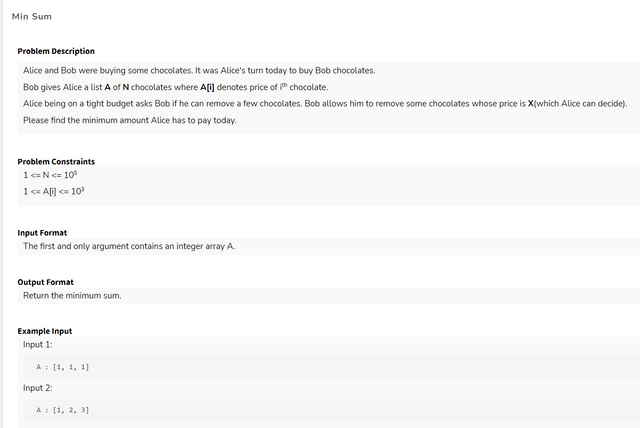
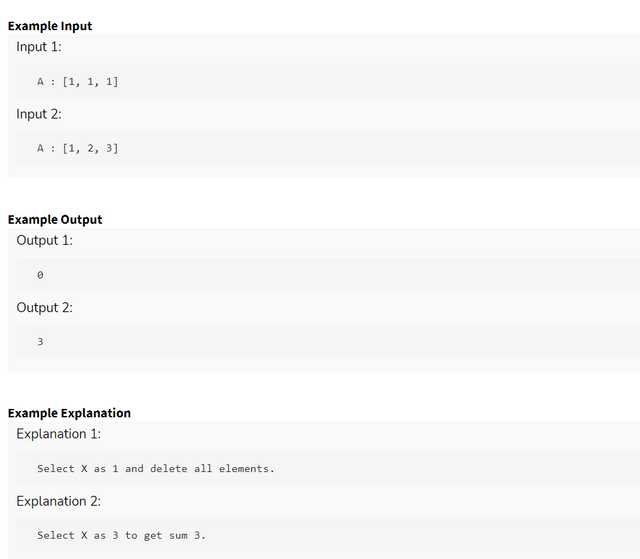
Problem 3: Simple implementation problem — just store the frequency of every number. Answer = Sum of initial array. Then, ans = min(ans, sum — freq(val) * val) for all values. Solution complexity: $$$O(N)$$$
Problem 4:
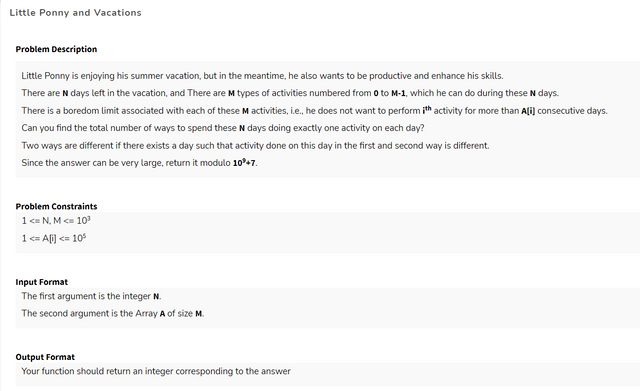
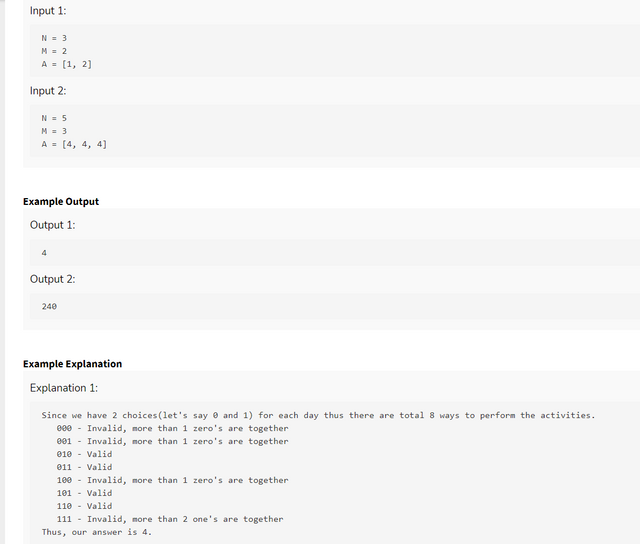
We can have a $$$O(N \cdot M)$$$ DP, where DP(i, j) stores the number of ways of spending i days, where at the last day, we did an activity of type j, adhering to all the constraints. Using prefix summations, we can get the transitions in O(1) time.
Problem 5:
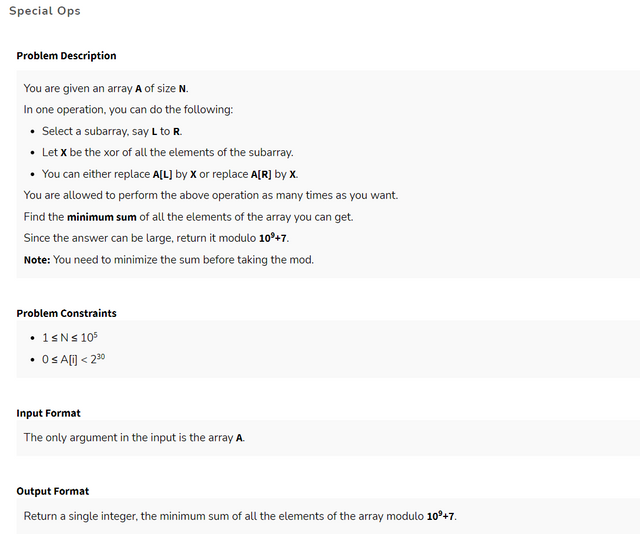
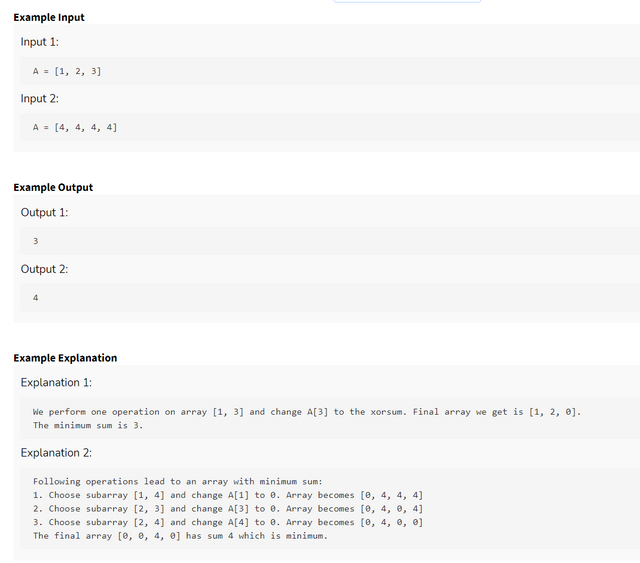
Observation 1: The order of the elements does not matter — we can swap any two elements doing the mentioned operations, and also get the xor of any subset of elements.
Observation 2: The above leads to Gaussian elimination based solution — we only care about the basis (linearly independent set) of elements in the array, since we can get all other XORs from it. Thus, the problem is reduced to finding the basis with the smallest sum. We can do this by finding any basis, and reduce the larger basis elements using the smaller ones.
Solution code: http://p.ip.fi/-1b1
Problem 6:
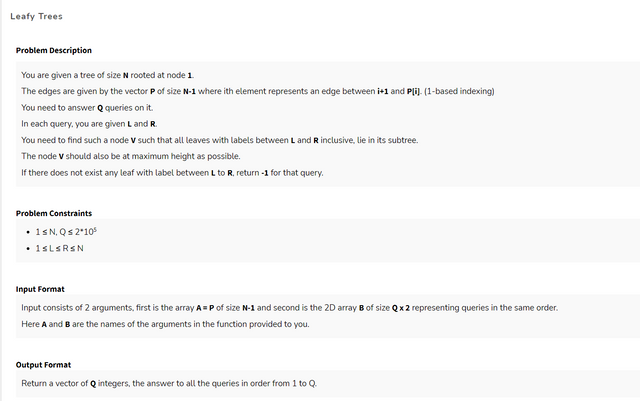
Observation 1: The required node is basically the LCA of all the leaf nodes in the range [L, R]. Observation 2: If we do a DFS order traversal of the tree and store the discovery time of every node, then we only care about finding LCA(first discovered leaf node, last discovered leaf node) in the query range, because all the other nodes lie in between.
Using this, we can solve the problem in $$$O(N \log N)$$$ using various techniques.
Did the questions have uneven points distribution or the same points for every question?
The harder problems had a higher score weightage. $$$P_3 \lt P_2 \lt P_1 = P_4 \lt P_6 \lt P_5$$$.
Were the problems prepared by InterviewBit team or some CodeNation people ?
FEEL FREE TO NOT ANSWER IF THE QUESTION SEEMS IRRELEVANT
Various questions were given the InterviewBit team and I was responsible for reviewing the questions. So we are not the setters, more like coordinators/reviewers.
Why not show this to participants?
Can you elaborate D a little more ?
Can you provide a rough estimate of the scores.
Due to this the people who did if else, if else for 3 hours will get more point than someone who solved genuinely.
How?
Problem 6: Segment Tree + LCA
Video editorial will be very cool. Ashishgup
Yeah Ashishgup
Sure, I'll consider making a video editorial on it tomorrow if enough people are interested :)
It'd be awesome if you could do so
I've uploaded the solutions: https://youtu.be/8tEXXSc351c
Thanks a lot, highly appreciated
plus please make these questions available to some platform so that we can solve these questions properly with proper test cases.
Can you elaborate on problem 4?
Like what will the recurrence relation look like?
yes, dp[day][lastact][streak] is very intuitive but how to reduce it to n^2
remove streak from dimension, and move it transitions instead. then it can be optimized by prefix sums.
$$$dp[i][j] = \sum\limits_{l=1}^{A_j}\sum\limits_{k=1}^{m} dp[i-l][k] - \sum\limits_{l=1}^{A_j}dp[i-l][j]$$$. You can simplify this by defining $$$pre[i][j] = \sum\limits_{l=1}^{i} \sum\limits_{j=1}^{m} dp[i-l][j]$$$
In problem 4, we need to define $$$dp[0][j] = \frac{1}{m-1}$$$. So we define $$$dp[0][j] = 1$$$ and divide the final obtained value by $$$(m-1)$$$. Or was there some easy way to define base cases?
Suppose we want answer for dp[i][j] and i-A[j]<=0, this is the only case we will be using dp[0][j]. Whenever we encounter this case, we can explicitly add 1 to dp[i][j] instead of defining dp[0][j]=1 and dividing it later. This will solve the issue.
Will the ranklist be revealed?
For problem 6, we can notice that LCA can be thought of as a monoid operation, so we can make a normal segtree on the range [1...N] and store the LCA in the segtree nodes. (we can store -1 corresponding to non-leafs, which will work as an identity element: LCA(x,-1) = x = LCA(-1,x))
To make it better we can notice that LCA(X,X) = X, so it is also idempotent, so we can use a sparse table as well. Which gives us a fast solution. $$$O((NlogN+Q) * f(N))$$$. Where $$$f(N)$$$ is the time in which you calculate LCA ($$$O(logN)$$$ or $$$O(1)$$$ depending on how you do it)
P2: answer can be 1 as well. if in the range, we already have an odd number, then we can add 1 to any even number and their AND will be > 0
Please answer this if you have any suggestions.
How do you actually get Ideas while you are stuck. I was trying to do the same problems yesterday. The basis question, I observed that the positions doesn't matter but was not able to get to the actual answer. I ended up having ith bit set if any of the numbers have that bit set. (Lead to WA).
Similarly, I was trying out the Little Pony question using DP but was not able to get to the final answer. More specifically, I was unable to re-arrange the activities, I was stuck in dp[i%2][j] = dp[(i+1)%2][j-k]+dp[(i+1)%2][j]; Realised that this would not rearrange the activities.
Any suggestion would be appreciated. (Also I am practising with keeping question ratings in mind)
In problem 6, was Farach Colton LCA the intended solution to find LCA without MLE? or was segment tree solution for LCA sufficient?
Yes,Lca with segment tree was sufficient.
Could you plz explain how to find the lca using segment tree here , I was able to get the observation required but wasn't able to find a way for lca.
just use standard min/max segtree, and change min()/max() to lca().
also, have lca(leaf, non-leaf) = leaf to get lca of leafs only.
for computing lca(a, b) use any standard way.
oh, nice method, I have never done a problem like this before. Also did you solve all the problems XD
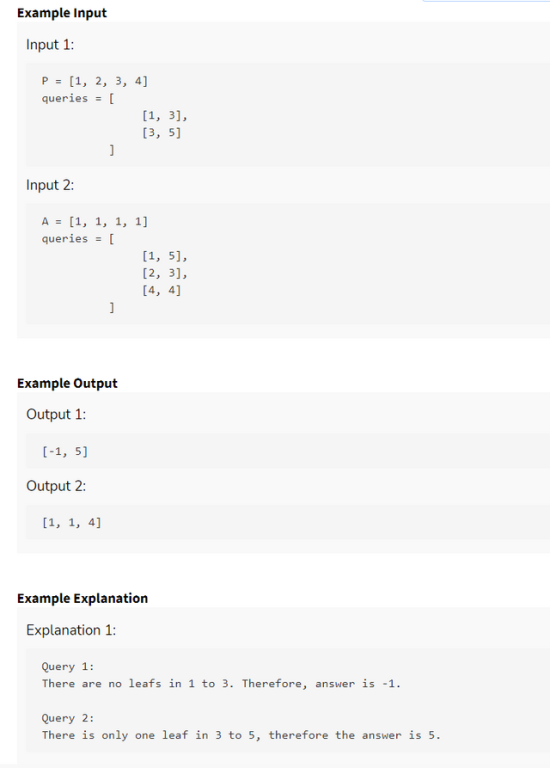
in the first sample case my ans[-1,3] AC->is [-1,5] but lca(3,5) is 3 then why 5 is considered?
Because only the lca of leaf nodes having the label within the given range is asked,you are finding the lca of a internal and a leaf node.
can anyone please explain problem statement of problem 1 , i could'nt even understand problem clearly , i tried hard to understand but couldnt ..plz explain anyone..
This is problem 4 — Problem
How do you guys come to know about these contests? Can anyone participate?
LinkendIn and Codenation social pages.
I solved
P2,P3andP6is there any probability I may get a call?Depends on how many people gave the test and how many peeps CN are going to interview, which might be revealed in some days.
Hey, did you got any response or anything? If yes, please let me know.
No i couldn't solve that many problems to expect a response :(, also i am not sure if they will even hire from this test because of all the cheating and since they are hiring through codechef as well.But for a more sure answer you can ask ashishgup.
So I was wrong, people who solved at least 4 did got interview calls.
Oh!, Thanks for info
Will I get the internship interview opportunity ? I solved first 3 Questions. Ashishgup
can anyone post the solutions of problem 4?
The comment is hidden because of too negative feedback, click here to view it
Can someone explain 5th question solution in a more detailed way? It will be better if you can mention the required mathematical concepts properly.
Ashishgup, could you please tell whether the testcases on which the solutions were tested at the time of the contest were only pretests or full testcases.
After being asked to do it by multiple people, I finally made a video explanation of all of these problems on my youtube channel.
So will the answer for fifth problem just be the bitwise OR of all the numbers according to the second solution you explained
No it won't be just bitwise OR of all numbers (I actually implemented this during contest and got WA xD) Let's say for some bit B you can have a situation of not having an element whose highest set bit is B , and provided that B is set in some elements.
Consider the case 3,6. The answer is 8 but the bitwise OR is 7.
(In particular, the answer will be equal to bitwise OR if all non-zero bits are linearly independent)
I see it now, thanks for replying :)
provide more problems please