


→ Pay attention
Before contest
Spectral::Cup 2026 Round 1 (Codeforces Round 1094, Div. 1 + Div. 2)
11:19:09
Register now »
Spectral::Cup 2026 Round 1 (Codeforces Round 1094, Div. 1 + Div. 2)
11:19:09
Register now »
*has extra registration
→ Streams
→ Top rated
| # | User | Rating |
|---|---|---|
| 1 | Benq | 3792 |
| 2 | VivaciousAubergine | 3647 |
| 3 | Kevin114514 | 3603 |
| 4 | jiangly | 3583 |
| 5 | turmax | 3559 |
| 6 | tourist | 3541 |
| 7 | strapple | 3515 |
| 8 | ksun48 | 3461 |
| 9 | dXqwq | 3436 |
| 10 | Otomachi_Una | 3413 |
→ Top contributors
| # | User | Contrib. |
|---|---|---|
| 1 | Qingyu | 157 |
| 2 | adamant | 153 |
| 3 | Um_nik | 146 |
| 3 | Proof_by_QED | 146 |
| 5 | Dominater069 | 145 |
| 6 | errorgorn | 141 |
| 7 | cry | 139 |
| 8 | YuukiS | 135 |
| 9 | TheScrasse | 134 |
| 10 | chromate00 | 133 |
→ Find user
→ Recent actions


Comments
|
0
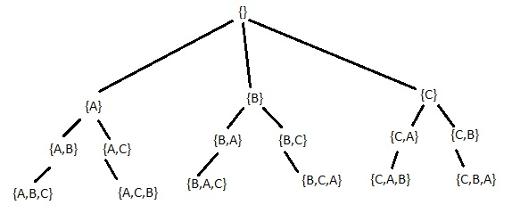
It helps me to think of backtracking (or recursion in general) as doing a depth first search of an implicit graph. In this problem, the "leaves" of the tree (our solutions) are the permutations of the first n letters. In the higher levels of the tree you have prefix/candidate solutions, beginning with the empty string. You can extend prefix solutions by appending the smallest unused letter to the end and recurring. Here's a picture of the tree for the first example: This will find the permutations in lexicographical order, as is clear from the picture. |

Codeforces (c) Copyright 2010-2026 Mike Mirzayanov
The only programming contests Web 2.0 platform
Server time: Apr/25/2026 06:15:52 (g2).
Desktop version, switch to mobile version.
Supported by


