


Dear Codeforces Team,
Thank you for notifying me about the code similarity issue. I'd like to respectfully explain the situation regarding my submissions for problems.
Contest 2143 D1
- Problem Constraints Lead to Natural Solutions:
This is an easy version with n ≤ 300, which naturally suggests using dynamic programming with O(n^3) complexity
The state definition
dp[l][r]is a common approach for subsequence counting problems with ordering constraints
- Standard Coding Patterns:
- The modulo arithmetic handling (
+= cur; if (>= MOD) -= MOD) is a well-known optimization technique - The
dp/ndpswap pattern is standard in iterative DP implementations to save memory - The triple nested loop structure is typical for subsequence DP problems
- My Problem-Solving Process:
- I approached this by considering how to track the "color constraints" through the largest red and blue elements seen so far
- The state
(l, r)represents the maximum values in the two color groups, which is a logical way to ensure the coloring condition
Contest 2143 D2
- Evidence from the author
So now we only have O(n^2) "state updates", but each takes linear time, keeping us at O(n^3). However, the transitions are now simple enough to apply a data structure on them, such as a fenwick tree.This sentence come from the editorial, the author also said that the solution should be fenwick tree, so it is Straightforward to it.
- Beyond compare with other similar codes
lukagvritishvili/339140741 vs Terrorb1ade/339121844. The result of beyond compare is below:

they are totally different.
-tyler_durden/339140213 vs Terrorb1ade/339121844:
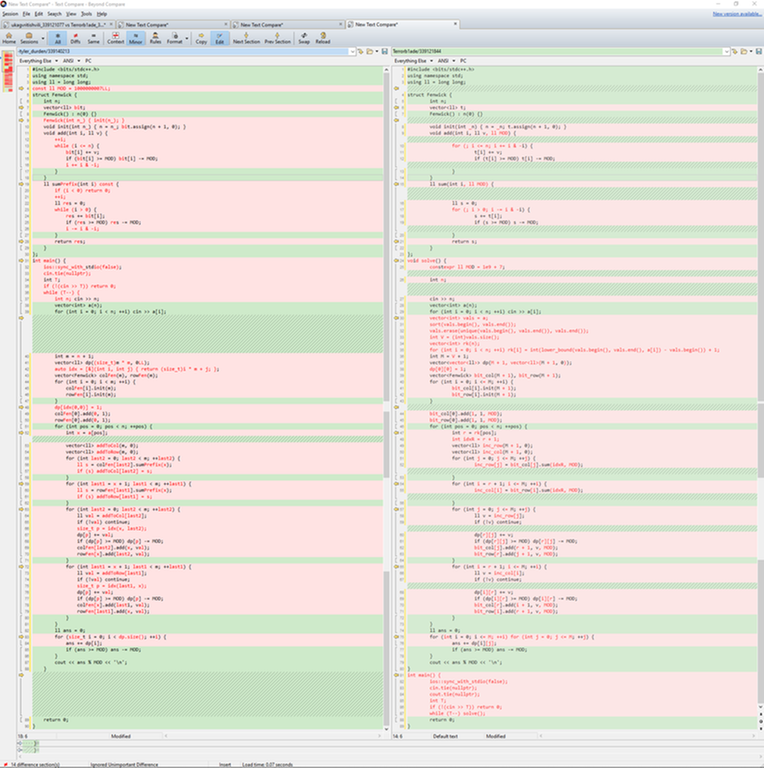
a lot of details are different.
Reduction to absurdity
Assuming that I plagiarize code from other places, let's say, chatgpt. More exactly, contest 2147 G, which is a tough one, but a lot of constants solved it, this is the ac code generated by chatgpt:
#include <bits/stdc++.h>
using namespace std;

using int64 = long long;
const int MAXA = 1000000;
const int64 MOD = 998244353;

// ----- SPF (最小素因数) を線形ふるいで作る -----
vector<int> spf(MAXA + 1);
vector<int> primes_list;

void build_spf() {
    spf[1] = 1;
    for (int i = 2; i <= MAXA; ++i) {
        if (spf[i] == 0) {
            spf[i] = i;
            primes_list.push_back(i);
        }
        for (int p : primes_list) {
            long long ip = 1LL * i * p;
            if (p > spf[i] || ip > MAXA) break;
            spf[ip] = p;
        }
    }
}

vector<pair<int,int>> factorize_int(int n) {
    vector<pair<int,int>> res;
    while (n > 1) {
        int p = spf[n];
        int c = 0;
        while (n % p == 0) { n /= p; ++c; }
        res.emplace_back(p, c);
    }
    return res;
}

int64 mod_pow(int64 a, long long e) {
    int64 r = 1 % MOD;
    a %= MOD;
    while (e > 0) {
        if (e & 1) r = (__int128)r * a % MOD;
        a = (__int128)a * a % MOD;
        e >>= 1;
    }
    return r;
}
int64 mod_inv(int64 a) { return mod_pow(a, MOD - 2); }

int main() {
    ios::sync_with_stdio(false);
    cin.tie(nullptr);

    build_spf();

    int T;
    if (!(cin >> T)) return 0;
    while (T--) {
        int x, y, z;
        cin >> x >> y >> z;

        // m = x*y*z (mod MOD)
        int64 m_mod = x % MOD;
        m_mod = ( (__int128)m_mod * (y % MOD) ) % MOD;
        m_mod = ( (__int128)m_mod * (z % MOD) ) % MOD;

        // m の異なる素因数集合 {p}
        // ついでに "q divides m?" 判定用に set かソート済みベクタ
        vector<pair<int,int>> fx = factorize_int(x);
        vector<pair<int,int>> fy = factorize_int(y);
        vector<pair<int,int>> fz = factorize_int(z);

        // p -> dummy exponent(合算しても区別なく「存在」判定に使う)
        unordered_map<int,int> pExp; pExp.reserve(16);
        auto add_pf = [&](const vector<pair<int,int>>& pf){
            for (auto [p,c] : pf) pExp[p] += c;
        };
        add_pf(fx); add_pf(fy); add_pf(fz);

        // {p} をベクタに
        vector<int> pList;
        pList.reserve(pExp.size());
        for (auto &kv : pExp) pList.push_back(kv.first);
        sort(pList.begin(), pList.end());

        // E_q = sum_{p|m} v_q(p-1)
        unordered_map<int,int> Eq; Eq.reserve(32);
        for (int p : pList) {
            int t = p - 1;
            if (t <= 1) continue;
            auto pf = factorize_int(t);
            for (auto [q, e] : pf) {
                Eq[q] += e;
            }
        }

        // ans = (xyz)^(-1) * Π_{q not| m} ((q^{E_q}+q-1)/q)
        int64 ans = mod_inv(m_mod);

        auto divides_m = [&](int q)->bool{
            return binary_search(pList.begin(), pList.end(), q);
        };

        for (auto &kv : Eq) {
            int q = kv.first;
            int e = kv.second;
            if (e == 0) continue;
            if (divides_m(q)) {
                // q | m のとき寄与は 1(= 何もしない)
                continue;
            }
            int64 q_mod = q % MOD;
            int64 term_num = (mod_pow(q_mod, e) + (q_mod + MOD - 1)) % MOD; // q^e + q - 1
            int64 term = (__int128)term_num * mod_inv(q_mod) % MOD;         // (q^e + q - 1)/q
            ans = (__int128)ans * term % MOD;
        }

        cout << ans << '\n';
    }
    return 0;
}
the code come from physics0523 shared in entry 146629.
Plz don't focus on what I gained, look at what I lost, I lost 252 rating in global round 29, think about it, why did not I use chatgpt to generate the ac code?
Conclusion
I understand that code similarity detection is important for maintaining contest integrity, and I appreciate your efforts in this regard.
Thank you for your understanding and consideration.


