


As far as I noted, Codeforces has had a guide for interactive problem since 2016.
I started Codeforces from middle 2017, and met my first interactive problem on August of that same year (843B - Interactive LowerBound). Honestly, it was a fun experience, though the solution was a bit out of expected convention for interactives.
Ever since, interactive to me has growth in its own way, even appearing in some more local contests as well. Yet, it seems to me that there were still a considerable portion of people having problems with those things even from their mind.
Ever from my first round in early 2019, someone already asked this.
first congrats on your first round second why interactive?
Umm...
Yep, along with that is a major lengthy discussion/prediction on the interactive problem (let's not talk about what happened after that).
Still, at those days, I simply gave them the benefits of a doubt. After all, the problem type is still novel, and there are a quadzillion ways to make an interactive problem function (other than the classic binsearch-simulation).
But that should be a thing back in 2019, right?
Well...
Then I saw this just a few days ago on announcement of Codeforces Round 988 (Div. 3).
...Really?
Okay, okay, but let's just put down my own personal hate on that comment and discuss seriously. If it's just a "new kind of fun", isn't it the same analogy towards the more advanced topics in lower rated participants' eyes? (i.e. flow, 2-SAT; though I honestly won't encourage raw implementations of such in a div3, of course). What is the problem with interactives that give many people an immediate frown even before seeing the problem itself?
The year is 2024 (no it's almost 2025 even what the heck) already, and why are interactives still uniquely discriminated?
(insert some funny propagating hashtags for interactive rights here, I'm a lame guy I can't make up one on the spot XD)
(the discussion I want to raise is still serious though)







 .
. .
. time complexity).
 to
to  .
. (as the number of prime factors of an integer
  ).
). as the minimum number of moves required to make the segment
  is the least moves required to make the segment having color
  is the least moves required to make the segment having color
  .
. queries.
 . Our solution will success if
  (where
  for all
  for all
 . To calculate
  .
. ,
, 
 ,
,  .
.
 means
means  .
. .
. .
. only depends on the appearance or non-appearance of the primes, and the constraints guaranteed us to have at most
  . Still, this complexity is quite high and surpassed time limit on a pretty thin margin.
 .
. .
. for regular arrays, or
  for maps.
 that
that  .
. or
or  (the order doesn't matter here).
 .
. .
. ?
? boxes per each group. Let's denote
  .
. .
. or
or  , based on implementation (I myself did
  and
and  .
. .
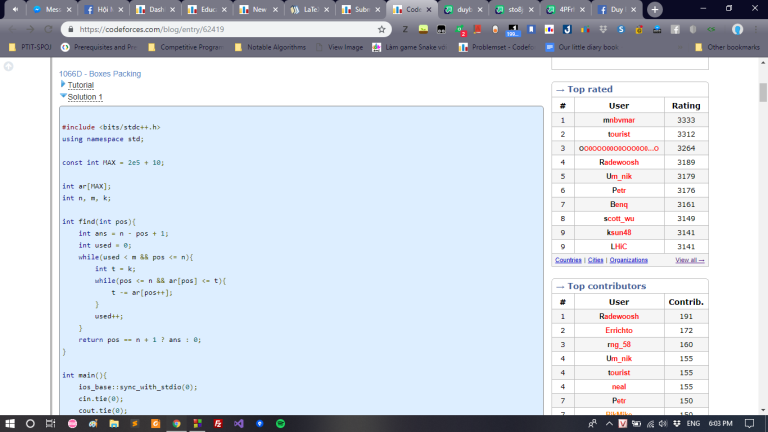
.
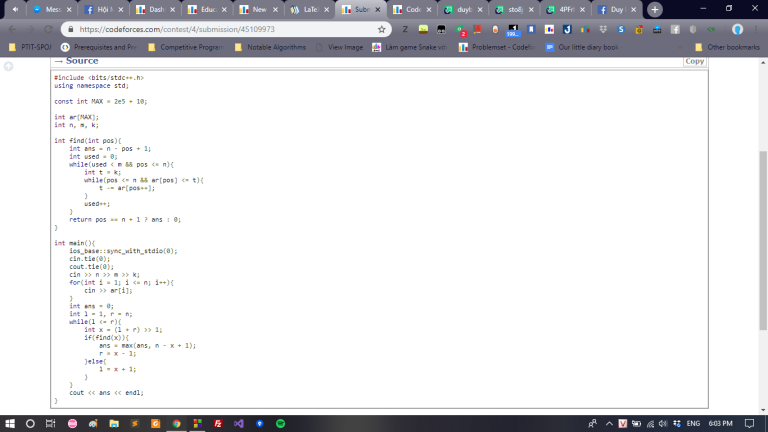
 to
to  that of the line itself, while it's about
  the size in the blog posts.


