Arpa's blog

By Arpa, history, 10 years ago, In English

Hi!

One of the C++ programmers problems is to work with integers greater than 2^64-1 (we can save 0to 2^64-1 in unsigned long long int). So I want to share the best Bignum implementation I have ever seen (Link) with CodeForces Community.

Its specifications are as follows:

  • Supported operations: + , -, / , * , % , ^(pow) , gcd , lcm , abs.

  • It is able to work with Standard Input/Output streams.

  • It can cast data to long long, string.

  • It uses fast multiplication.

source.(but I have edited that and added pow and size().)

UPD1 (September 2016): Bug in void operator=(long long v) is now fixed. Thanks to amsen.

Full text and comments »

  • Vote: I like it
  • +13
  • Vote: I do not like it

By Arpa, 10 years ago, In English

Hi!

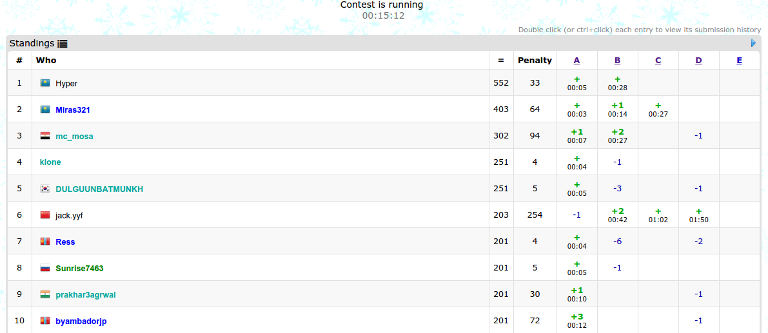
I am in virtual contest and I'm seeing this in my friends standings.

What is the problem?

P.S. top10 in contest:

Full text and comments »

Tags bug
  • Vote: I like it
  • +10
  • Vote: I do not like it

By Arpa, 10 years ago, In English

Hi!

After my previous post about unordered_map now I want to explain hash functions.

std::hash.

C++ STL has one hash function in library <functional>. You can use it for this data types:

template<> struct hash<bool>;
template<> struct hash<char>;
template<> struct hash<signed char>;
template<> struct hash<unsigned char>;
template<> struct hash<char16_t>;
template<> struct hash<char32_t>;
template<> struct hash<wchar_t>;
template<> struct hash<short>;
template<> struct hash<unsigned short>;
template<> struct hash<int>;
template<> struct hash<unsigned int>;
template<> struct hash<long>;
template<> struct hash<long long>;
template<> struct hash<unsigned long>;
template<> struct hash<unsigned long long>;
template<> struct hash<float>;
template<> struct hash<double>;
template<> struct hash<long double>;

For example:

hash<int>hi;
int x=69;
cout<<hf(x)<<endl;
hash<long double>hld;
long double y=69.6969696969;
cout<<hld(y)<<endl;
hash<vector<int> >hv;
vector<int>v({69,69,69,69});//v→ 69,69,69,69
cout<<hv(v)<<endl;
Hand-made hash functions.

There are many ways to create hash function for your struct. For example:

struct reval{
  vector<int>v;
  int n;
  string s;
  size_t hash(){//size_t is alias of unsigned int
    hash<string>hs;
    hash<long long>hll;
    hash<int>hi;
    hash<vector>hv;
    long long ans=hs(s);
    ans<<=32;
    ans|=hi(n);
    ans=hll(ans);
    ans<<=32;
    ans|=hv(v);
    ans=hll(ans);
    return ans;
  }
}

A simple example:(be careful;it is only a sample and it isn't good hash function of course)

struct reval{
  vector<int>v;
  int n;
  string s;
  size_t hash(){//size_t is alias of unsigned int
    hash<string>hs;
    hash<int>hi;
    hash<vector>hv;
    return hs(s)+hv(v)+hi(n);
  }
}

A trick:

struct S{
  string first_name;
  string last_name;
};
namespace std{
    template<>struct hash<S>{
        size_t operator()(S const& s) const{
            size_t h1=hash<string>()(s.first_name);
            size_t h1=hash<string>()(s.last_name);
            return hash<long long>()( (h1<<32)^h2 );
        }
    };
}
int main(){
    S s;
    s.first_name="MohammadSina";
    s.last_name="PakSeresht";
    cout <<"hash(s) = "<<hash<S>()(s)<<endl;
}

Note1: You can use hash<type>()(variable), like this:

int x=69;
cout<<hash<int>()(x)<<endl;

Instead of:

int x=69;
hash<int>hasher;
cout<<hasher(x)<<endl;

Note2: please be careful about combining two hashes. There are two good ways:

1-x*P+y mod M(when P is prime number (like 43) and M is less than 2^32 and not a power of 2 (like 10^9+7)).

2-hash<long long>()((x<<32)^y) or hash<long long>()(x*1000000007LL+y).

Full text and comments »

  • Vote: I like it
  • +5
  • Vote: I do not like it

By Arpa, history, 10 years ago, In English

UPD: Tricks to make unordered_map faster added.

Hi!

What is unordered_map?

It is a data structure like map but it is more than 4 times faster than map.you can use it in C++11 with including #include<unordered_map>.for example:

#include<unordered_map>
using namespace std;
int main(){
  unordered_map<int,int>mp;
  mp[5]=12;
  mp[4]=14;
  cout<<mp[5]<<' '<<mp[4]<<endl;//prints: 12 14
}

Lets explain it more.

How it works?

Focus on unordered_set for simplify.You can imagine that it has vector of vector like vector<vector<type> > mp. Every time you insert value V in that, it calculate its hash(I will explain how it works), let hash(V)=K; it inserts V into mp[K] (formally it calls mp[K].push_back(V)).When you call mp.count(V) it searchs for V in mp[K].

map VS unordered_map (and set VS unordered_set)

1-unordered_map is more than 4 times faster

Focus on problem 527E - Data Center Drama, it seems that it is good to use unordered_map instead of map.

My submission with map: 14269000 Time:484 MS.

My submission with unordered_map: 14269381 Time:358 MS.

Another good sample to show how fast is unordered_map is problem 178C3 - Smart Beaver and Resolving Collisions:

My submission with map: 15781810 Time limit exceeded on test 36 .

My submission with unordered_map: 15774685 Accepted (Time:966 MS).

2-unordered_set (and unordered_map) is not sorted

Please note that set (and map) is sorted, for example *(s.begin()) is always smallest number in the set; but in unordered_set it isn't. similarly there isn't lower_bound and upper_bound in unordered_set (and unordered_map similarly).

Creating hash function for structs

Now, one other problem remains, you can try to compile this code:

unordered_map<pair<int,int>,int>mp;

You will get Compilation Error! Why? See this page for unordered_map supported types. For unsupported types, you have to create your own hash function for use. For example lets see how we can create a hash function for pair<int,int>.

As you know any int value is between -2^31+1 to 2^31-1.so if we create function that for every pair<int,int> returns distinct value in type size_t(alias of unsigned int), it will be done. It is pretty easy: x.first^(x.second<<32) is good. but be careful about overflow ;for having good hash function we use hash<long long>.The code is looks like this:

struct HASH{
  size_t operator()(const pair<int,int>&x)const{
    return hash<long long>()(((long long)x.first)^(((long long)x.second)<<32));
  }
};
unordered_map<pair<int,int>,int,HASH>mp;

Now you have a unordered_map of pair<int,int> (it isn't problem what is second member, in example it was int).Creating hash function for other structs is same.

How to test unordered_map is faster than map?

You can test that for N=10^6, unordered_set(unordered_map) is more than 4 times faster than set(map) ;with this code:(compile code with command: g++ file.cpp -std=c++11 -O2)

#include <bits/stdc++.h>
using namespace std;
unordered_set<int>s;//replace it with set for test.
int main(){
  auto T=clock();
  s.reserve(32768); //updated !
  s.max_load_factor(0.25); //updated !
  for(int i=0;i<1000000;i++)
    s.insert(i);
  cout<<double(clock()-T)/CLOCKS_PER_SEC<<'\n';
}

Note1: Let your hash function H(V), it is better that H(V) returns distinct value for every distinct V, it makes unordered_map faster; but if you can't do that it doesn't problem. The only problem is that unordered_map becomes slower(however it is better than map).

Note2: Please be careful about your hash function time complexly! it is fun to use this hash function:

struct HASH{
  size_t operator()(const pair<int,int>&x)const{
    size_t ans=0;
    for(int i=0;i<x.first;i++)
      ans+=x.second;
    return ans;
  }
};

UPD I will explain hash<type> in my next post.

UPD It seems that sometimes unordered_map becames so slow.but it can improve with this two lines of code:

unordered_map<int,int>mp;
mp.reserve(1024);
mp.max_load_factor(0.25);

With this two lines unordered_map become about 10 times faster. You can replace 1024 with another suitable power of two.(it depends on number of insert s you will do).

Full text and comments »

  • Vote: I like it
  • +47
  • Vote: I do not like it

By Arpa, history, 11 years ago, In English

Hi!

COCI (CROATIAN OPEN COMPETITION IN INFORMATICS) will be held saturday.

Let's discuss about problems after contest.

Full text and comments »

  • Vote: I like it
  • +9
  • Vote: I do not like it

By Arpa, history, 11 years ago, In English

Hello

it will be good for all programmers :)

https://sercantutar.github.io/infint/

Geek trick: you can paste all InfInt.h to top your code for sending it for CF or another programming sites :D

Full text and comments »

  • Vote: I like it
  • +8
  • Vote: I do not like it