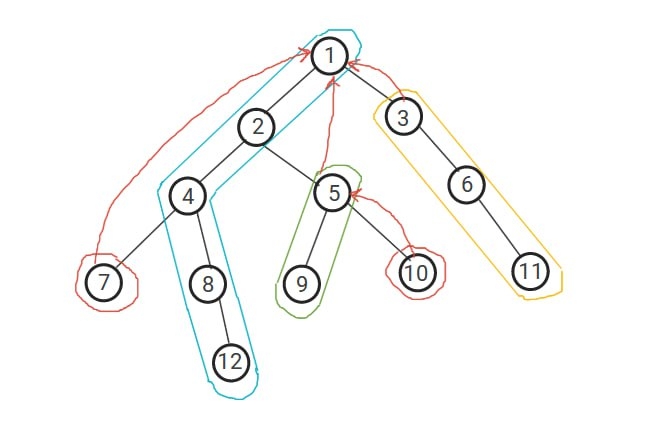
#pragma GCC optimize("O3", "unroll-loops")
#pragma GCC target("avx2", "popcnt")
#include <bits/stdc++.h>
// v.erase( unique(all(v)) , v.end() )    ----->   removes duplicates and resizes the vector as so
using namespace std;
#define IO_file freopen("output.txt","w",stdout), freopen("input.txt","r",stdin);
#define ll long long
#define lld long double
const lld pi = 3.14159265358979323846;
#define pb push_back
#define pf push_front
#define all(a) a.begin(),a.end()
#define rall(a) a.rbegin(),a.rend()
#define getunique(v) {sort(v.begin(), v.end()); v.erase(unique(v.begin(), v.end()), v.end());}
constexpr int mod = (int)(1e9 + 7);
#define log(x) (31^__builtin_clz(x)) // Easily calculate log2 on GNU G++ compilers
mt19937 rng(chrono::steady_clock::now().time_since_epoch().count());
int rand(int x, int y) {
  return uniform_int_distribution<int>(x, y)(rng);
}

const int N = 2e5 + 1;

struct HLD {

  int n; // the number of nodes
  vector<int> sub, top, depth, parent, in, out, seq;
  vector<vector<int> > adj;
  vector<int> dep; // for the lift tree
  vector<int> up[4]; // for the lift tree
  int tick;

  HLD() {}

  HLD(int n) {
    init(n);
  }

  void init(int n) {
    this->n = n;
    sub.resize(n + 1);
    top.resize(n + 1);
    depth.resize(n + 1);
    parent.resize(n + 1);
    in.resize(n + 1);
    out.resize(n + 1);
    seq.resize(n + 1);
    adj.resize(n + 1, {});
    dep.resize(n + 1);
    for(int i = 0 ; i < 4 ; i++){
      up[i].resize(n + 1);
    }
    tick = 0;
  }

  void add_edge(int u, int v) {
    adj[u].push_back(v);
    adj[v].push_back(u);
  }

  void build_HLD(int root = 1) {
    top[root] = root;
    depth[root] = 0;
    parent[root] = -1;
    up[0][root] = root;
    dfs1(root);
    dfs2(root);
  }

  void dfs1(int v) {
    if(parent[v] != -1){
      adj[v].erase(std::find(adj[v].begin(), adj[v].end(), parent[v]));
    }
    sub[v] = 1;
    for(auto &u : adj[v]){
      parent[u] = v;
      depth[u] = depth[v] + 1;
      dfs1(u);
      sub[v] += sub[u];
      if(sub[u] > sub[adj[v][0]]){
        std::swap(u, adj[v][0]);
      }
    }
  }

  void dfs2(int v) {
    in[v] = ++tick;
    seq[in[v]] = v;
    for(auto u : adj[v]){
      top[u] = u == adj[v][0] ? top[v] : u;
      if(top[u] != top[v]){
        dep[u] = dep[top[v]] + 1;
        up[0][u] = top[v];
        for(int c = 1 ; c < 4 ; c++){
          up[c][u] = up[c - 1][up[c - 1][u]];
        }
      }
      dfs2(u);
    }
    out[v] = tick;
  }

  // is u an ancestor of v ?
  bool is_ancestor(int u, int v) {
    return in[u] <= in[v] && in[v] <= out[u];
  }

  // kth ancestor of u
  int lift(int u, int k) {
    if(k < 0 || k > depth[u]) return -1;
    int t = top[u];
    if(depth[t] <= depth[u] - k){
      return seq[in[t] + depth[u] - k - depth[t]];
    }
    for(int c = 3 ; c >= 0 ; c--){
      if(depth[up[c][t]] <= depth[u] - k) continue;
      t = up[c][t];
    }
    t = up[0][t];
    return seq[in[t] + depth[u] - k - depth[t]];
  }

  // lowest common ancestor of u and v
  int LCA(int u, int v) {
    if(depth[u] > depth[v]) swap(u, v);
    if(is_ancestor(u, v)) return u;
    int tu = top[u];
    int tv = top[v];
    if(dep[tu] > dep[tv]) swap(tu, tv);
    if(is_ancestor(tu, tv)){
      for(int c = 3 ; c >= 0 ; c--){
        if(dep[up[c][tv]] <= dep[tu]) continue;
        tv = up[c][tv];
      }
      return parent[tv];
    }
    int k = dep[tv] - dep[tu];
    while(k){
      int c = log(k);
      tv = up[c][tv];
      k ^= (1 << c);
    }
    for(int c = 3 ; c >= 0 ; c--){
      if(up[c][tu] == up[c][tv]) continue;
      tu = up[c][tu];
      tv = up[c][tv];
    }
    return depth[tu] < depth[tv] ? parent[tu] : parent[tv];
  }

};

int main()
{ios_base::sync_with_stdio(0),cin.tie(0);
int n, q; cin>>n>>q;
HLD t(n);
for(int i = 2 ; i <= n ; i++){
  int p; cin>>p;
  t.add_edge(p, i);
}
t.build_HLD();
while(q--){
  int x, y; cin>>x>>y;
  cout<<t.LCA(x, y)<<'\n';
}
    return 0;
}