


After the World Final this year, I think that instead of let the reference material we used rot in a depository, it is better if we can collaborate and polish a piece of reference that can serve as the foundation for any team that wishes to best their skill in contests, or for any person who wishes to achieve a higher rating on Codeforces. After all, who can say that they haven't thought of "color their name red" on this website?
So here it is, Allow me to present you Luna's Magic Reference, which is the foundation we used to develop our reference for the ICPC contests last year: https://github.com/Nisiyama-Suzune/LMR
I hope that you can try to utilize it in the next contest, point out bugs or confusing parts if you find any, and share your own masterpiece of code that can potentialy benefit the whole community.
Thanks in advance and wish you all high rating!



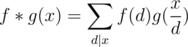
 , we can also claim that
  .
. for a given
  (denoted as
  ) are (miraculously) very easy to obtain in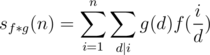
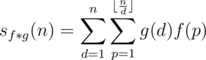


 different elements exist for
  . We can thus recursively calculate the value of those
  into at most
  complexity.
 of
of  , the overall cost should be
  .
. elements of

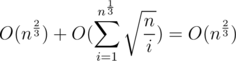
 .
. ,
,  , we can prove that
  (with the "
 is multiplicative first, and then compute
  ), so
), so  .
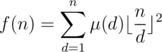
.
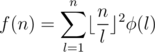

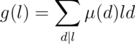
 . Therefore, if we use
  as the hashing function, we can prove that
  and
and  complexity (with the
  ). Let us take a minute to consider the bottleneck of such sieve. While we do need to cross out each composite once, in practice we run the inner loop for a composite multiple times due to the fact that it has multiple factors. Thus, if we can establish a unique representation for each composite and pick them out only once, our algorithm will be somewhat better. Actually it is possible to do so. Note that every composite
  , denoting the sum of the
  . The following code gives an example on the function I've just written.
 refers to the integer division.
 .
. .
. . Hence
  . Since the fraction part of
  cannot exceed
  , we achieve the conclusion.
 . For every
  , there will be no more than
  and is a positive integer, so there can be at most
  , we know that
  , so the sum of the original sequence is approximate to
  . The piece of code below demonstrates one way to program it.
 is also multiplicative. Specifically, if
  is also multiplicative.
 for every positive integer
  , where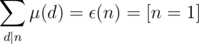
 is multiplicative. After that, we can see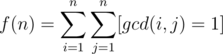
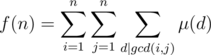
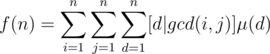
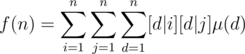

 . Thus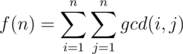
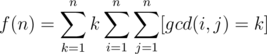
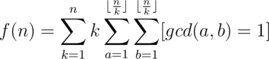
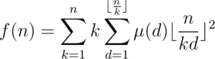
 . Therefore, if we compute the sum above with brute force, the overall complexity will be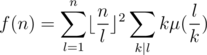
 is multiplicative. Moreover, we have
  , which can be simply computed in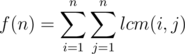
 , let
, let 
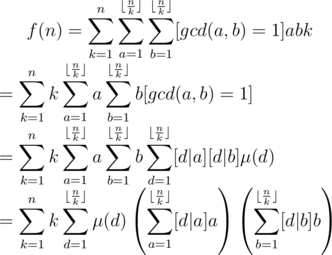
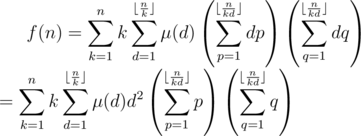
 , and we have

 is also multiplicative, and
  . The overall complexity will be
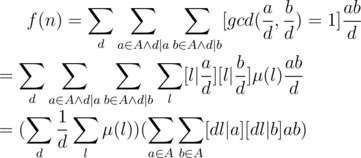
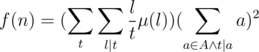
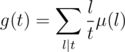 is multiplicative with
  is also fairly easy to figure out if you keep track of the number of the elements equal to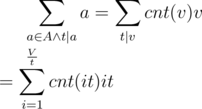
 . Hence the overall complexity is
  .
.


