de_sousa's blog

By de_sousa, history, 4 months ago, In English

This is the editorial for my Small Imprecision Contest ( https://mirror.codeforces.com/gym/106258 ). It is more detailed than regular editorials and is meant to be a standalone blogpost, so it should still be an interesting read even if you didn't participate.

This problem has been passed around as a funny concept in some Discord servers, and it was first proposed by pajenegod in 2023.

This problem doesn't belong in regular competitions, but regardless, I thought it was too cool to not exist, and at the same time, solving it requires some advanced floating point knowledge and intuition; this blogpost is more detailed than usual in an attempt to create a good introduction to these concepts.

With this blogpost I would like to participate in https://mirror.codeforces.com/blog/entry/149422 , a cool initiative by cadmiumky that is rewarding interesting Codeforces blogposts. If you have something interesting to share, please give it a read.

I hope you enjoy it. ^-^

Full text and comments »

  • Vote: I like it
  • +171
  • Vote: I do not like it

By de_sousa, history, 5 months ago, In English

Hello Codeforces!

I'd like to invite you to participate in my Small Imprecision Contest ( https://mirror.codeforces.com/gym/106258 ).

It will be running until the midnight of the 24th of December (UTC+1) and it started the moment this blogpost was posted. The editorial will be published on the 25th.

All four problems are variations of the same problem.

This problem has been passed around as a funny concept in some Discord servers, but there was never a good place for it to belong to. Regardless, I thought it was too good for it not to exist, so I decided to prepare it and give it to you in this format.

Enjoy. ^-^

Full text and comments »

Announcement of Small Imprecision Contest
  • Vote: I like it
  • +146
  • Vote: I do not like it

By de_sousa, 22 months ago, In English

Motivation

I remember struggling to understand the Tarjan algorithm for Strongly Connected Components. The algorithm feels intuitive to me now and I no longer feel this struggle, but what I do still remember is feeling the lack of some good online resource to guide me through it. This is my attempt to write the article I wish I had read.

Directed DFS tree

Before we get to the problem, we have to first understand the most important concept: directed DFS trees. Understanding them will allow for the Tarjan algorithm to feel like a natural extension (and this article is actually about them, not about Tarjan).

A directed DFS tree is an explicit representation of a DFS traversal of a directed graph.

When a node is visited for the first time, it is added to the tree, either as a root if it was visited in the beginning of a DFS call, or as the child of the node it got visited from.

The edges that were used to visit a node for the first time will be considered as part of the tree and be called tree-edges.

Every other edge of the graph will be described in relation to this tree:

  • a forward-edge is an edge that connects a node to a descendant.
  • a back-edge is an edge that connects a node to an ancestor.
  • a cross-edge is any other edge.

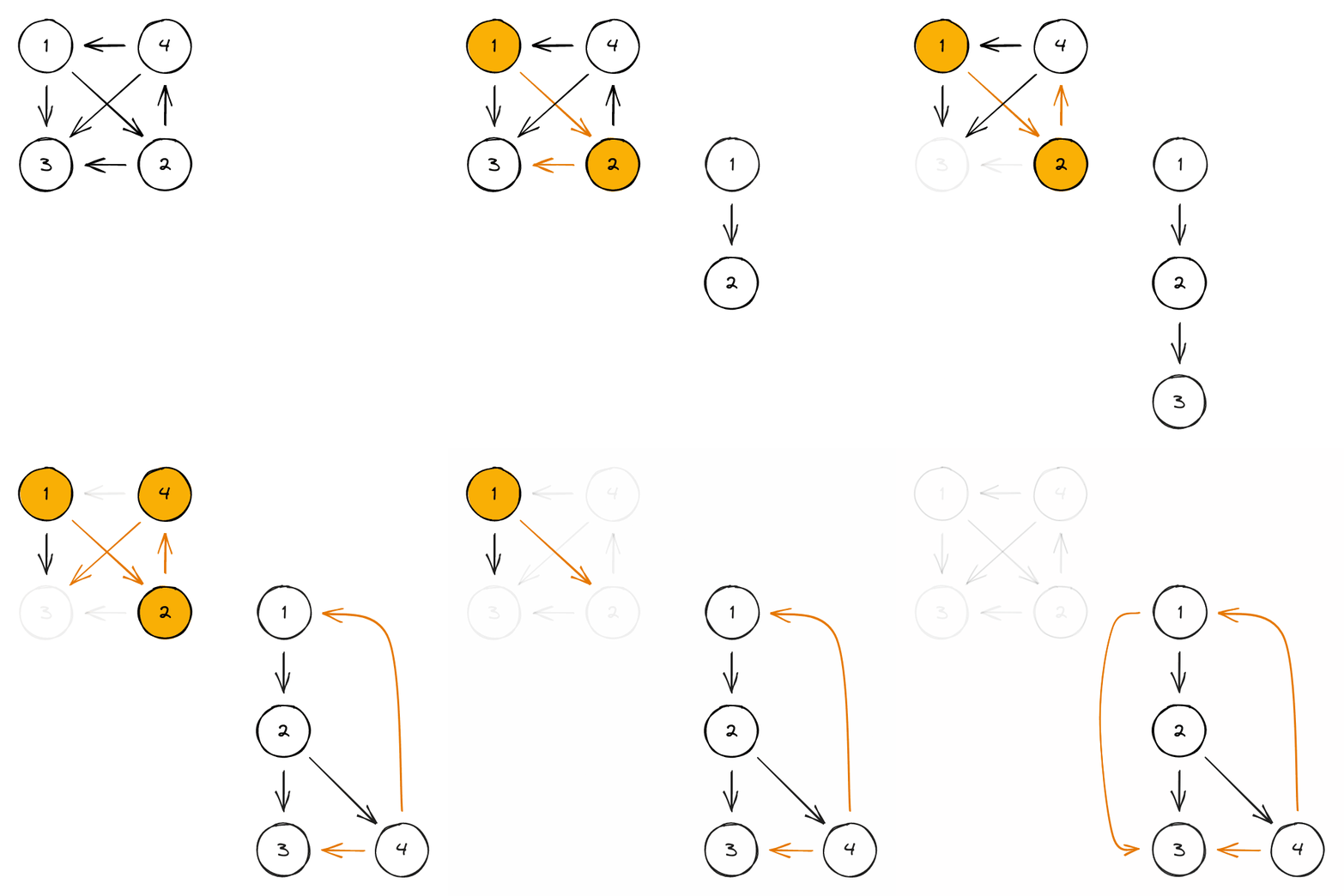
Here is an example of the construction of a tree, with every kind of edge:

Full text and comments »

  • Vote: I like it
  • +199
  • Vote: I do not like it

By de_sousa, 2 years ago, In English

Recently I was recommended the problem CERC'10 J — Justice for All. I really liked the solution I came up with and it's different from the editorial, so here's a blogpost talking about it.

Problem

You are given a number $$$n$$$ and you want to create a bipartite graph with $$$n$$$ perfect matchings, $$$1 \leq n \leq 10^6$$$.

The number of nodes in the graph shouldn't exceed $$$400$$$.

Main Idea

We want to build a kind of graph whose number of perfect matchings can be expanded.

If the graph has $$$x$$$ perfect matchings, we want to be able to expand it so that the new graph now has either $$$2x$$$ or $$$2x+1$$$.

If it's possible to do this, then we can use the binary representation of $$$n$$$ to create the graph.

Solution

Locking Mechanism

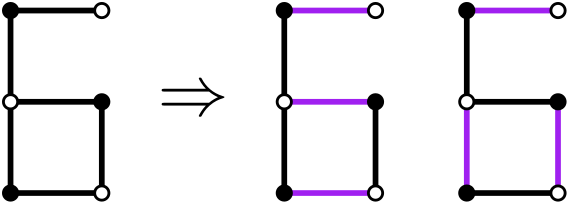
The idea for doubling is simple, we just need to add a graph with two matchings in such a way that it doesn't disturb the configurations that were previously there. Such graph with two matchings can simply be a square:

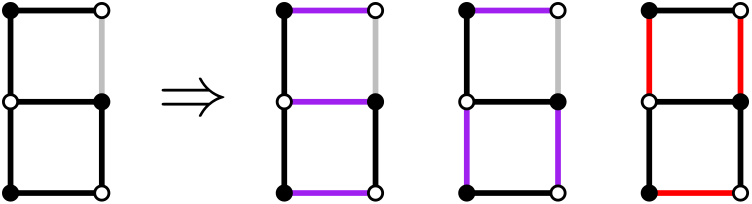
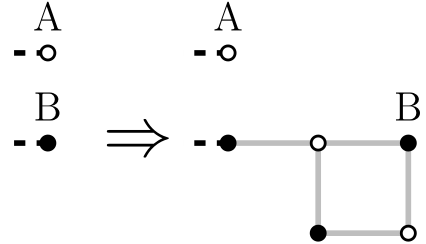
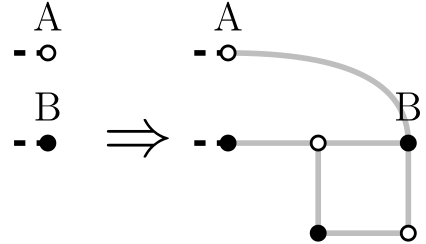
Now for doubling and adding one, we can keep the idea of adding a square, but after adding it we need some kind of locking mechanism that either forces a specific configuration of the whole graph or doesn't disturb the configurations that were already there.

We can see the idea of a locking mechanism on a small graph.

Without the locking edge, it has $$$2$$$ perfect matchings.

With the locking edge, it has $$$3$$$ perfect matchings. When the locking edge is selected the configuration of the whole graph is forced, otherwise it's the same as if there was no locking edge.

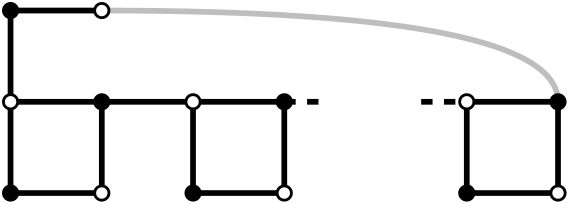
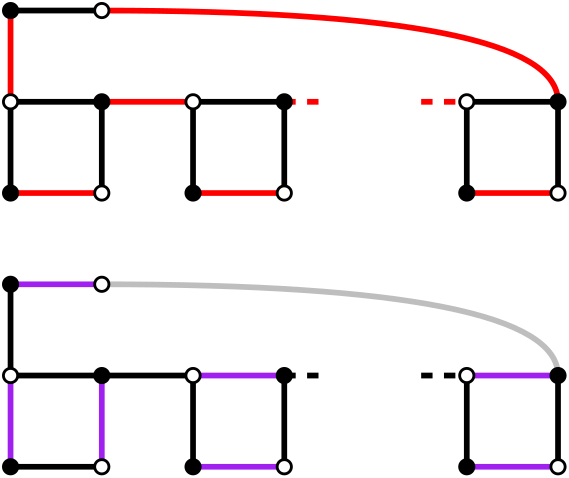
This idea for one square can be extended to lock a chain of squares:

If the locking edge is selected, the configuration of the whole chain is locked. If it's not selected, each square is independent.

Extending $$$x \rightarrow 2x+1$$$

Now we can see that these chains can be extended.

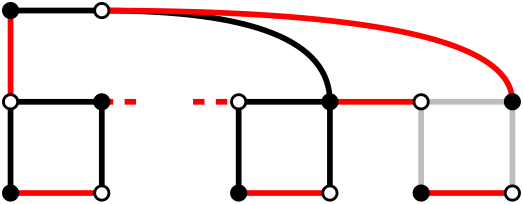
By extending and adding a locking edge, the same previous scenarios can happen:

So if the previous chain had $$$x$$$ perfect matchings, this extension now has $$$2x+1$$$.

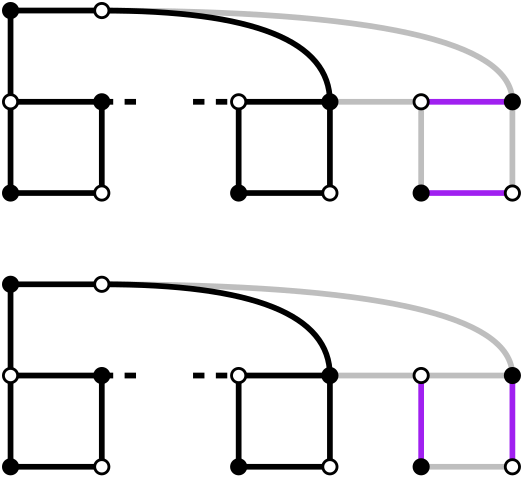
Extending $$$x \rightarrow 2x$$$

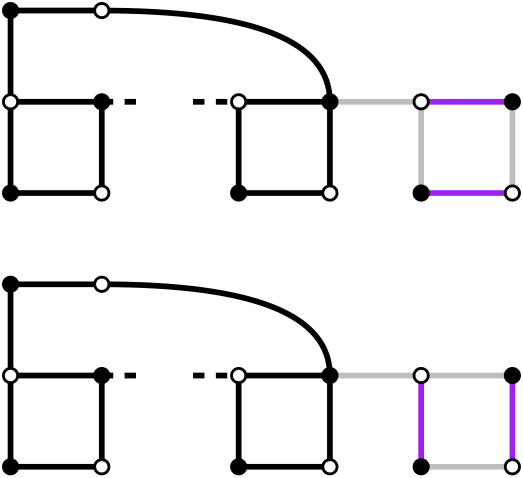
By extending and not adding the locking edge, we just don't have the locked configuration:

If the chain had $$$x$$$ perfect matchings, this extension now has $$$2x$$$.

So this is it. We found a procedure that lets us extend a chain in the manner we wanted.

Construction

We start with a simple edge with $$$1$$$ perfect matching:

If we have a graph with $$$x$$$ perfect matchings and we want to make it $$$2x$$$, we add a square without a locking edge:

If we have a graph with $$$x$$$ perfect matchings and we want to make it $$$2x+1$$$, we add a square with a locking edge:

Analysis

We want the number of nodes to be less or equal to $$$400$$$.

This construction starts with $$$2$$$ nodes and adds $$$4$$$ for each bit in $$$n$$$ below the most significative.

So this solution has at most $$$4\lfloor \log_2(10^6) \rfloor+2 = 78$$$ nodes, which fits very comfortably below the limit.

Note: the official solution follows a similar idea, but adds 6 nodes for increasing by one and for doubling, resulting in $$$214$$$ nodes in the worst case

Code

The code for this is surprisingly short.

Here is an accepted submission (you may need coach mode to access it).

But for each test case, the code is the following:

Full text and comments »

  • Vote: I like it
  • +72
  • Vote: I do not like it