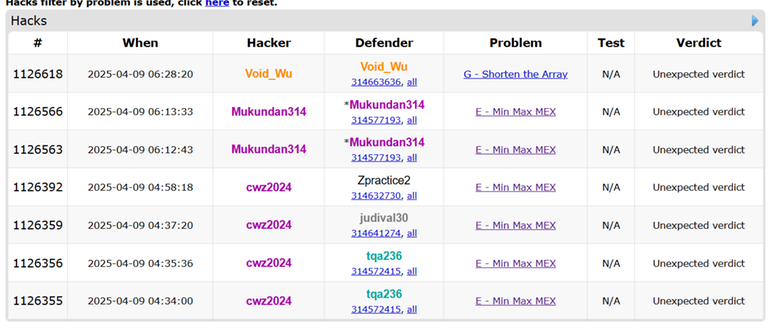
What happened??
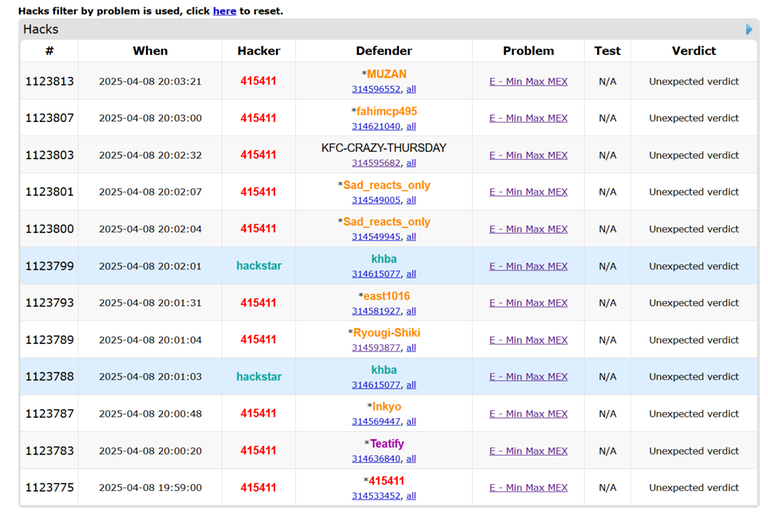
How to handle this judge?
it is weird
| # | User | Rating |
|---|---|---|
| 1 | Benq | 3792 |
| 2 | VivaciousAubergine | 3647 |
| 3 | Kevin114514 | 3611 |
| 4 | jiangly | 3583 |
| 5 | strapple | 3515 |
| 6 | tourist | 3470 |
| 7 | Radewoosh | 3415 |
| 8 | Um_nik | 3376 |
| 9 | maroonrk | 3361 |
| 10 | XVIII | 3345 |
| # | User | Contrib. |
|---|---|---|
| 1 | Qingyu | 162 |
| 2 | adamant | 148 |
| 3 | Um_nik | 146 |
| 4 | Dominater069 | 143 |
| 5 | errorgorn | 141 |
| 6 | cry | 138 |
| 7 | Proof_by_QED | 136 |
| 8 | YuukiS | 135 |
| 9 | chromate00 | 134 |
| 10 | soullless | 133 |
How to handle this judge?
it is weird


The problem tester also used a set and got hacked
u mean, E unhackable?
E is hackable, but you need to wait for the problemsetters to fix their solution first
thanks)
Does this mean this question will be discarded?
But why nlog^2(n) should give a TLE
```bool part(int x, const vector& a, int k) { if(x == 0) return true;
int segs = 0;
int cnts = 0;
vector<bool> nv(x, false);

for (int num : a) {
    if(num < x && !nv[num]) {
        nv[num] = true;
        ++cnts;
    }
    if(cnts == x) {
        segs++;
        if(segs >= k)
            return true;
        fill(nv.begin(), nv.end(), false);
        cnts = 0;
    }
}
return false;
}``` this shouldn't pass right this is like O(n^2logn) but it is getting passed
Now there is a hack with unexpected verdict for problem G