


I search it in google , but i can't find it. Can somebody tell me how to use lower_bound in set<pair<int,int>> , so i can find the fist pair whose first element is not small than the element i search for ?
→ Pay attention
→ Top rated
| # | User | Rating |
|---|---|---|
| 1 | Benq | 3792 |
| 2 | VivaciousAubergine | 3647 |
| 3 | jiangly | 3631 |
| 4 | Kevin114514 | 3574 |
| 5 | maroonrk | 3521 |
| 6 | strapple | 3515 |
| 7 | Radewoosh | 3461 |
| 8 | tourist | 3428 |
| 9 | turmax | 3378 |
| 10 | Um_nik | 3376 |
→ Top contributors
| # | User | Contrib. |
|---|---|---|
| 1 | Qingyu | 162 |
| 2 | adamant | 148 |
| 3 | Um_nik | 146 |
| 4 | Dominater069 | 143 |
| 5 | errorgorn | 140 |
| 6 | cry | 138 |
| 7 | Proof_by_QED | 136 |
| 8 | YuukiS | 135 |
| 9 | chromate00 | 134 |
| 10 | soullless | 133 |
→ Find user
→ Recent actions


Codeforces (c) Copyright 2010-2026 Mike Mirzayanov
The only programming contests Web 2.0 platform
Server time: May/24/2026 22:18:06 (g1).
Desktop version, switch to mobile version.
Supported by


x.lower_bound({first, -inf});got it! Thanks.
Could you explain the reasoning behind using that ? Also could you tell how you would do it for upper_bound ? Thanks :)
x.upper_bound({first, inf});
In these implementations we only care about the first value.
pair<int,int> will compare the first int first, then the second int. We want ALL second integers to work
As for upperbound Na2a uses {first, inf} because we want the value to be greater than first, and {first, inf} is the highest pair with first as its first value. (again, we only care about the first value)
How to get the index of that pair,i mean we can't do this:x.lower_bound({first,-inf})-x.begin()?
There is no way to do that, set can't get index of key. You can use this though http://mirror.codeforces.com/blog/entry/11080
This is a pretty good site : http://bit.ly/1DMMnub
I didn't knew such site exists!
Wow , Awesome site .
Wow , Awesome necro .
Your link actually gives us the link of this blog -
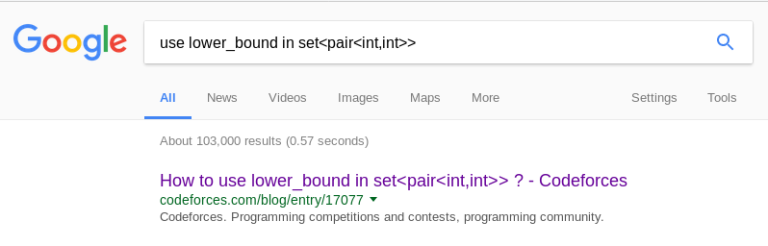
Well, there is actually an answer on that page!
Recursion ...
error:stack overflow,no base case
How can i call lower_bound on pair<int,int> to get the last occurence of pair if element is repeating ?
For eg :
[7,1,5,3,1,1]
[ {1,1,} , {1,4} , {1,5}, {3,3}, {5,2}, {7,0} ]
if i do lower_bound for should get pair {1,5}
try auto it = st. upper_bound({first+1,-inf})
if(it == st.begin()) element not found
else element in it--
can u explain more ?
upper bound return an iterator that points to the first element strictly bigger than {x,y}
st. upper_bound({first+1,-inf}) return an iterator to the first element strictly bigger than the element we are looking for
for example :
[ {1,1,} , {1,4} , {1,5}, {3,3}, {5,2}, {7,0} ]
auto it = st. upper_bound({2,-inf})
*it = {3,3}
so to get {1,5} all we need to do is it--;
A corner case is :
[ {3,3}, {5,2}, {7,0} ]
auto it = st. upper_bound({2,-inf})
*it = {3,3} (it = st.begin())
in this case it-- is not defined so this will cause a runtime error
tha's why we need to test if (it == st.begin())
PS : in our case lower_bound will give the same result as we are sure that no pair have the second element equals -inf so stricly bigger ( < ) or stricly bigger or equal ( <= ) gives the same result
you can do it this way : s.lower_bound(make_pair(x, y)) or s.lower_bound(pair(x, y)). (the last case just in c++17).