


tutorial
tutorial
tutorial
tutorial
tutorial
tutorial
tutorial


| № | Пользователь | Рейтинг |
|---|---|---|
| 1 | Benq | 3792 |
| 2 | VivaciousAubergine | 3647 |
| 3 | jiangly | 3631 |
| 4 | Kevin114514 | 3574 |
| 5 | maroonrk | 3521 |
| 6 | strapple | 3515 |
| 7 | Radewoosh | 3461 |
| 8 | tourist | 3428 |
| 9 | turmax | 3378 |
| 10 | Um_nik | 3376 |
| Страны | Города | Организации | Всё → |
| № | Пользователь | Вклад |
|---|---|---|
| 1 | Qingyu | 162 |
| 2 | adamant | 148 |
| 3 | Um_nik | 146 |
| 4 | Dominater069 | 143 |
| 5 | errorgorn | 140 |
| 6 | cry | 138 |
| 7 | Proof_by_QED | 136 |
| 8 | YuukiS | 135 |
| 9 | chromate00 | 134 |
| 10 | soullless | 133 |


Auto comment: topic has been updated by FalseMirror (previous revision, new revision, compare).
Автокомментарий: текст был обновлен пользователем FalseMirror (предыдущая версия, новая версия, сравнить).
При попытке нажать на Решение задачи 983A выдает сообщение "недостаточно прав для просмотра страницы"
В разборе этой задачи, видимо, допущена опечатка: вместо
q = q / gcd(p, q)нужноq = q / gcd(b, q)Ну и в предложении "..., то есть простые делители q..." пропущено "существуют": ".., то есть существуют простые делители q, которые не являются простыми делителями b...".
Кстати, мне одному показалось, что задача C div2 была довольно сложная для обычного уровня таких задач? Сложность задач div2 после введения div3 повысилась?
Can't access codes. Thanks for the editorial though !
Your code(38299456) for problem Div2. C / Div1. A is not accessible. Please fix it.
Update: Actually none of the codes in the editorial is accessible.
Задачи интересные , без спор. Но не по духи КФ =). Div 2 задачи имею ввиду.
Прощу, за мою субъективное мнение.
Лучше пиши на английском, пожалуйста!
Ok, thx.
The codes are accessible. Click on the "tutorial" link to reveal a "solution" link towards the end.
They were not accessible at the time of our comments :)
Can you prove that your optimization in A improves complexity? Or have you just put there some random opt and noticed that it significantly sped up on tests you prepared? The way it is put right now is for me kinda unserious.
Look here for relevant discussion: http://mirror.codeforces.com/blog/entry/59457?#comment-431043
Authors should use the "you must use some optimizations to make it pass" only if necessary, so I guess only if there is some naive solution that would pass with bigger TL. Otherwise, you just make a problem worse (less cool).
Here you go. http://mirror.codeforces.com/blog/entry/59457?#comment-431152
Вот что должно быть в разборе этой задачи, дак это анализ, почему куча участников в первой посылке получила ТЛ и почему их вторая посылка имеет лучшую асимптотику. Если авторы этот анализ не провели, то это очень серьезная ошибка (хоть здесь и повезло — скорее всего все соптимизировали действительно асимптотику): если бы нужны были неасимптотические оптимизации в А, здесь поднялось бы намного больше шума. Ну и вообще отсекать лог квадрат в самой простой задаче контеста, который все напишут, идея имхо не очень. Надеюсь, в претестах плохой тест был сразу? Боюсь представить, что было бы в комментах после фестиваля хаков.
Ну тут кажется понятно, каким образом это улучшает асимптотику. В неэфективном решении gcd может быть использовано 59 раз(259 < 1018), а в эфективном худший тест кажется q = 13 * 112 * 73 * 54 * 35 * 26, b = 13 * 11 * 7 * 5 * 3 * 2, так что gcd будет использовано максимум 6 раз. Хотя забавно, что среди тестов этого теста нет.
http://mirror.codeforces.com/contest/983/submission/38304212 — это решение валится тестом
1
1 5244319080000 30030
из-за ассерта.
Wild_Hamster прав, данная оптимизация улучшает асимптотику. Проблема в том. что ее достаточно сложно оценить, лично я умею доказывать O(nlog1.5MAX), но для данных ограничений проще сказать что это O(nlogMAX) с константой 6. Плохой тест появился сразу после того, как обнаружилось что отсекается log2. Разбор будет обновлен, однако провести подробное доказательство асимптотики все же сложно.
Ничего сложного, уже ж оценили и доказали O(log) на запрос: http://mirror.codeforces.com/blog/entry/59457?#comment-431152
Более того, вложенный while цикл не нужен, он на асимптотику не влияет. То есть вот этот код работает за :
:
Can anyone explain div2 C more clearly?
I think problem div 2 C the whole round and i can't figured it out till i read the tutorial and know that a problem is finite only if exist k that q | p*b^k. But how do we figure out this fact?If you know this fact,then the problem will be easily solved.
Sorry for poor English.
Try dividing a smaller number with a larger one in some base b . You will find that at each step of division we will be doing r=(r*b)%q . After some point of time if r=0 then we are done .In simple words if (p*b^k)%q=0 for some k then fraction will be finite .
p, q, and b have range 1E18. How would we be multiplying p*b^k? Won't it overflow?
use binary multiplication
I got it!! :D
My thought process for base 10:
Let's assume our fraction is . If q's prime factors are 2 and 5, we can always multiply it by 2 and 5 until it becomes a power of 10, i.e. q2a5b = 10n. Let's assume q has some other prime factor, e.g. 3. Then, there must exist
  such that q2a5b = 10n , which is obviously impossible, since the right-hand side must be divisible by 3 too. It is easy to generalize this to a base with arbitrary prime factors.
For Div 1.C, the state can be defined as: the number of employees that have already entered to the elevator (m), the destinations of the employees that are currently in the elevator (x1, x2, x3, x4) (xi may be zero, which means the corresponding position is empty), and the floor where the elevator currently is (f). However, there are 2000 × 104 × 9 ≈ 2e8 different states; to reduce the number of states, we may ''canonicalize'' destinations of the employees that are currently in the elevator, by sorting x1, x2, x3, x4 to make sure that they are in ascending order. Now the number of states is only about 1e7, which is small enough. Now we can directly perform BFS with memoization. For each state (m, x1, x2, x3, x4, f), we can
Each of these operations takes exactly one second, so we do not need Dijkstra or other shortest path algorithm; BFS works here. Note that, we ''violate the atomicity'' of the second command described in the problem; however, it is not hard to prove that such violation won't imporove the final answer.
am i the only one solved div 1 C using BFS?
I used it, too.
In div2 B in some test cases input says 100 n and 100 m but the input given was 5 n and varying m . My code is giving wrong answers on those types of cases. Please look upon it.
detailed explaination about div2 C. my proof to div 2.C(div 1. A)
UPD: Thanks to
I_LOVE_SMRITI_KIRANandthanglong, they find some unclear sentences and welcome you to give me more so that i can do it better. Here is what i rewrite.Can you explain the solution for this testcase when p=7 q=5 base = 7 ?. p in base b can be written as 10 and 5 can be written as 5. so p/q= 10/5 and the answer becomes FINITE. But the actual answer is INFINITE .. Any help where am i going wrong?
init: p=7,q=5,base=7;
My explaination use "1/p" to explain how to judge not using "1/q", which maybe puzzle you, i should apologize for that if so.
Why did you have to make p,q relatively prime?
e.g. p=3, q=30, base=10, now 3/30 is just 1/10=0.01, is
finite, however if you do not do reduction of a fraction,you will got the wrong answerinfinite.@zhsq11 You have a very beautiful handwriting. ^_^
Thank you for your praise. ^_^ It is the first time that a native English speaker praises my handwriting. :)
One last question,can you prove that p*base^n>q?,thanks.
emm...i don't think it is must to make p*base^n>q.
For a fraction
p/q, if we prove1/qis finite, thenp/qmust be finite. so after reduction of the fraction, it will be not relevant with the numeratorp.Yeah! I really liked it :) but English is my 2 language :P
Also can you please help me debug my solution to problem C (Div 2) ?
Code link
I don't understand the meaning of the following code.
In fact, it's not a must to judge which one is bigger in b and c in your code. what we need to do is only to find whether b has a factor that c doesn't have.
here is my submission
also in the last paragraph, I think you mean "(base)^n can be divided by q". Nice proof btw...
Thank you :D
Why these links are not accessible?
For div 2 C, after dividing q by gcd(p,q), I calculate (b^(10e18))%q. The answer is finite if the result is 0 else infinite. Since q<10e18, the exponent of any of its prime factor is less than 64. So b^(10e18) should always be divisible by q if all prime factors of q are factors of b as well. Can anyone explain why this gives a wrong answer on test case 11?
Code: http://mirror.codeforces.com/contest/984/submission/38308682
Overflow in exponentiation function at line x = (x * x) % MOD .
Since x can be as large as 1018. A prerequisite for the exponentiation is that the square must not overflow.
Your argument however seems correct.
I didn't like the way the last paragraph of 1E was written (took quite a bit to figure out), so for anyone who might be struggling to understand it, I hope this helps:
We have reduced the question to the following cleaner problem:
Given some paths in a tree, determine if there is a subpath between s_i and t_i. (2e5 queries on the same set of paths). If one is an ancestor of the other, we can possibly handle it together with the earlier binary lifting. Otherwise, this is equivalent to asking if there exists a path with endpoints in the subtrees of s_i and t_i.
Using the Euler's Tour technique, a subtree gets transformed into a range. So now each path can be represented by a start and an end point, and we want to know if there is some path which starts in the range corresponding to the subtree of s_i and ends in the range corresponding to the subtree of t_i (wlog assume s_i comes before t_i in the tour).
If we represent a path as a pair (a, b) -- the start and end points, we realise that this is an offline 2D range query. We now solve the black-boxed problem.
If we had a good bookcode for 2D segment tree we were confident in, we could stop here now, but we can do better since it is offline:
We will be using a 1D fenwick tree to count the number of points with x-coordinates in a certain range. Furthermore, for a rectangle, we will be making 2 queries: the number of points under the top of the rectangle and the number of points under the bottom of the rectangle (and we can then subtract).
We process points and queries simultaneously in increasing y-coordinate. Hence, when a query is processed, the fenwick tree on the x-coordinate reflects all points under the current y-coordinate which gives us what we require.
Thanks for writing up a much better explanation!
I couldn't understand the last paragraph of the tutorial solution to 1E at all, even after rereading it dozens of times.
Did anyone do recursive dp solution for Div2 D / Div1B ?
Sure (not in contest though)
"It's neccesary to do some optimizations to pass TL."
For Div1 A, I couldn't come up with the iterative reducing technique of Q until it reaches 1. Nice technique, by the way. To my surprise, java BigInteger worked within TL.
BigInteger Solution
Can anybody explain me please at div1 B, why f( l , r ) = f( l , r-1 ) ^ f( l+1 , r) ?
Look at the "pyramid" for f(1, 2, 4, 8), the arrows represent XOR. (Sorry for the poor drawing):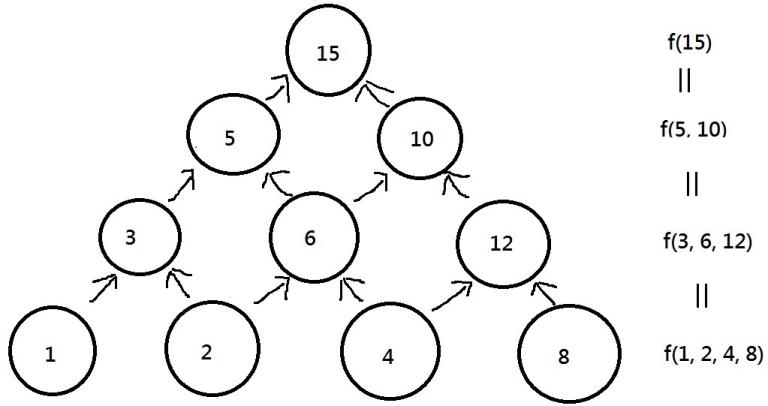
And the pyramid for f(1, 2, 4). Can you find it in f(1, 2, 4, 8)?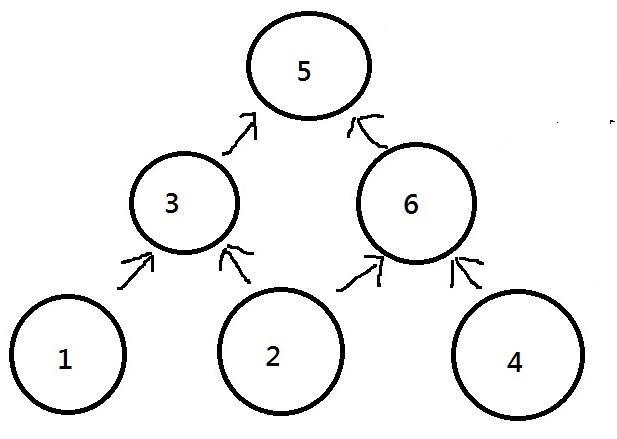
This is the basic idea. I think you can prove it by induction on N := number of parameters in f.
For N = 2, it is obviously true, and then...
Thanks, it helped me a lot
Thanks..
Div1C. Any relation with editorial and solution code? The definition of 'state' is different at least i think. The solution code is just representing the state in base of 10.
Can anybody point me to the proof of the maths applied in Div2 C problem
here
How to observe "dp[i][j] = dp[i — 1][j + 1] ^ dp[i — 1][j" in Div2 D or Div1 ?
draw it!!
or by experience ( and guessing XDD
Can someone give detailed explanation of Div 2 D. How the array dp[n][n] is formed?
q ∣ p⋅b^k Что означает верхний слеш | ?
p · b^k делится на q
Делится без остатка или дробь конечна?
Без остатка
In div1B , f(l,r) seems to be f(l,r-1) ^ f(l+1,r) , any intuitive or easy proof of this?
Induction.
f(a(l),..,a(r)) = f(a(l)^a(l+1),.....,a(r-1)^a(r)) =f(a(l)^a(l+1),....,a(r-2)^a(r-1)) ^ f(a(l+1)^a(l+2),.....,a(r-1)^a(r))(induction step on smaller length) =f(a(l),...,a(r-1)) ^ f(a(l+1),....,a(r)).can you please explain in more detail
please see this link
this 1
this 2
this
codeforces.com/contest/984/submission/38316222
and still you have question you can ask!
How do u guarantee that a[i+1][j] is already calculated when u calculate a[i][j] in step 2?
First equality is coming from the definition of
f.Second equality is coming from the induction. (Assuming that our assumption holds for smaller arrays. As a base step of the induction, length of the array is 2.)
Third equality is coming from the definition of
f.Actually, after knowing the answer it seems trivial. But initially, how you came up with such recurrence? Is it standard, or just by observation?
My code for div2C (div1A) is failing on the 7 case. Can someone please help me debug it?
Thanks in advance.
Code link
line 31 else if (b>c)
you didn't handle the case b<c
like b=20 and c=25
that is finite
good problems in this problemset.
Anyone solved D with dp + segment tree? I observed how to calculate f values, but to calculate max value in range I used segment tree.
Did your solution work? DP array takes 5000x5000 memory which is okay, but segment tree on 2-D array takes 16x5000x5000 space which is too much. Even if we get the memory, build_tree would time out for such a huge tree.
Its not 2d segment tree. You can see solution. I insert dp values in specific order in 1d array and then 1d segment tree on that array.
Thank you for the contest. However, I think the time limit for problem C div 2 is too tight. I tried your solution without fast input/output. It still got TLE. Here is my submission: http://mirror.codeforces.com/contest/983/submission/38354529.
I think it would be better if you consider to extend the time limit a little bit more next time.
Taking into consideration when fast input is needed is part of solving problems, it's the same as considering when long long is needed or not.
I agree the TL was a bit tight but the setters did it intentionally. At least they didn't hide it and put the worst case for the "naive" algorithm in pretests.
I think If needed it should be mentioned in problem statement. Or if the time limit difference is so crucial then I think there probably be another type of input like randomly generating input based on a fomular. But yea, I will consider fast input in my solution next time. Thank you.
...
Задача Div1E заходит и без двоичных подъемов. Просто люблю держать в курсе.
For Div 2 E, could someone explain how state is stored? I want to use an integer, so that the ith digit (i from 1 to 4) is the floor that the ith person wants to go. The 5th digit is the current floor the elevator is on. But there must be a better way.
Also, "The fast one is we say we go from the floor a[i] to the floor a[i + 1] and iterate over the persons who we let come in on the way." What does this mean?
What is the state of dp in DIV.2 D? Thanks in advance :-)
The left index and the right index of your segment
For the div1 D, how can I figure out this fantastic segment tree. it's to difficult for me to choose the three features to describe this problem... Please help me understand this algorithm further.. THX!
used priority queue but not working properly please help https://ideone.com/JE16M9
983A - Finite or not?
Tutorial says "...changes iterations of the first type and when it doesn't change — iterations of the second type."
I do not see two types of iterations. Can someone explain how that is meant?
is there any pattern for the function in the xor pyramid problem?,or it is just a random order ?