


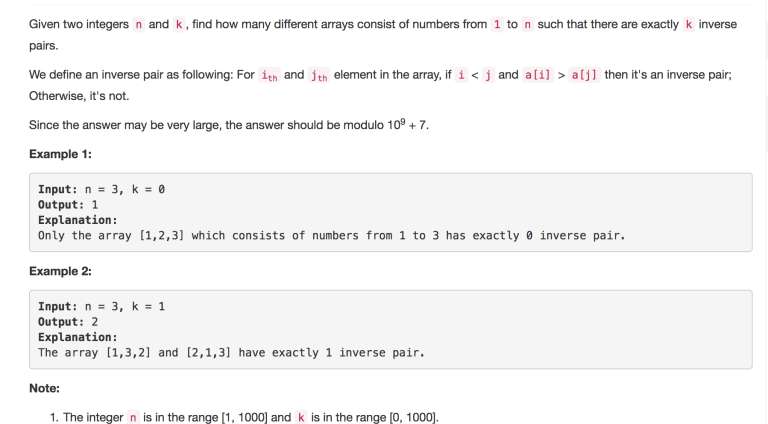
I'm trying to come up with a recursive solution for this problem but I haven't been able to so far. Any advice/pointers here?
I tried 0-1 knapsack style but there is an issue with backtracking the array.
| # | User | Rating |
|---|---|---|
| 1 | Benq | 3792 |
| 2 | VivaciousAubergine | 3647 |
| 3 | Kevin114514 | 3603 |
| 4 | jiangly | 3583 |
| 5 | turmax | 3559 |
| 6 | tourist | 3541 |
| 7 | strapple | 3515 |
| 8 | ksun48 | 3461 |
| 9 | dXqwq | 3436 |
| 10 | Otomachi_Una | 3413 |
| # | User | Contrib. |
|---|---|---|
| 1 | Qingyu | 157 |
| 2 | adamant | 153 |
| 3 | Um_nik | 147 |
| 4 | Proof_by_QED | 146 |
| 5 | Dominater069 | 145 |
| 6 | errorgorn | 141 |
| 7 | cry | 139 |
| 8 | YuukiS | 135 |
| 9 | TheScrasse | 134 |
| 10 | chromate00 | 133 |
I'm trying to come up with a recursive solution for this problem but I haven't been able to so far. Any advice/pointers here?
I tried 0-1 knapsack style but there is an issue with backtracking the array.


It appears that the statement is actually asking for the number of permutations of 1... n with k inversions. If In(t) is the number of permutations of size n with t inversions, then . This recurrence can be calculated in O(nt) using prefix sums on In.