


"> ~~~~~ // 0-based implementation template T extended_euclidean(const deque
&cof, extended_euclidean(const deque &cof, deque &var) { int n = cof.size(); if
(!cof.back
→ Pay attention
→ Streams
→ Top rated
| # | User | Rating |
|---|---|---|
| 1 | Benq | 3792 |
| 2 | VivaciousAubergine | 3647 |
| 3 | Kevin114514 | 3611 |
| 4 | jiangly | 3583 |
| 5 | strapple | 3515 |
| 6 | tourist | 3470 |
| 7 | dXqwq | 3436 |
| 8 | Radewoosh | 3415 |
| 9 | Otomachi_Una | 3413 |
| 10 | Um_nik | 3376 |
→ Top contributors
| # | User | Contrib. |
|---|---|---|
| 1 | Qingyu | 164 |
| 2 | adamant | 150 |
| 3 | Um_nik | 146 |
| 4 | Dominater069 | 144 |
| 5 | errorgorn | 141 |
| 6 | cry | 139 |
| 7 | Proof_by_QED | 136 |
| 8 | YuukiS | 135 |
| 9 | chromate00 | 134 |
| 9 | TheScrasse | 134 |
→ Find user
→ Recent actions
You can use several words in query to find by all of them at the same time. In addition, if you are lucky search understands word forms and some synonyms. It supports search by title and author. Examples:
305— search for 305, most probably it will find blogs about the Round 305andrew stankevich contests— search for words "andrew", "stankevich" and "contests" at the same timeuser:mikemirzayanov title:testlib— search containing "testlib" in title by MikeMirzayanov"vk cup"— use quotes to find phrase as istitle:educational— search in title
Results
1.
Extended Euclidean algorithm for n variables I was learning the extended Euclidean algorithm in basic number theory and wondered how I should solve it for $n$ variables without using the fact that $gcd(cof_1,cof_2,\ldots,cof_n) = gcd(cof_1,gcd(cof_2,cof_3,\ldots,cof_n))$ as this can get overflow in specific test cases.
**Concept**
-------
I tried to grasp the idea of extended Euclidean for $2$ variables. It used the fact that $gcd(a + b, b) = gcd(a, b) = gcd((a + b) \bmod b, b)$ such that $a > 0$ and $b > 0$. This fact can be easily applied to $n$ variables by taking $\bmod cof_n$ to all the $n - 1$ coefficients from $1$ to $n - 1$ and moving the last element to the beginning, aka right cyclic shift, since $cof_n$ is now greater than all other coefficients and taking another modulo will change nothing.
The extended Euclidean for $2$ variables also used the fact that $gcd(a,0)=a$ and to solve the equation $a \cdot x + b \cdot y = GCD$, $x$ must equal $1$ since $b$ equals $0$. Also, $x$ and $y$ for the previous call of th...


2.
Algorithms repo on github Hi all!
Several months ago I decided to write down all the algorithms I know (and don't know) in one Visual Studio project for reusing, remembering, preparing to the interviews and easy learning of new algorithms and compose them in the one big library.
I have implemented some part of this library, but before going deeper I want to provide some examples of library current usages:
<spoiler summary="Example">
For example, you can compute Fibonacci n-th element using matrix exponentiation by writing the following code:
~~~~~
#include <iostream>
#include <Math/Math.h>
using namespace std;
int main()
{
algo::Matrix<int> mat{ {1, 1}, { 1, 0 } };
algo::Matrix<int> neutral{ {1, 0}, { 0, 1 } };
algo::Matrix<int> fib { {1, 1} };
mat = algo::bin_pow(mat, 7, neutral, algo::matrix_mul<int>);
fib = algo::matrix_mul(fib, mat);
cout << fib[0][0]; // prints 34
}
~~~~~
After this code compiles another file is generated that do not contain any of r...
primes; } int extended_euclidean(int a, int b, int& x, int& y) { if (a == 0, ; } } } return primes; } int extended_euclidean(int a, int b, int& x, extended_euclidean(int a, int b, int& x, int& y) { if (a == 0) { x = 0
3.
AlgoThugs 2026 — Editorial ### Contest announcement blog: [Link](https://mirror.codeforces.com/blog/entry/152857)
### [problem:669000A]
Author: [user:Krishnadev44,2026-04-15]
<spoiler summary="Hint 1">
We claim that the answer is always `YES`.
</spoiler>
<spoiler summary="Hint 2">
Let the direct path from vertex $u$ to vertex $v$ consist of $d$ edges. Since $u$ and $v$ are distinct, $d \ge 1$. Let the sequence of costs along these edges be $C = (c_1, c_2, \dots, c_d)$.
We claim that there always exists a contiguous subarray of $C$ whose sum is perfectly divisible by $d$.
</spoiler>
<spoiler summary="Solution">
Let $S$ denote the prefix sum array of $C$, where the $k$-th prefix sum is defined as:
$$S_k = \sum_{i=1}^{k} c_i \quad \text{for } 1 \le k \le d$$
Consider the values of these prefix sums modulo $d$. There are two cases:
* Case $1$: There exists an index $k$ such that $S_k \equiv 0 \pmod d$.
In this case, the sum of the prefix subarray $(c_1, c_2, \dots, c_k)$ is directly divisi...
= a * a % m; b >>= 1; } return res; } int extended_euclidean(int a, int b, int, ; } return res; } int extended_euclidean(int a, int b, int &x, int &y) { if (b
== 0
4.
How to solve it using dp (Distinct Adjacent) ? 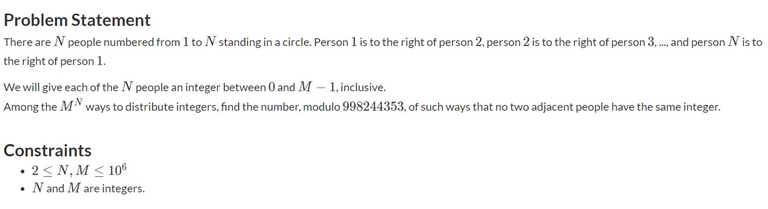
[Question](https://atcoder.jp/contests/abc307/tasks/abc307_e)
#### I didn't understand the editorial please help
extended_euclidean
Codeforces (c) Copyright 2010-2026 Mike Mirzayanov
The only programming contests Web 2.0 platform
Server time: May/15/2026 14:27:30 (g2).
Desktop version, switch to mobile version.
Supported by


