


Problem Statement: Count Grouped Binary Substrings
In my last Post i gave the question to help people to solve the question and commented the code and its explanation if ever needed. But then, i think some of us really need a good explanation which i couldnt provide .So i am improving , providing better explanation, photos of the test case,etc for the community to get it in a better way with all my efforts.
Do upvote if you think the work i did was worth and you like it.
I found this problem during my JPMorgan Chase OA. It’s a good example of a string + grouping based DSA problem that tests your pattern observation.
You are given a binary string s consisting of only '0' and '1'.
A binary substring is called grouped if: - All '0's come together followed by all '1's, or - All '1's come together followed by all '0's.
For example, "0011" or "1100" are grouped, but "0101" is not.
You need to count the number of such non-empty substrings where: - The number of consecutive '0's and '1's are equal, and - All '0's and '1's are grouped together (e.g. "01", "0011", "1100", "000111", etc.)
Input
A binary string s of length up to 10^5.
Output
An integer denoting the total number of valid grouped substrings.
Example
Input:
00110011
Output:
6
Explanation
The valid grouped substrings are: - "0011"(twice) - "01" (twice) - "1100" - "10"
Total = 6.
Spoiler Ahead :)
Detailed Explanation and code are shared below
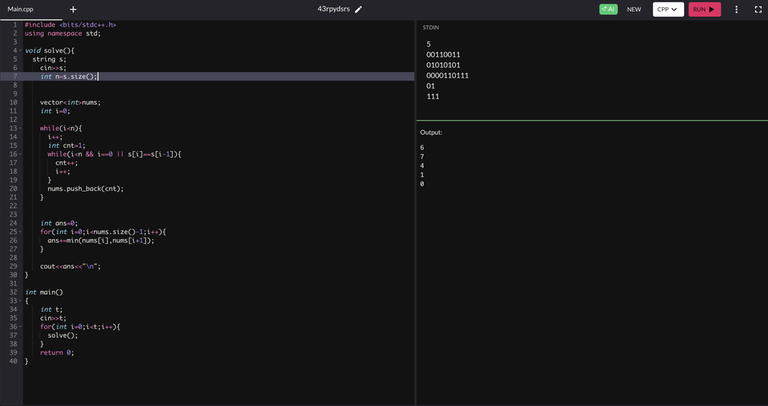 !
!
Explanation:-
The code works as first: we group all the grouped 0's,1's, and then try to make pairs of them to get the number of strings, for example.
In 00110011
Let's say we would get nums as
2 2 2 2
i.e.2 '0',s 2 '1's 2 '0's 2 '1's so now i make the ans from this count as lets say the array of the count be nums.
So for two contiguous groups nums[0] and nums[1] i.e. 2 0's ans 2 1's can make atmost min(2,2)=2 i.e. two substrings which satisfy the condition i.e. 01 , 0011
for e.g. if we get something like 000011 so we can make min(4,2) =2 substrings 0011 01 .
Similarly, we can do it for all adjacent groups by making up to min(of the two adjacent)groups
I hope you would have understood the explanation plz upvote if you like and understand __
Code:-
// this is code

#include <bits/stdc++.h>
using namespace std;

void solve(){
  string s;
    cin>>s;
    int n=s.size();


    vector<int>nums;
    int i=0;

    while(i<n){
      i++;
      int cnt=1;
      while(i<n && i==0 || s[i]==s[i-1]){
        cnt++;
        i++;
      }
      nums.push_back(cnt);
    }


    int ans=0;
    for(int i=0;i<nums.size()-1;i++){
      ans+=min(nums[i],nums[i+1]);
    }

    cout<<ans<<"\n";
}

int main()
{
  int t;
  cin>>t;
    for(int i=0;i<t;i++){
      solve();
    }
    return 0;
}


Auto comment: topic has been updated by Shreyash1379 (previous revision, new revision, compare).
Auto comment: topic has been updated by Shreyash1379 (previous revision, new revision, compare).
Auto comment: topic has been updated by Shreyash1379 (previous revision, new revision, compare).
Check out my solution.
I tried solving in 1 pass
Logic : we will count the number of countigous 0s before 1 , lets call it cnt0 and from the first index where we have found 1, we will ans++ if until the number of contigous 1s is less than cnt0.
Similar thing will be done in reverse case.
OK got it you just did by keeping track of recents and updating them in the same loop instead of other. But at the time of OA it didn't matter for me to put it fronm 2n to n as it was the same.
So I got to the next question. Still Great !!!
I hope the community would like that.
This is an amazing thing to work on. O(2n)->O(n);
Something more to think---> Actually, you can do it bit differntly too as current and prev. where you just pass the current to prev and start appending current whenever the charachters are changed.
Sort of same logic just different way of thinking.
DO UPVOTE IF YOU THINK IT HELP YOU AND YOU LIKE IT
Div2 A level problem
True.
Also every problem might teach us something new or atleast the discussion.
And the soul reason of posting this was to get the people know the level , actual questions asked in the OA.
Auto comment: topic has been updated by Shreyash1379 (previous revision, new revision, compare).
Can we do it like whenever we find "01" or "10" then we try to expand from this position by assuming l = i, r = i + 1 and we will do l--, r++ till we can match means make the valid substring. At first glance think approach looks like O(N^2) but i think we will not go to any position more than 3 times ?? Please correct me if i am wrong
Ya you are correct its a O(n) approach .
As the r increments it would it increment as much as the i needs to be put up at the next,also in n^2 elements are revisited.Here it wouldnt happen on the r side to be true.It would happen on left but since its happening simulatneously with right side we can say its not revisiting. and moving further
Great observation.
Check this one
Nice implementation, Saharsh! The use of prev and curr counters to count alternating groups and applying min is a clean and efficient way to solve this. Handles edge cases well too — O(n) time and easy to read. Keep up the great work!
Appreciated.
Thank you!!!