


Thank you for participating! We hope you enjoyed the problems and, most importantly, had fun!
2102A - Dinner Time
If you have the first $$$p$$$ elements, what happens to the rest?
What happens if $$$n\%p\neq0$$$?
How can the fact that we can also use negative numbers be useful?
The first thing to realize is that if the first $$$p$$$ elements of the array are determined, the rest will be unique ($$$a_i = a_{i-p}$$$ to hold the sum). If $$$p$$$ divides $$$n$$$, there will be $$$\frac{n}{p}$$$ blocks, each summing to $$$q$$$, so their total sum which is $$$q\cdot \frac{n}{p}$$$ should be equal to $$$m$$$. If not, the incomplete block that is created at the end can be used to cover any difference in sum, so it's always possible!
t = int(input())

for _ in range(t):
    n, m, p, q = map(int, input().split())

    if n % p == 0 and (n // p) * q != m:
        print("NO")
    else:
        print("YES")
This problem was supposed to be for cyclic arrays, and also required construction, but due to D2A difficulty it was adjusted!
Do you have a solution for the cyclic array version? Comment it below
2102B - The Picky Cat
Does the initial sign and order of elements matter?
If an element is before the median in the sorted array, can you shift it forward?
What if it is initially after the median?
Before starting, we take the absolute value of all elements since their signs do not matter. Then, if the first element of the array is equal to or smaller than the $$$\left\lfloor \frac{n}{2}\right\rfloor + 1$$$ smallest element of the array, the answer is possible. Else, it is impossible. The proof is as follows:
If the first element is equal to or smaller than the $$$\left\lceil\frac{n}{2}\right\rceil$$$ smallest element of the array, we can negate the big values until the first element becomes the $$$\left\lceil\frac{n}{2}\right\rceil$$$ smallest element of the array, hence becoming the median.
If the first element is equal to the $$$\left\lfloor \frac{n}{2}\right\rfloor + 1$$$ smallest element of the array, we can negate the entire array, which results in the first element becoming the $$$\left\lceil\frac{n}{2}\right\rceil$$$ smallest element of the array.
Otherwise, if the first element of the array is larger than the $$$\left\lfloor \frac{n}{2}\right\rfloor + 1$$$ smallest element of the array, negating values smaller than it has no effect, while negating values larger than it just makes the first element further away from the median position. You can verify that negating the first element itself does not help either by using similar cases.
t = int(input())

for _ in range(t):
    n = int(input())
    a = list(map(int, input().split()))

    pairs = [(abs(a[i]), i) for i in range(n)]
    pairs.sort()

    ans = [0] * n

    for i in range(n // 2 + 1):
        _, index = pairs[i]
        ans[index] = 1

    if ans[0]:
        print("YES")
    else:
        print("NO")
Would it be easier to calculate the answer for all indices and just output for the first index?
What's up with the name of the problem?
2101A - Mex in the Grid
What is the MEX, if $$$0$$$ is not there?
When is the MEX equal to $$$k$$$?
If we want a subgrid to be included in as many other subgrids as possible, what shape should it have? What about its place?
The first fact to notice is that if the subgrid does not contain $$$0$$$, then the MEX is $$$0$$$ and we can ignore such subgrids. If the MEX is going to be $$$k$$$, it means all the values from $$$0$$$ to $$$k-1$$$ are included in the subgrid. For each $$$0\le k\le n^2$$$, we count how many subgrids have a MEX of at least $$$k$$$, aiming to maximize this.
To find the total sum of all MEX values, for each $$$k$$$ we count the number of subgrids that contain all the values from $$$0$$$ to $$$k-1$$$. Summing these counts gives us the final result.
We claim that if our subgrid is nearly square (either a perfect square or a difference of $$$1$$$ in lengths), and is placed in the middle of the grid, then the answer is maximized.
Proof: The multiplication of two numbers with the same sum is maximized when they are as close to each other as possible. Therefore, for each subgrid, if we consider the empty rows above and below it and separately consider the columns on its right and left, if one is fixed, the place is optimized to be in the middle. Now, similarly, we can say that it is optimal if the length and height of the subgrid are close to each other as well, as increasing one will cause the other one to decrease. With these two observations combined, a subgrid having the above properties is optimal when it's a nearly square subgrid in the middle of the grid.
Any ordering with this property works; an easy example is a spiral shape that starts from the center of the grid and turns around itself.
def magical_spiral(n):
    arr = [[-1] * n for _ in range(n)]

    if n % 2 == 0:
        x, y = n // 2 - 1, n // 2 - 1
    else:
        x, y = n // 2, n // 2

    arr[x][y] = 0
    value = step = 1

    dir = [(0, 1), (1, 0), (0, -1), (-1, 0)]


    while value < n * n:
        for d in range(4):
            steps = step

            step += d % 2; dx, dy = dir[d]

            for _ in range(steps):
                x += dx; y += dy

                if 0 <= x < n and 0 <= y < n and arr[x][y] == -1:
                    arr[x][y] = value
                    value += 1
                if value >= n * n:
                    break

            if value >= n * n:
                break


    for row in arr:
        print(" ".join(str(num) for num in row))
    print()


t = int(input())

for _ in range(t):
    n = int(input())

    magical_spiral(n)
We had the idea of dividing this problem into two subtasks, in which the second subtask requires you to count the sum of MEX of all subgrids!
Do you have a solution for this? Comment it below
2101B - Quartet Swapping
Is it possible for an element to change its index parity after some operations?
What else is not effected by the operation?
How to combine the above two properties under the time limit?
The first observation is that the parity of the position of the elements doesn't change with the operations. Thus, if an element is at an odd or even index in the initial permutation, it will retain the same parity in the final permutation. As long as we have four elements left, we can freely adjust them within their index parity zone, but what about the last three ones? We can see that the parity of the number of inversions is fixed, so by counting the inversions of the initial permutation, the order of the last four elements will be uniquely determined.
#include <bits/stdc++.h>

#define pb push_back
#define int long long
#define F first
#define S second
#define sz(a) (int)a.size()
#define pii pair<int,int>
#define rep(i , a , b) for(int i = (a) ; i <= (b) ; i++)
#define per(i , a , b) for(int i = (a) ; i >= (b) ; i--)
#define all(a) a.begin(),a.end()

using namespace std ;
const int maxn = 1e6 + 10 ;
int a[maxn] , n , fen[maxn] ;

void upd(int x){
    while(x <= n){
        fen[x]++;
        x += x&-x;
    }
}

int que(int x){
    int ans =0 ;
    while(x){
        ans += fen[x] ;
        x -= x&-x;
    }
    return ans ;
}

int f(vector<int> x){
    rep(i , 0, n)fen[i] =0;
    int ans =0 ;
    per(i , sz(x)-1 , 0){
        ans += que(x[i]);
        upd(x[i]) ;
    }

    return ans ;
}

signed main(){
    ios::sync_with_stdio(0) ; cin.tie(0);

    int T ;
    cin >> T ;

    while(T--){
        vector <int> a1 , a2 ;

        cin >> n ;
        rep(i ,1 ,n){
            int x; cin >> x;

            if (i%2==1) {
                a1.pb(x);
            } else {
                a2.pb(x);
            }
        }

        bool v = (f(a1)%2 != f(a2)%2);

        sort(all(a1)); sort(all(a2));

        int x1 = 0, x2 =0;

        rep (i ,1 , n) {
            if (i%2==1) {
                a[i] = a1[x1] ; x1++;
            } else {
                a[i] = a2[x2] ; x2++;
            }
        }

        if (v) {
            swap(a[n] , a[n-2]) ;
        }

        rep(i ,1 ,n) cout << a[i] << " ";
        cout << "\n";
    }
}
This problem was one of the first problems that we had, and the intended constraits were $$$n\le 3000$$$ as a D1A, but later was moved to D1B with $$$n\le 2\cdot 10^5$$$!
Do you know how to count the parity of inversions without counting the number of inversions?
2101C - 23 Kingdom
Does it matter if there are $$$2$$$ occurance of a number or $$$200$$$?
What greedy approaches can you think of?
Are they fast enough?
The first observation is that we only care about the first and last occurrences of each number in the final array, as anything in between doesn't change the maximum distance. Instead of counting the distances directly, the main idea of this problem is to break them down into pieces. For example, the distance of a pair $$$(i, j)$$$ such that $$$1\le i \lt j\le n$$$ and $$$a_i = a_j$$$ and also these indices are the farthest possible, instead of adding up $$$j-i$$$, we count one for each index in between $$$i$$$ and $$$j$$$. In Another word, for each index $$$i$$$, we count how many begins are in or before $$$i$$$, and how many ends are after $$$i$$$, adding up these values for each index gives us the sum of distances.
For each prefix and suffix of our array, we count the maximum number of different begins that we can get greedily. It can be proven that if we try to match each $$$a_i$$$ with the biggest unmatched number left, we'll end up getting the maximum number of different matches possible. Doing so can be calculated in many different ways, one using sets is shown in the implementation below.
After that, for each $$$1\le i \lt n$$$, we have a bound for the number of pairs that these indices can be in between of, as we calculated the maximum distinct matches possible for both sides (one prefix and one suffix). It can be proven that there exists an array $$$b$$$ meeting the problem conditions such that the bound for each index is held, and therefore summing up all values gives us the final answer.
#include <bits/stdc++.h>

#define int long long

// #pragma GCC target("avx2,bmi,bmi2,lzcnt,popcnt")
// #pragma GCC optimize("O3")
// #pragma GCC optimize("unroll-loops")


#define F first
#define S second
#define mp make_pair
#define pb push_back
#define all(x) x.begin(), x.end()
#define kill(x) cout << x << "\n", exit(0);
#define pii pair<int, int>
#define pll pair<long long, long long>
#define endl "\n"


using namespace std;
typedef long long ll;
// typedef __int128_t lll;
typedef long double ld;


const int MAXN = (int)1e6 + 7;
const int MOD = (int)1e9 + 7;
const ll INF = (ll)1e18 + 7;

int n, m, k, tmp, t, tmp2, tmp3, tmp4, u, v, w, p, q, ans, flag;
int arr[MAXN], f[MAXN][2];
set<int> st;


void solve() {
    cin >> n;

    for (int i=1; i<=n; i++) cin >> arr[i];

    for (int j=0; j<2; j++) {
        st.clear();
        for (int i=1; i<=n; i++) st.insert(i);

        for (int i=(j? n : 1); (j?i>1 : i<n); (j? i-- : i++)) {
            auto it = st.upper_bound(arr[i]);

            if (it != st.begin()) it--, st.erase(*it);

            f[i][j] = n-st.size();
        }
    }

    ans = 0;
    for (int i=1; i<n; i++) ans += min(f[i][0], f[i+1][1]);

    cout << ans << endl;
}

int32_t main() {
    #ifdef LOCAL
    freopen("inp.in", "r", stdin);
    freopen("res.out", "w", stdout);
    #else
    ios::sync_with_stdio(0); cin.tie(0); cout.tie(0);
    #endif

    cin >> t;

    while (t--) solve();


    return 0;
}
We thought every greedy approach for this problem is wrong, and the intended solution used to be a $$$O(n^3)$$$ DP, but later realized we were wrong!
Can you think of a rational DP idea that despite the time limit can solve this question?
2101D - Mani and Segments
What are some characteristics of a cute subarray?
Is cuteness a monotone property?
How to find the maximal cute subarray for a fixed index $$$i$$$?
The first observation is that a subarray is cute, iff there is an index $$$i$$$, such that it is the one and only share of the LIS and LDS, and all other elements belong to either LIS or LDS.
Proof: We know that there cannot be two elements belonging to both LIS and LDS, and if there is none, the property won't be held. Therefore, we conclude that there is exactly one element shared between the LIS and LDS.
Diving deeper into the shared element, we can see that the smaller elements before it must all be ascending, and the bigger elements after it must also all be ascending (as this will make our LIS). Similarly, all the bigger elements before it and all the smaller elements after it should be descending. This gives us a good pattern, and we can easily see that any subarray included within a cute subarray is cute itself (call this monotonic property).
For counting the total number of cute subarrays, we calculate the values of $$$R_i$$$ and $$$L_i$$$ for each index. Let $$$L_i$$$ be the biggest index before $$$i$$$, such that the condition above is met. Similarly define $$$R_i$$$ as the $$$smallest$$$ index after $$$i$$$. If we can somehow calculate this values for all indices, then we'll end up with $$$n$$$ segments (for each $$$1\le i\le n$$$), and a subarray is cute iff it's included in at least one segment. This is a very classic problem, so the solution won't be discussed here.
The only detail left is how to calculate the values of $$$L_i$$$ and $$$R_i$$$? We'll discuss the process of calculating the $$$R_i$$$ here, but the $$$L_i$$$ follows a very similar pattern. We claim that $$$R_i = min(R_{i+1}, f(i))$$$. In here $$$f(i)$$$ is defined as follow:
- if $$$a_i \gt a_{i+1}$$$: then $$$f(i)$$$ is minimum index $$$j$$$, such that $$$a_{i+1}\le a_j\le a_i$$$.
- if $$$a_i \lt a_{i+1}$$$: in this case $$$f(i)$$$ is minimum $$$j$$$ such that $$$a_i\le a_j\le a_{i+1}$$$.
Proof: The fact that $$$R_i\le R_{i+1}$$$ can easily be concluded from the fact thay cuteness is a monotonic property. Also going back to the conditions described above, we can see that $$$f(i)$$$ is basically the first index that will ruin our condition, so based on the definition of $$$R_i$$$, we can say that $$$R_i = min(R_{i+1}, f(i))$$$.
The calculation of $$$L_i$$$ and $$$R_i$$$ can both be implemented using a Segment Tree or a Monotonic Stack; both implementations are included below. After we have those values, we count the number of subarrays included in at least one segment, and that would be our final answer.
#include <bits/stdc++.h>

#define int long long

// #pragma GCC target("avx2,bmi,bmi2,lzcnt,popcnt")
// #pragma GCC optimize("O3")
// #pragma GCC optimize("unroll-loops")


#define F first
#define S second
#define mp make_pair
#define pb push_back
#define all(x) x.begin(), x.end()
#define kill(x) cout << x << "\n", exit(0);
#define pii pair<int, int>
#define pll pair<long long, long long>
#define endl "\n"


using namespace std;
typedef long long ll;
typedef long double ld;


const int MAXN = (int)1e6 + 7;
const int MOD = 998244353;
const int INF = (int)1e9 + 7;


int n, m, k, tmp, t, tmp2, tmp3, tmp4, u, v, w, q, ans, flag;
int arr[MAXN], L[MAXN], R[MAXN];


/* Segment Tree */
#define mid ((l+r)>>1)
#define lid (mid<<1)
#define rid (lid|1)


int seg[MAXN<<2];


void build(int l=0, int r=n, int id=1) {
    if (l+1 == r) {
        if (!flag) seg[id] = INF;
        else seg[id] = -INF;

        return;
    }

    build(l, mid, lid);
    build(mid, r, rid);

    if (!flag) seg[id] = min(seg[lid], seg[rid]);
    else seg[id] = max(seg[lid], seg[rid]);
}


void upd(int ind, int k, int l=0, int r=n, int id=1) {
    if (l+1 == r) {
        seg[id] = k;
        return;
    }

    if (ind < mid) upd(ind, k, l, mid, lid);
    else upd(ind, k, mid, r, rid);

    if (!flag) seg[id] = min(seg[lid], seg[rid]);
    else seg[id] = max(seg[lid], seg[rid]);
}


int get(int s, int t, int l=0, int r=n, int id=1) {
    if (l >= r || s >= t) {
        if (!flag) return INF;
        else return -INF;
    }

    if (s <= l && t >= r) return seg[id];
    if (t <= mid) return get(s, t, l, mid, lid);
    if (s >= mid) return get(s, t, mid, r, rid);

    if (!flag) return min(get(s, t, l, mid, lid), get(s, t, mid, r, rid));
    else return max(get(s, t, l, mid, lid), get(s, t, mid, r, rid));
}

/* Segment Tree */


void solve() {
    cin >> n;

    for (int i=1; i<=n; i++) {
        cin >> arr[i];
    }

    fill(L, L+n+7, 1);
    fill(R, R+n+7, n);


    flag = 0;
    build();

    for (int i=n-2; i>=1; i--) {
        upd(arr[i+2]-1, i+2);

        R[i] = min(R[i], get(min(arr[i], arr[i+1]), max(arr[i], arr[i+1]))-1);
    }

    flag = 1;
    build();

    for (int i=3; i<=n; i++) {
        upd(arr[i-2]-1, i-2);

        L[i] = max(L[i], get(min(arr[i], arr[i-1]), max(arr[i], arr[i-1]))+1);
    }

    for (int i=n-1; i>=1; i--) R[i] = min(R[i], R[i+1]);
    for (int i=2; i<=n; i++) L[i] = max(L[i], L[i-1]);

    ans = R[1];

    for (int i=2; i<=n; i++) {
        ans += R[i-1]-i+1;
        ans += (i-L[i]+1)*(R[i]-R[i-1]);
    }

    cout << ans << endl;
}


int32_t main() {
    #ifdef LOCAL
    freopen("inp.in", "r", stdin);
    freopen("res.out", "w", stdout);
    #else
    ios::sync_with_stdio(0); cin.tie(0); cout.tie(0);
    #endif

    cin >> t;

    while (t--) solve();

    return 0;
}
#include <bits/stdc++.h>

#define pb push_back
#define int long long
#define F first
#define S second
#define sz(a) (int)a.size()
#define pii pair<int,int>
#define rep(i , a , b) for(int i = (a) ; i <= (b) ; i++)
#define per(i , a , b) for(int i = (a) ; i >= (b) ; i--)
#define all(a) a.begin(),a.end()

using namespace std ;
const int maxn = 5e5 + 10 , mod = 1e9 + 7;
int a[maxn] , ri[maxn] , le[maxn] , bl[maxn] , br[maxn] , sl[maxn] , sr[maxn] ;


signed main(){
    ios::sync_with_stdio(0) ; cin.tie(0);

    int T;
    cin >> T;

    while(T--) {
        int n; cin >> n;

        rep(i ,1, n) {
            cin >> a[i];
        }

        vector <int> s , b;

        rep(i , 1 ,n){
            while(sz(s) && a[s.back()] > a[i])s.pop_back() ;
            while(sz(b) && a[b.back()] < a[i])b.pop_back() ;

            sl[i] = (sz(s) ? s.back() : 0);
            bl[i] = (sz(b) ? b.back() : 0);
            s.pb(i); b.pb(i) ;
        }

        s.clear();
        b.clear();

        per(i , n , 1){
            while(sz(s) && a[s.back()] > a[i])s.pop_back() ;
            while(sz(b) && a[b.back()] < a[i])b.pop_back() ;
            sr[i] = (sz(s) ? s.back() : n+1);
            br[i] = (sz(b) ? b.back() : n+1);
            s.pb(i); b.pb(i) ;
        }

        ri[n] = n;
        per(i , n-1 ,1){
            ri[i] = ri[i+1];
            if(a[i] > a[i+1] && a[br[i+1]] < a[i]){
                ri[i] = min(ri[i] , br[i+1]-1);
            }

            if(a[i] < a[i+1] && a[sr[i+1]] > a[i]){
                ri[i] = min(ri[i] , sr[i+1]-1);
            }
        }


        le[1] = 1 ;
        rep(i , 2,n){
            le[i] = le[i-1] ;
            if(a[i] > a[i-1] && a[bl[i-1]] < a[i]){
                le[i] = max(le[i] , bl[i-1]+1);
            }
            if(a[i] < a[i-1] && a[sl[i-1]] > a[i]){
                le[i] = max(le[i] , sl[i-1]+1);
            }
        }

        int ans = ri[1] ;
        rep(i , 2 , n){
            ans = (ans + (i-1 - le[i] + 1) * (ri[i] - ri[i-1]) + ri[i]-i+1) ;
        }
        cout << ans << "\n" ;
    }
}
We ended up having two D1D difficulty problems, but in the end chose this one as it was more cute!
We believe this was one of the cleanest problems we had. However, both the statement and solution made it look too classic, so we had a hard time making sure this idea had not been used elsewhere!
Do you have a different approach than ours? Tell us in the comments.
2101E - Kia Bakes a Cake
Can we see any node twice in our walk?
What is the upper bound on the length of the path?
How do we approach this using dynamic programming?
How to optimize the DP?
The length of each two nodes in a tree is always less than the number of nodes, and therefore the maximum weight that we can see in our constructed graph has an upper bound of $$$n-1$$$. Because the weight of any nice path is doubled every time, the maximum length of any nice path won't exceed $$$log_2(n)$$$.
The next observation is that we cannot see any node twice in a nice path (in other words, there are no cycles).
Proof: Let's assume that a cycle exists. We know that the weight of each edge is always greater than the sum of all previous edges, so even without any waste, $$$\sum_{i=0}^{k} 2^i \lt 2^{k+1}$$$. This tells us no matter how far we get, because we're taking more steps in the last edge than the sum of all previous ones, we can never end up in the first node. Therefore, every nice path is a simple path, and no cycles can be made.
Now, let's define $$$dp_{i, j}$$$ as the maximum weight of any edge to start a simple path from vertex $$$j$$$ and take $$$i$$$ steps, and $$$0$$$ if not possible. The idea here is to build the nicest path reversly, from the end to the beginning. We can update this $$$dp$$$ and build the paths backwards, and this will give us an $$$O(n^2\cdot log(n))$$$ solution as $$$i\le log_2(n)$$$.
To optimize this, we use the suffix trick on centroid decomposition and keep the maximum two suffixes every time, to update $$$dp_{i, ?}$$$ in increasing order of $$$i$$$ accordingly. This would result in a $$$O(n\cdot log(n)^3)$$$ implementation, which can be further optimized to $$$O(n\cdot log(n)^2)$$$ using the fact that we can use counting sort for sorting as we have an upper bound of $$$n$$$. Both implementations are included below.
#include <bits/stdc++.h>

using namespace std;

typedef long long ll;
typedef long double ld;
typedef pair<int,int> pii;
typedef pair<ll,ll> pll;

#define F first
#define S second
#define endl '\n'
#define Mp make_pair
#define pb push_back
#define pf push_front
#define size(x) (ll)x.size()
#define all(x) x.begin(), x.end()
#define fuck(x) cout<<"("<<#x<<" : "<<x<<")\n"

const int N = 2e5 + 100, lg = 18;
const ll Mod = 1e9 + 7;
const ll inf = 1e18 + 10;

ll MOD(ll a, ll mod=Mod) {
    a%=mod; (a<0)&&(a+=mod); return a;
}

ll poww(ll a, ll b, ll mod=Mod) {
    ll res = 1;
    while(b > 0) {
        if(b%2 == 1) res = MOD(res * a, mod);
        b /= 2;
        a = MOD(a * a, mod);
    }
    return res;
}

int t, n, a[N], dp[lg + 1][N], gl, subt[N], mark[N];
int h[N], T[N], pd[N], tag[N];
vector<int> adj[N], centAdj[N];

void init(int v, int p=0) {
    subt[v] = 1, h[v] = (p == 0 ? 0 : h[p] + 1);
    for(int u : adj[v]) {
        if(u == p || mark[u] == 1) continue;
        init(u, v);
        subt[v] += subt[u];
    }
}

int findCent(int v, int p=0) {
    for(int u : adj[v]) {
        if(u == p || mark[u] == 1) continue;
        if(subt[u] > subt[gl]/2) return findCent(u, v);
    }
    return v;
}

int createCentTree(int v) {
    gl = v;
    init(v);
    int cent = findCent(v);
    init(cent);

    mark[cent] = 1;
    for(int u : adj[cent]) {
        if(mark[u] == 1) continue;
        centAdj[cent].pb(createCentTree(u));
    }

    return cent;
}

struct node {
    pii mx1, mx2;
    node() {
        mx1 = {-1e9, -1}; mx2 = {-1e9, -2};
    }
} suff[N];

node util(node y, pii x) {
    if(y.mx1 < y.mx2) swap(y.mx1, y.mx2);
    if(y.mx1 < x) swap(y.mx1, x);

    if(y.mx2 < x) swap(y.mx2, x);
    if(y.mx1.S == y.mx2.S) swap(y.mx2, x);

    return y;
}

vector<int> vec;
void dfs1(int v, int p=0) {
    // update v by gl
    if(2*h[v] <= T[gl]) pd[v] = max(pd[v], h[v]);
    // update gl by v
    if(2*h[v] <= T[v]) pd[gl] = max(pd[gl], h[v]);

    if(p == 0) tag[v] = 0;
    else if(p == gl) {
        tag[v] = v;
    } else tag[v] = tag[p];

    if(tag[v] != 0 && T[v] - h[v] * 2 >= 0) vec.pb(v);

    for(int u : adj[v]) {
        if(u == p || mark[u] == 1) continue;
        dfs1(u, v);
    }
}

void dfs2(int v, int p=0) {
    if(p != 0) {
        if(suff[2*h[v]].mx1.S != tag[v]) {
            pd[v] = max(pd[v], suff[2*h[v]].mx1.F + h[v]);
        } else {
            pd[v] = max(pd[v], suff[2*h[v]].mx2.F + h[v]);
        }
    }

    for(int u : adj[v]) {
        if(u == p || mark[u] == 1) continue;
        dfs2(u, v);
    }
}

void solve(int v) {
    init(v, 0);

    gl = v;
    dfs1(v);

    for(auto it : vec) {
        int wh = min(T[it] - 2*h[it], 2*subt[v]);
        suff[wh] = util(suff[wh], {h[it], tag[it]});
    }

    for(int i=2*subt[v]-1; i>=1; i--) {
        suff[i] = util(suff[i], suff[i+1].mx1);
        suff[i] = util(suff[i], suff[i+1].mx2);
    }

    dfs2(v);

    vec.clear();
    for(int i=0; i<=2*subt[v]+1; i++) suff[i] = node();
    mark[v] = 1;
    for(int u : centAdj[v]) {
        solve(u);
    }
}

void work() {
    cin>>n;

    for(int i=1; i<=n; i++) {
        char ch; cin>>ch;
        a[i] = (ch == '1');
    }

    for(int v,u,i=1; i<n; i++) {
        cin>>v>>u; adj[v].pb(u); adj[u].pb(v);
    }

    int rt = createCentTree(1);
    fill(mark, mark+n+2, 0);
    fill(h, h+n+2, 0);

    for(int i=1; i<=n; i++) dp[0][i] = (a[i]==1 ? 2*n : -1);

    for(int i=1; i<=lg; i++) {
        for(int j=1; j<=n; j++) {
            if(a[j] == 1) T[j] = dp[i-1][j];
            else T[j] = -1;
        }

        solve(rt);

        for(int j=1; j<=n; j++) {
            tag[j] = mark[j] = 0;
            dp[i][j] = pd[j];
            pd[j] = 0;
        }
    }

    for(int i=1; i<=n; i++) {
        if(a[i] == 0) {cout<<-1<<' '; continue;}
        for(int j=lg; j>=0; j--) {
            if(dp[j][i] >= 1) {
                cout<<j+1<<' ';
                break;
            }
        }
    }
    cout<<endl;
}

void reset_work() {
    for(int i=0; i<=lg; i++) for(int j=1; j<=n; j++) dp[i][j] = 0;

    gl = 0;
    for(int i=0; i<=n+1; i++) {
        adj[i].clear();
        centAdj[i].clear();
        h[i] = T[i] = pd[i] = tag[i] = 0;
        subt[i] = mark[i] = 0;
    }

    return;
}

int main() {
    ios_base::sync_with_stdio(false), cin.tie(0);

    cin>>t;

    while(t--) {
        work();
        reset_work();
    }

    return 0;
}
#include <bits/stdc++.h>
using namespace std;

using ll  = long long;
using ld  = long double;
using pii = pair<int, int>;
using pll = pair<long long, long long>;
using ull = unsigned long long;

#define X               first
#define Y               second
#define SZ(x)           int(x.size())
#define all(x)          x.begin(), x.end()
#define mins(a,b)       (a = min(a,b))
#define maxs(a,b)       (a = max(a,b))
#define pb              push_back
#define Mp              make_pair
#define lc              id<<1
#define rc              lc|1
#define mid             ((l+r)>>1)
mt19937_64              rng(chrono::steady_clock::now().time_since_epoch().count());

const ll  INF = 1e9 + 23;
const ll  MOD = 1e9 + 7;
const int MXN = 7e4+2;
const int LOG = 18;

int n;
string s;
vector<int> g[MXN];
int dp[LOG][MXN];

bool dead[MXN];
int sz[MXN];
int get_sz(int v, int p=0) {
    sz[v] = 1;
    for(int u : g[v])
        if(!dead[u] && u!=p)
            sz[v] += get_sz(u, v);
    return sz[v];
}
int centroid(int v, int N, int p=0) {
    for(int u : g[v])
        if(!dead[u] && u!=p && sz[u]+sz[u]>N)
            return centroid(u, N, v);
    return v;
}

vector<pair<int, int>> U;
vector<pair<int, int>> G;
int h[MXN], par[MXN];

void dfs(int i, int v, int p=0) {
    if(s[v-1]=='1') {
        G.pb({h[v]<<1, v});
        if(dp[i-1][v]>=2*h[v]) U.pb({dp[i-1][v]-2*h[v], v});
    }
    for(int u : g[v])
        if(!dead[u] && u!=p)
            par[u] = par[v],
            h[u] = h[v]+1,
            dfs(i, u, v);
}

void solve(int i, int v) {
    dead[v=centroid(v,get_sz(v))] = 1;
    U.clear();
    G.clear();
    h[v] = 0;
    par[v] = v;
    if(s[v-1]=='1') {
        G.pb({h[v]<<1, v});
        if(dp[i-1][v]>=2*h[v]) U.pb({dp[i-1][v]-2*h[v], v});
    }
    for(int u : g[v])
        if(!dead[u]) {
            par[u] = u;
            h[u] = 1;
            dfs(i, u);
        }
    sort(all(U), greater<>());
    sort(all(G), greater<>());
    int mx1=0, mx2=0, ptr=0;
    for(auto [lim, u] : G) {
        while(ptr<SZ(U) && U[ptr].X>=lim) {
            if(mx1 && par[mx1]==par[U[ptr].Y]) {
                if(h[U[ptr].Y]>h[mx1]) mx1 = U[ptr].Y;
            }
            else if(mx2 && par[mx2]==par[U[ptr].Y]) {
                if(h[U[ptr].Y]>h[mx2]) mx2 = U[ptr].Y;
                if(h[mx2]>h[mx1]) swap(mx1, mx2);
            }
            else {
                if(!mx1 || h[U[ptr].Y]>h[mx1]) mx2=mx1, mx1=U[ptr].Y;
                else if(!mx2 || h[U[ptr].Y]>h[mx2]) mx2=U[ptr].Y;
            }
            ptr++;
        }
        if(mx1) {
            if(mx1 && par[mx1]!=par[u]) maxs(dp[i][u], h[mx1]+h[u]);
            else if(mx2) maxs(dp[i][u], h[mx2]+h[u]);
        }
    }
    for(int u : g[v])
        if(!dead[u])
            solve(i, u);
}

void Main() {
    cin >> n >> s;
    for(int i=1; i<=n; i++) g[i].clear();
    for(int i=1,u,v; i<n; i++) {
        cin >> u >> v;
        g[u].pb(v);
        g[v].pb(u);
    }
    for(int i=1; i<=n; i++)
        if(s[i-1]=='1')
            dp[0][i] = 2*n-2;
        else
            dp[0][i] = -1;
    for(int i=1; i<LOG; i++) {
        fill(dead+1, dead+n+1, 0);
        fill(dp[i]+1, dp[i]+n+1, -1);
        solve(i, 1);
    }
    for(int i=1; i<=n; i++)
        if(s[i-1]=='1') {
            for(int j=LOG-1; j>=0; j--)
                if(dp[j][i]!=-1) {
                    cout << j+1 << ' ';
                    break;
                }
        }
        else cout << "-1 ";
    cout << '\n';
}

int32_t main() {
    cin.tie(0); cout.tie(0); ios_base::sync_with_stdio(0);
    int T = 1;
    cin >> T;
    while(T--) Main();
    return 0;
}
We aimed to kill $$$log(n)^3$$$ implementations but then ended up making some correct $$$log(n)^2$$$ ones TLE, and gave up!
What was your favorite part about this problem? Comment it below.
2101F - Shoo Shatters the Sunshine
What are some properties of such colored trees?
Is the farthest blue and red node unique?
Should we look for an $$$O(n^2)$$$ solution or optimizes a slower one?
Note: For the purpose of this editorial, the diameter of a colored tree is defined as a simple path with maximum coolness which has a blue and red node on each side.
Let's say a node is special iff the distance of the farthest blue node from it plus the distance of the farthesrt red node is equal to the length of the diameter of the tree. We also define a special edge as an edge such that the distances of the farthes red nodes on both sides are equal, and the distances of the blue nodes on each side are also equal to each other. Something like this:
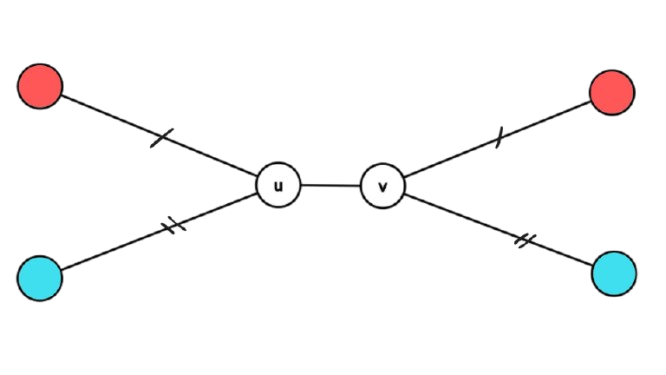
We can see that the sum of distances of the farthest blue and green plus one is the length of the diameter. We claim that if there is no special node in a colored tree, then there must be a special edge.
Proof: If there is no special node in a tree, then that means the farthest red and blue node for each vertex are on one side of it. We know that if there is at least one blue and one red colored node, then we have a valid diameter, so considering each node on that diameter, becuase it is not a special node the farthest blue and red of it must be on one side, and this leasds us towards a speical edge, the formal proof is described later when discussing $$$T'$$$.
Let's make some more observations. It's easy to see that the diameter of a tree is not necessarily unique, but an interesting fact is that every two valid diameters must intersect with each other.
Proof: if not, consider the tree is rooted from the blue/red node of one diameter, this would trivially show us a new blue and red node that has a distance longer than our current diameter and therefore a contradiction.
This gives us the idea that the intersection of all valid diameters is a non-empty simple path on the tree.
Proof: Consider two diameters and take their intersection, then add the rest one by one and take the intersection of the intersections. If there are any two pairs with intersections that do not intersect, this means there exists a pair of valid diameters which do not intersect with each other, and this is against our hypothesis.
Before continuing, you must have an idea so far that we are aiming to count the trees with special node based on their node, and others based on their special edge, but there is still a lot to discuss.
Going back to the special nodes, it's easy to see that they must must be on our diameter, and what makes this more interesting is that they must be on all diameters! So, taking the simple path that was the intersection of all valid diameters, we know that all of our special nodes lie on this path.
Getting deeper on special nodes, we can see that for a non-special node such as $$$v$$$, the farthest blue and red are both on the same subtree if we root the tree from $$$v$$$. This makes the sum of distances to farthest red plus the farthest blue result in a number always bigger than the actual length of our diameter (as there is a shared part). Call the child in which both the farthest red and blue lie on a cool child.
Let's create another graph based on our tree (call it $$$T'$$$) that has identical nodes to the tree, and directed edges. For each non-special node, give a directed edge from the identical vertex in $$$T'$$$ to its cool child. It's easy to see that special nodes would not have any incoming edges to them in this new graph, but every non-special node has at least one.
We can use this graph to formally prove almost everything. Let's start with the fact that why any tree without a special node has a special edge?
Proof: No special edge means that there are $$$n$$$ nodes in our tree that each have an outgoing edge, therefore $$$n$$$ directed edges as well. Our initial tree had only $$$n-1$$$ edge, so therefore based on the pigeonhole principle, there must be an edge in the initial tree, that two directed edges pass above it. It's trivial that those edges cannot have the same direction, and therefore this will lead us to a directed cycle of length two. Well, think about it, this is exactly what a special edge is!
So if no special node is there, now we know that there is at least one special edge there somewhere. Well, it appears that we also cannot have more than one special edge in a colored tree.
Proof: If so, we know that both of them must appear on the diameter, and considering their placement, this will contradict the fact that the distance of red and blue from both sides must be equal.
Combining both above observations, now we know that if there is no special node in the colored tree, then there is exactly one special edge there somewhere.
Now let's solve the first sub-problem, which is how to solve the problem if there is no special node. Define $$$f(v, a, b)$$$ for a node $$$v$$$ as the number of colourings which the farthest blue has a distance of $$$a$$$, and the farthest red has a distance of $$$b$$$. How to calculate $$$f$$$? Define $$$g(v, a, b)$$$ as the same thing, but this time for the distance of at most $$$a$$$ for blue and at most $$$b$$$ for red. It's easy to see that if we somehow calculate $$$g(v, a, b)$$$, then the following equation holds: \begin{equation} f(v, a, b) = g(v, a, b) — g(v, a-1, b) — g(v, a, b-1) + g(v, a-1, b-1) \end{equation} And here's how we find $$$g(v, a, b)$$$:
\begin{equation} g(v, a, b) = 3^{p\cdot q}\cdot 1^r \end{equation} Where $$$p$$$ is the number of nodes such as $$$u$$$ that have a distance less than or equal to $$$a$$$, $$$q$$$ is the number of nodes that have a distance bigger than $$$a$$$ but less than or equal to $$$b$$$, and $$$r$$$ is the number of nodes that have a distance more than $$$b$$$. Formally:
This will so far give us an $$$O(n^3)$$$ solution, dw we'll optimize it further later. Now we count the result for each edge of the tree, considering it will be a special edge in some colourings. Call both sides of the edge $$$u$$$ and $$$v$$$ just like the diagram shown above. Assuming we have $$$f$$$ calculated for all nodes, the answer is: \begin{equation} \sum_{a=0}^{n} \sum_{b=0}^{n} f(u, a, b) \cdot f(v, a, b) \cdot (a + b + 1) \end{equation} We're halfway there! Before the optimizing part, the only question left is what if there is a special node?
Let's define a super-special node a node that is special, and not only does it have the farthest blue and red on different sides, but also either a blue node with distance one less than the farthest blue, or a red node with distance one less than the farthest red.
Using the same observations that we made earlier and a deeper understanding of $$$T'$$$, you can prove that there is at least one super-special node, also at most one super-special node, and therefore always exactly one super-special node if there exists at least one special node. For such trees, we aim to calculate the answer for them based on their super-special node.
Make the tree rooted from an arbitrary node. Define $$$dp_{v, i, a, b, j}$$$ as if you're in vertext $$$v$$$, you iterated $$$i$$$ children, so far the farthest blue node has a distance of $$$a$$$, the farthest red node has a distance of $$$b$$$, and $$$j=0$$$ if these two don't belong to one subtree (if possible, preferably $$$0$$$), and $$$1$$$ otherwise. Iterate over new subtrees and use the $$$f$$$ function defined before to end up with a computable $$$O(n^4)$$$ implementation!
Now add another dimension $$$k$$$ to the above DP to keep track of if there is any blue node with distance one less than the farthest blue, or a red node with distance one less than the farthest red. Note that this really doesn't change anything.
The above DP, though correct, won't give us a good solution and is only explained for gaining deeper insight. After truly understanding what is going on and what we are looking for, we can break down the same idea and calculate it manually, which will result in a $$$O(n^2)$$$ solution in the end. The primary fact to notice is that if the number of edges between two farthest red vertices is even, then it can be proven that the middle vertex of this path is a special node, and if odd, the middle edge is a special edge. As explaining everything in detail takes forever, try to prove the things we missed yourself and ask if you encountered any issues.
#include <bits/stdc++.h>
using namespace std;
using ll = long long;
using ld = long double;
using pii = pair<int, int>;
using pll = pair<long long, long long>;
using ull = unsigned long long;
#define X first
#define Y second
#define SZ(x) int(x.size())
#define all(x) x.begin(), x.end()
#define mins(a,b) (a = min(a,b))
#define maxs(a,b) (a = max(a,b))
#define pb push_back
#define Mp make_pair
#define lc id<<1
#define rc lc|1
#define mid ((l+r)>>1)
mt19937_64 rng(chrono::steady_clock::now().time_since_epoch().count());
const ll INF = 1e9 + 23;
const ll MOD = 998244353;
const int MXN = 3006;
const int LOG = 23;
template<typename T>
inline T md(T x) { return x — (x>=MOD ? MOD : 0); }
template<typename T>
inline void fix(T &x) { x = md(x); }
int n;
vector<int> g[MXN];
vector<int> H[MXN];
int cnt[MXN], pscnt[MXN];
ll red[MXN], redb[MXN];
ll two[MXN], thr[MXN], itwo[MXN];
ll ans;
ll ps[MXN];
void dfs(int v, int h=0, int p=-1) {
cnt[h]++;
H[h].back()++;
for(int u : g[v])
if(u!=p)
dfs(u, h+1, v);
}
void Main() {
cin >> n;
for(int i=1; i<=n; i++) g[i].clear();
ans = 0;
for(int i=0, u,v; i<n-1; i++) {
cin >> u >> v;
g[u].pb(v);
g[v].pb(u);
}
for(int v=1; v<=n; v++) {
for(int adj=-1; adj<SZ(g[v]); adj++) {
for(int i=0; i<n; i++) H[i].clear(), cnt[i]=0;
if(adj==-1) {
cnt[0]++;
for(int u : g[v]) {
for(int i=0; i<n; i++) H[i].pb(0);
dfs(u, 1, v);
}
}
else {
if(g[v][adj]<v) continue;
for(int i=0; i<n; i++) H[i].pb(0);
dfs(v, 0, g[v][adj]);
for(int i=0; i<n; i++) H[i].pb(0);
dfs(g[v][adj], 0, v);
}
pscnt[0] = cnt[0];
for(int i=1; i<n; i++) pscnt[i] = pscnt[i-1] + cnt[i];
red[0] = 1;
redb[0] = 1;
for(int i=1; i<n; i++) {
red[i] = two[cnt[i]]-1;
for(int a : H[i])
fix(red[i] += MOD-(two[a]-1));
redb[i] = md(thr[cnt[i]]-two[cnt[i]]+MOD);
for(int a : H[i])
fix(redb[i] += MOD-(thr[a]-two[a]+MOD)*two[cnt[i]-a]%MOD);
}
for(int i=0; i<n; i++) {
ps[i] = red[i]*two[i==0?0:pscnt[i-1]]%MOD*(i+(adj!=-1))%MOD;
if(i) fix(ps[i] += ps[i-1]);
}
for(int j=0; j<n; j++)
fix(ans += thr[j==0?0:pscnt[j-1]]
*(thr[cnt[j]]-two[cnt[j]]+MOD)%MOD
*itwo[pscnt[j]]%MOD
*(ps[n-1]-ps[j]+MOD)%MOD);
for(int i=0; i<n; i++) {
ps[i] = red[i]*two[i==0?0:pscnt[i-1]]%MOD;
if(i) fix(ps[i] += ps[i-1]);
}
for(int j=0; j<n; j++)
fix(ans += thr[j==0?0:pscnt[j-1]]
*(thr[cnt[j]]-two[cnt[j]]+MOD)%MOD
*itwo[pscnt[j]]%MOD
*j%MOD
*(ps[n-1]-ps[j]+MOD)%MOD);
for(int i=0; i<n; i++) {
ps[i] = redb[i]
*thr[i==0?0:pscnt[i-1]]%MOD
*itwo[pscnt[i]]%MOD
*(i+(adj!=-1))%MOD;
if(i) fix(ps[i] += ps[i-1]);
}
for(int j=1; j<n; j++)
fix(ans += two[pscnt[j-1]]%MOD
*(two[cnt[j]]-1)%MOD
*ps[j-1]%MOD);
for(int i=0; i<n; i++) {
ps[i] = redb[i]
*thr[i==0?0:pscnt[i-1]]%MOD
*itwo[pscnt[i]]%MOD;
if(i) fix(ps[i] += ps[i-1]);
}
for(int j=1; j<n; j++)
fix(ans += two[pscnt[j-1]]%MOD
*(two[cnt[j]]-1)%MOD
*j%MOD
*ps[j-1]%MOD);
for(int i=0; i<n; i++) {
fix(ans += (redb[i]-red[i]+MOD)*thr[i==0?0:pscnt[i-1]]%MOD*(i+i+(adj!=-1))%MOD);
}
}
}
cout << ans << '\n';
}
int32_t main() {
cin.tie(0); cout.tie(0); ios_base::sync_with_stdio(0);
int T = 1;
cin >> T;
two[0] = 1;
for(int i=1; i<MXN; i++) two[i] = two[i-1]*2%MOD;
thr[0] = 1;
for(int i=1; i<MXN; i++) thr[i] = thr[i-1]*3%MOD;
itwo[0] = 1;
for(int i=1; i<MXN; i++) itwo[i] = itwo[i-1]*((MOD+1)/2)%MOD;
while(T--) Main();
return 0;
}
The intended solution was the $$$O(n^3)$$$ discussed with some further optimizations, but then a new $$$O(n^2)$$$ solution showed up that changed everything! We thought of dividing the problem into two subtasks, but didn't do so, as the observation required for the $$$O(n^2)$$$ solution was quite beautiful.
Also, we would like to thank Hamed_Ghaffari for his contributions to this problem.


