


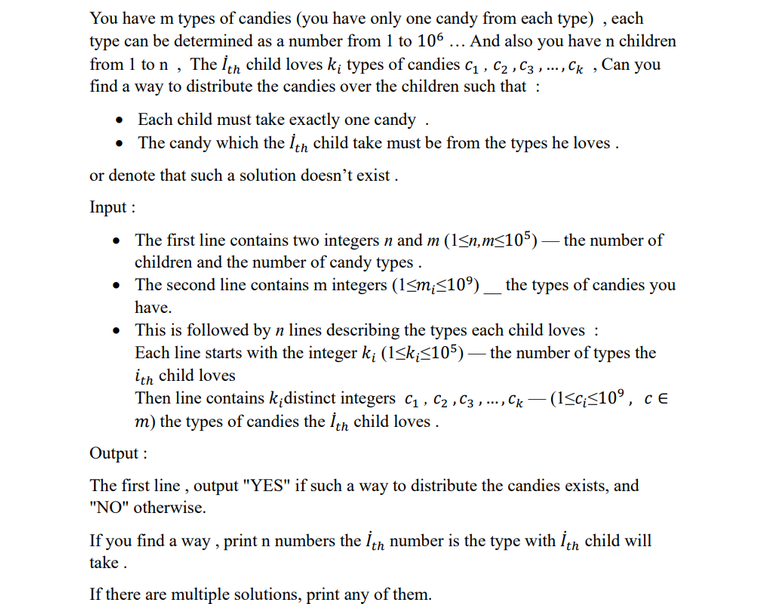
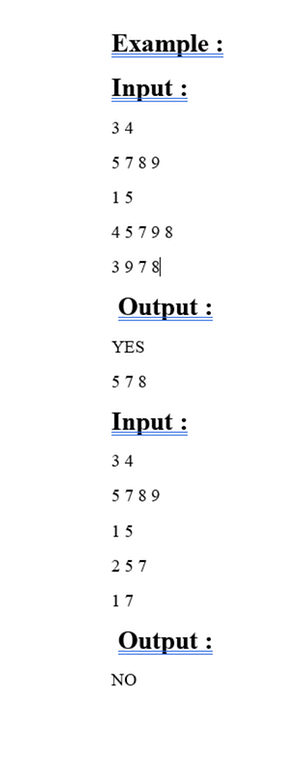
- I met this problem as a subproblem many times and tried to find a solution for it but failed ,So I make an elegent statement for the problem asking for someone's help :
→ Pay attention
→ Streams
→ Top rated
| # | User | Rating |
|---|---|---|
| 1 | Benq | 3792 |
| 2 | VivaciousAubergine | 3647 |
| 3 | Kevin114514 | 3611 |
| 4 | jiangly | 3583 |
| 5 | strapple | 3515 |
| 6 | tourist | 3470 |
| 7 | dXqwq | 3436 |
| 8 | Radewoosh | 3415 |
| 9 | Otomachi_Una | 3413 |
| 10 | Um_nik | 3376 |
→ Top contributors
| # | User | Contrib. |
|---|---|---|
| 1 | Qingyu | 163 |
| 2 | adamant | 149 |
| 3 | Um_nik | 145 |
| 4 | Dominater069 | 143 |
| 5 | errorgorn | 141 |
| 6 | cry | 138 |
| 7 | Proof_by_QED | 135 |
| 7 | YuukiS | 135 |
| 9 | chromate00 | 134 |
| 10 | soullless | 132 |
→ Find user
→ Recent actions


Codeforces (c) Copyright 2010-2026 Mike Mirzayanov
The only programming contests Web 2.0 platform
Server time: May/15/2026 22:58:07 (f1).
Desktop version, switch to mobile version.
Supported by


Could you give a publicly available link instead of screenshots? Or at least tell where the problem is from? This looks fishy.
Edited , Bro
The reason why I asked for a link ia to prevent cheating, but considering the statement you sent doesn't even have a bound on the sum of $$$k_i$$$ i will assume youre not.
This is the maximum bipartite matching problem, you can read about it here https://cp-algorithms.com/graph/kuhn_maximum_bipartite_matching.html
However, this is an advanced topic and you should probably worry about other things more. If you're encountering this problem a lot youre probably making the wrong reductions.
I understood the topic , but can't it be solved in time complexity less than O(n*m) time , if we don't need the number of matchings, just need whether or not the solution exists
Kuhn is faster than $$$O(nm)$$$ in practice with the heuristics they talk about there. There is also a $$$O(n\sqrt{n})$$$ that as far as i know is hard to distinguish from kuhn. Asking if there is a perfect matching doesn't help in this problem.
Also, if you are thinking on how to solve a specific problem, send that specific problem instead. A lot of times when beginners ask for help they make wrong reductions and leave out important information, that's probably what is happening here.