


| # | User | Rating |
|---|---|---|
| 1 | Benq | 3792 |
| 2 | VivaciousAubergine | 3647 |
| 3 | Kevin114514 | 3611 |
| 4 | jiangly | 3583 |
| 5 | strapple | 3515 |
| 6 | tourist | 3470 |
| 7 | Radewoosh | 3415 |
| 8 | Um_nik | 3376 |
| 9 | maroonrk | 3361 |
| 10 | XVIII | 3345 |
| # | User | Contrib. |
|---|---|---|
| 1 | Qingyu | 162 |
| 2 | adamant | 148 |
| 3 | Um_nik | 146 |
| 4 | Dominater069 | 143 |
| 5 | errorgorn | 141 |
| 6 | cry | 138 |
| 7 | Proof_by_QED | 136 |
| 8 | YuukiS | 135 |
| 9 | chromate00 | 134 |
| 10 | soullless | 133 |


|
+34
I couldn't submit my solution for C in the last 40 minutes, and I believe others are experiencing a similar situation. Please, unrate this round. |

|
0
Why is rating relapsed? Recalculation? EDIT 3: it keeps on relapsing and fixing itself... strange. |
|
0
What is better than anime? |
|
+1
Sure, for attaining normal conversations just consuming them is sufficient; I wrote about truly fine literacy and more of a standardized English language — with emphasis on concision, precision, and simplicity. Appreciation of a language and its beauty is worthwhile, and though your personal anecdote is considerable, one can hardly imagine a person possessing enough skill to read great books, but not consuming (and producing) day-to-day English and being good at it too. And just to nail it down, it's long been proven that learning of language is all-input. Here's a quote from Washington Post: "The results of studies done over the last few decades by a wide variety of researchers and published in scientific journals support this view: We do not master languages by hard study and memorization, or by producing it. Rather, we acquire language when we understand what people tell us and what we read, when we get “comprehensible input.” As we get comprehensible input through listening and reading, we acquire (or “absorb”) the grammar and vocabulary of the second language." |
|
-10
ignore |
|
0
Can you please provide a link to the problem? |
|
+1
Compress $$$A$$$, and let $$$M=min(N, A)$$$. Now you have $$$O(MNlogM)$$$. |
|
0
Auto comment: topic has been updated by prudent (previous revision, new revision, compare). |
|
0
Auto comment: topic has been updated by prudent (previous revision, new revision, compare). |
|
0
Sorry, I totally misunderstood problem. |
|
0
Edited: Sorry, I totally misunderstood problem. |
|
+14
He means following: |
|
0
The same thing man, I can be expert for the first time in my whole life after 2 years of work, if this round will be rated, please let it be so. |
|
0
Why, you set - value[i] to i instead of 0? Don't we need to neutralize/erase it? |
|
0
Don't You know why I get TLE? |
|
0
I implemented it, but I'm getting TLE which I shouldn't get because my solution uses O(NlogN) memory, right? Can You please view my submission 39701020? |
|
+3
Thank You :) |
|
+4
OMG, I'm blown away, thank You! |
|
0
WOW, great solution, I'll definitely implement it! |
|
0
Auto comment: topic has been updated by prudent (previous revision, new revision, compare). |
|
+1
Thank You very much, great explanation! |
|
0
Does he mean last j < i, that Aj = Ai? |
|
+1
My friend told me that it's satisfied when all bits are unique. Yes that makes sense and it's true. But is it the only case when xorsum is equal to sum? |
|
0
Doesn't such j always exist, since j ≥ i and Aj = Ai? |
|
0
Can You please further explain how can I apply it? |
|
0
You didn't say anything about co-primeness between x and y. If it's easier for You to speak and write in Russian, do it. I can speak Russian, too. Can You please explain to me problem's statement again, please. (if more preferable for You, in Russian). And please, give some samples with explanations, if possible. |
|
0
Solution is: 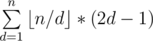 And this can be further optimized until O(sqrt(n)logsqrt(n)), since there are at most 2sqrt(n) unique values of n / d, among all 1 ≤ d ≤ n |
|
0
Auto comment: topic has been updated by prudent (previous revision, new revision, compare). |
|
0
What is a constraint for n? 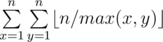 doesn't it? It can be rewritten as: |
|
0
Thank You very very extremely much! My solution: 39462553. I missed some stuff there and original problem asked to calculate  But however, by understanding concept I could further generalize it and solve, thank You very much again! |
|
0
I didn't even read a problem's statement, but by just looking to your code, I see some not reliable things... You should write: |
|
0
Amazing! Can You please explain it to me one more time! And to find out gaps as fast as possible, I'll try to show You how much I didn't get. Let n = 10 Here's what I get: But result should be: What I do wrong? |
|
0
Wonderful! |
|
0
Thank You! |
|
0
Wow, thank You very much, I thought it's fact only when d|n, is it so with a lot of other concepts, too? If it is, can You please provide some examples, I'm very grateful for your response. |
|
0
Well, can You please help me out with one more issue, when I try to register to icpcarchive.ecs.baylor.edu, it gives me this error, how to fix it? |
|
0
Good day to You too, I'm sorry to ask such a question, but I really couldn't really find where I can submit problem called "8015 — Alice and Bob play Contact" in a division trie_string, because when I go to UVA and insert a value 8015 in a problem id in a Quick Submit, I get a message: "The selected problem ID does not exist.", what is its actual id by which I can submit the problem? |
|
+5
|
|
0
problem B can You please explain why we don't consider the case, when we do -1 to k, by decreasing height of our final answer? |
|
0
So, do you recommend to NOT watch friends' standings while contest? |
|
0
Hello Everyone, can someone please explain me solution of Div.2 E with more details? I'll be grateful if someone'll, any help is appreciated! More exactly: how does it work & why does it work? |
|
0
Can someone please explain me how to turn some value into a w-ary representation? Because as I know it's always possible to turn any number to only BinaryRepresentation, sorry for my English if there're some mistakes. Thanks in advance! |
|
+3
Wow, thank you so much, I struggled with this problem for a long time! |
|
0
here's my submission: 36150483 |
|
0
Thank you a lot for such a great response & I'm really sorry for my so long one. Everything is pretty clear, but I still didn't get the idea why I should save direction. Because let's assume that we stay in state (x, y), and we'll just brute force some count in range[1; k] and anyway we'll do +1 to our adjacents to which we can go in one step. |
|
0
Can you please explain why do we need to save direction, too? |
|
0
Thank you so much! |
|
0
Would you please explain me why answer is always subarray of length 1 or 2? And would You please define a notion of subarray?, is it a continuous segment in array? fact: depth[lca(a, b)] >= depth[lca(a, b, c)] Let's denote V as set of vertices which are in subtree(v), so if we'll increase size of V, lca of all vertices of V won't at least become more distant from v, so all we need to do is find two vertices(x, y), lca(x, y) = v & if we'll denote i as index of x and j as index of y in array, is it correct that all vertices in range[i, j] in array must be in subtree(v) to say that answer for current query is (x, y)? Thanks in advance! UPD: I forgot that fact that those vertices (x, y) must be in two different children of vertex v, how should I do there? UPD': Probably, I got it! Thank you very much! But here's last request to confirm something: if we have set of vertices V that all vertices locate in subtree of v, will it be correct & enough to consider always & only adjacent vertices from set V? |
|
0
Yeah, I've got that asymptotics'll be O(nlogn) and why, and I also have written CentroidDecomposition several times, but I still didn't get one thing, why it takes all possible n2 or n * (n - 1) / 2 cases? And if your answer's going to be DivideAndConquer again, would you please explain why it is correct? |
|
0
I mean, how does CentroidDecomposition consider all n2 cases in O(nlogn) |
|
0
Thank you very much for this beautiful implementation. I have a request, would you please explain to me how CentroidDecomposition considers all n2 cases? |
|
+4
588E - Duff in the Army. Nice problem, maybe some complex implementation, but if You'll solve it, You'll definitely have no problems with Binary Rise |
|
+8
tourist would to use Far Manager as C++ IDE |
|
+1
hah, just luck, unfortunately, it this problem's solution was tutorialed here... many of us could get more rating for this round) |
|
+5
Hello everyone! I'd like to solve Div.2(A) in O(M log N), can someone give me a clue how to realize it with segment tree? |
|
0
thanks a lot, my inattention( |
|
0
Can someone explain me "Segment Tree structure" solution for "F" ? |


